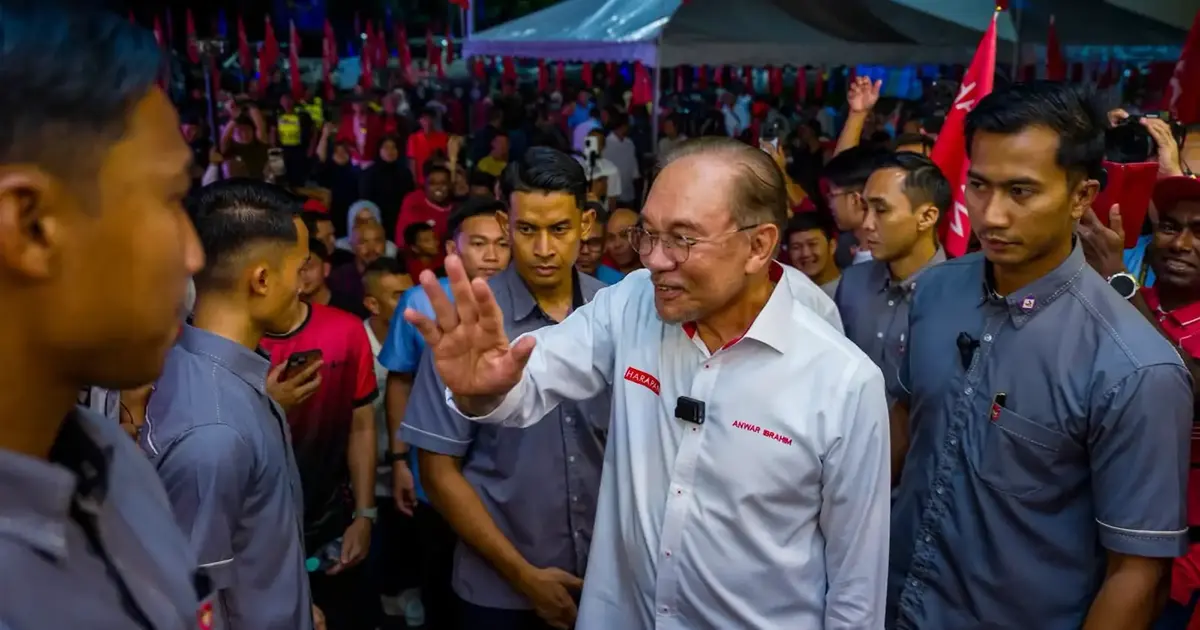
Prime Minister Anwar Ibrahim has placed responsibility for accumulated debts totalling RM20 billion at two major institutions serving Malaysia's rural and Muslim communities squarely on the shoulders of previous administrations. Delivering his closing remarks during the Negeri Sembilan state election campaign, Anwar sought to reframe the unity government's stewardship by highlighting the financial inheritances that have constrained policymaking since 2022.
The dual debt crisis at Tabung Haji, the Islamic pilgrimage savings scheme, and Felda, the Federal Land Development Authority, represents one of the most contentious legacies of prior governance. These institutions hold particular significance within Malaysia's Malay-Muslim demographic, making their financial health a politically sensitive matter. The scale of the liabilities—accumulated over decades—has forced the current administration to balance fiscal responsibility with the imperative to protect savers and smallholder farmers who depend on these organisations for financial security and livelihood support.
Anwar's intervention during the Negeri Sembilan campaign addresses mounting criticism that the unity government has not sufficiently prioritised Malay-Muslim concerns since assuming office. Opposition parties have sought to exploit perceptions that the coalition government, which spans ideologically diverse partners, may dilute policies traditionally associated with Malay-Muslim advancement. By invoking the debt legacy directly tied to previous administrations' mismanagement, Anwar attempts to demonstrate that fiscal constraints, rather than policy indifference, explain resource allocation decisions that might otherwise appear to shortchange these communities.
The financial predicament at Tabung Haji and Felda illustrates how institutional weaknesses compound over successive political cycles. Years of inadequate oversight, questionable investment decisions, and administrative inefficiency have created obligations that now consume significant portions of government attention and resources. When Anwar references this inheritance, he is essentially arguing that the unity government has inherited a structural problem that demands immediate remedial action—a narrative that seeks to establish credibility with voters who might otherwise view the coalition as inattentive to rural and Muslim constituencies.
Negeri Sembilan holds particular importance in this political calculus. As a state with considerable Malay-majority districts and strong agricultural linkages through Felda settlements, the election provides a direct platform to address concerns about the government's commitment to communities that have historically benefited from these institutions. By explicitly naming the RM20 billion debt burden in his final campaign address, Anwar signals that addressing institutional collapse remains a priority, even as governing coalitions impose constraints on policy flexibility.
The unity government's approach to Tabung Haji and Felda restructuring has involved complex negotiations balancing creditor protection, depositor security, and operational viability. These technical matters rarely generate electoral enthusiasm, yet they profoundly affect millions of Malaysians. Anwar's campaign messaging attempts to connect abstract financial management to tangible voter interests—implying that current hardships stem from inherited dysfunction rather than contemporary policy choices.
Previous administrations' stewardship of these institutions became particularly controversial following revelations about investment losses, fund misappropriation allegations, and governance lapses that eroded public confidence. The scale of required intervention—potentially exceeding the RM20 billion figure through recapitalisation and debt restructuring—underscores how previous governments mortgaged the financial security of vulnerable constituencies through negligent management.
For Malaysian voters, particularly in states like Negeri Sembilan where Felda settlements concentrate, Anwar's attribution of debt responsibility carries immediate relevance. Small farmers and pilgrimage savers have legitimate grievances about institutional failure, regardless of which administration caused the damage. The unity government's challenge involves demonstrating that inherited problems are being addressed systematically, rather than ignored or exacerbated by political indifference.
The campaign messaging also reflects broader Southeast Asian political dynamics. Across the region, newly elected governments frequently invoke previous administrations' fiscal mismanagement to justify unpopular measures or explain policy limitations. This rhetorical strategy attempts to separate electoral mandates from inherited constraints, allowing leaders to claim virtue for difficult decisions while blaming predecessors for necessity itself.
Anwar's emphasis on the RM20 billion debt in his Negeri Sembilan address suggests the unity government views institutional restructuring as essential to demonstrating competence and commitment to core constituencies. Whether voters accept this framing—and whether tangible improvements materialise in coming months—will likely influence electoral outcomes in states where Malay-Muslim constituencies dominate and where grievances about institutional performance run deep.
The political economy of these two institutions extends beyond immediate electoral considerations. Tabung Haji and Felda represent quasi-governmental frameworks through which the state channels developmental resources to specific communities. When institutional performance deteriorates, it reflects not merely administrative failure but also broader questions about whether government-mediated mechanisms effectively serve their intended beneficiaries. Anwar's campaign intervention thus addresses both immediate debt attribution and longer-term questions about institutional reform.

