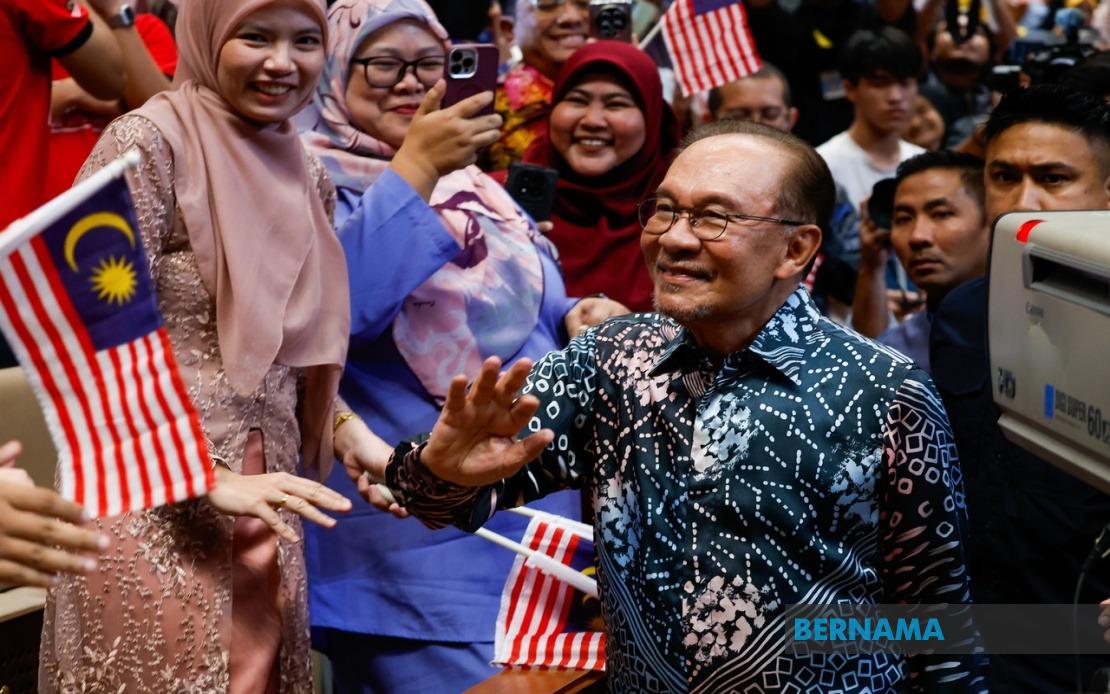
Prime Minister Datuk Seri Anwar Ibrahim has positioned the cultivation of genuine independence as a matter of individual consciousness rather than mere institutional mechanics, arguing that the true foundation of national strength lies in the mindset and resolve of ordinary Malaysians. Delivering his National Day address at the Putrajaya International Convention Centre (PICC) on 30 August, he presented a vision of independence that extends far beyond the formal structures of government and state apparatus, instead emphasising the personal and collective psychological commitment required to sustain a free nation.
Anwar articulated a nuanced distinction between independence as a constitutional fact and independence as a living, active principle embedded in the national consciousness. He contended that while Malaysia achieved formal independence decades ago, the more formidable challenge facing the country today involves ensuring that every citizen internalises a spirit of autonomy, critical thinking, and self-determination. This rhetorical framing suggests a deeper concern with what he perceives as complacency or dependency within Malaysian society—issues that might otherwise remain unspoken in official discourse.
The Prime Minister's remarks carry particular weight given Malaysia's current political trajectory. His emphasis on building from ruins—a phrase laden with significance—implies acknowledgment of recent institutional and social fractures that have tested national cohesion. By pivoting the conversation from structural reform to ideological renewal, Anwar positioned independence not as a historical achievement to be passively commemorated, but as an ongoing project requiring active participation and recommitment from all segments of the population.
Critically, Anwar rejected a narrower conception of unity based on ethnic or geographic demarcation, instead invoking the vision of Malaysia's founding generation. He stressed that integration must transcend racial boundaries, with Malays and Bumiputera communities serving as a foundational core while all other communities contribute equally to national defence and the pursuit of justice. This formulation attempts to reconcile inclusive nation-building with constitutional recognition of Bumiputera interests—a perpetual tension in Malaysian politics.
The attendance of Deputy Prime Minister Datuk Seri Dr Ahmad Zahid Hamidi, Communications Minister Datuk Seri Fahmi Fadzil, and Chief Secretary to the Government Tan Sri Shamsul Azri Abu Bakar underscored the address's significance as an official policy statement rather than mere ceremonial rhetoric. The presence of these senior figures signalled government alignment around Anwar's framing of national challenges and priorities as he approaches potential electoral contests.
Anwar's invocation of successive generations carries implications for how Malaysia addresses contemporary challenges spanning generational divides. Younger Malaysians, increasingly connected to global discourse on governance, accountability, and individual rights, may interpret his call for independence differently than older cohorts. The Prime Minister's formulation appears designed to bridge these interpretative gaps by suggesting that independence of spirit serves as a unifying principle across age groups, regardless of differing political preferences or ideological orientations.
The emphasis on defending rights and upholding justice, while stated in general terms, resonates with ongoing debates within Malaysian civil society regarding judicial independence, freedom of expression, and access to remedies. By linking these concerns to the broader independence narrative, Anwar positioned them not as partisan political issues but as foundational to national identity and sovereignty—a rhetorical move with significant implications for how the government frames future policy decisions.
For Malaysia's regional standing, such emphasis on consolidated internal unity and psychological independence carries strategic importance. In a geopolitical environment where larger powers vie for influence in Southeast Asia, a nation whose citizens collectively embrace intellectual autonomy and commitment to justice represents a more stable and predictable partner. Anwar's address can thus be read as both a domestic appeal and an implicit statement about Malaysia's positioning in regional and global affairs.
The Prime Minister's focus on reconstruction also obliquely references the economic and institutional challenges Malaysia has faced in recent years, from charges of corruption to perceptions of institutional decay. By reframing these challenges as solvable through renewed commitment to independence—both individual and collective—Anwar offered a narrative of renewal grounded in ideological recommitment rather than technical fixes alone. This approach acknowledges that institutional reform, while necessary, proves insufficient without corresponding shifts in civic culture and personal agency.

