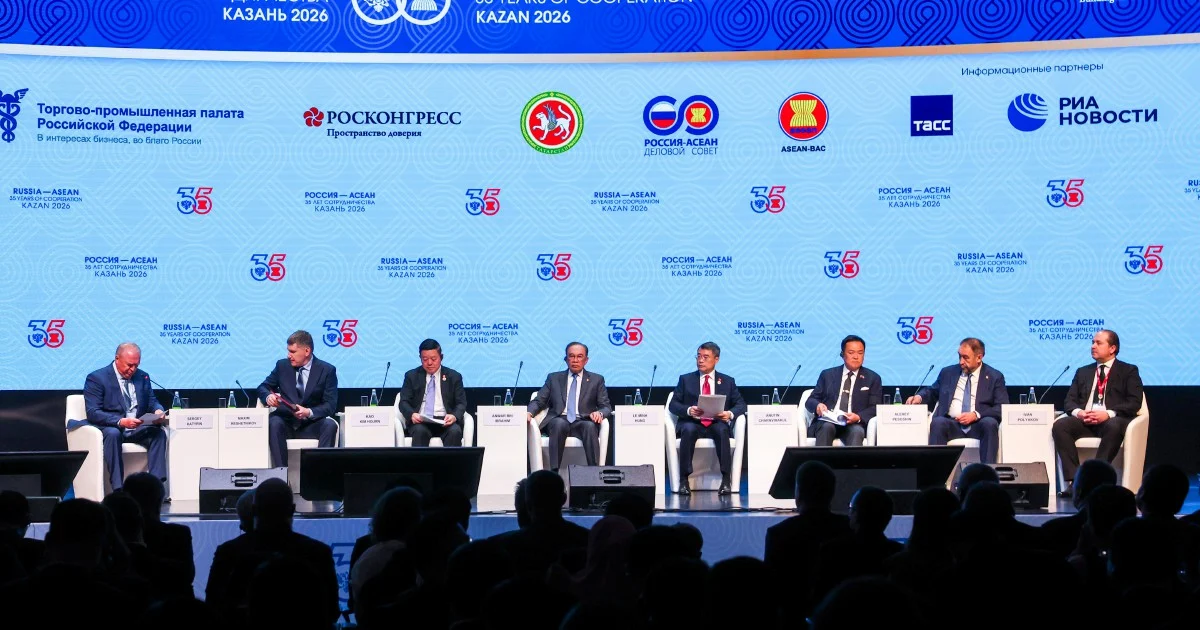
Prime Minister Datuk Seri Anwar Ibrahim has called for a comprehensive expansion of cooperation between Asean and Russia across multiple strategic sectors, signalling Malaysia's interest in broadening ties with Moscow at a time of significant geopolitical realignment in the Indo-Pacific region. Speaking from Kazan, Anwar articulated a vision for enhanced multilateral engagement that would position the regional bloc and Russia as more substantive economic partners, moving beyond traditional diplomatic channels to establish concrete partnerships in areas critical to both parties' development trajectories.
Food security represents a particularly pressing concern for Asean members, given the region's vulnerability to global supply chain disruptions and the critical role that agricultural production plays in feeding over 650 million people across ten nations. Russia's substantial agricultural output and advanced farming capabilities present complementary advantages that could stabilise food supplies across Southeast Asia and reduce regional dependence on less reliable sources. A coordinated approach to agricultural cooperation could encompass technology transfer, investment in crop diversification, establishment of strategic grain reserves, and joint research initiatives focused on developing climate-resilient farming practices suited to tropical and subtropical environments found throughout the association.
Energy cooperation assumes equally significant dimensions as Asean nations grapple with balancing rapid industrialisation against environmental commitments undertaken at international climate summits. Russia possesses extensive hydrocarbon reserves and expertise in energy infrastructure development, while Asean countries require substantial energy inputs to fuel economic growth and manufacturing expansion. Beyond traditional petroleum and natural gas trade, collaboration opportunities exist in renewable energy technologies, nuclear power development for select nations, and the establishment of integrated energy markets that could improve price stability and supply reliability across the region. Such partnerships would also facilitate technology exchange in areas like carbon capture and storage, helping member states navigate their energy transition pathways more efficiently.
Advanced manufacturing capabilities represent a sector where Asean and Russia could develop genuinely transformative synergies. The region has become increasingly attractive as an alternative manufacturing hub to China, yet faces persistent challenges in upgrading technological sophistication and achieving greater value-chain positioning. Russian expertise in industrial automation, precision engineering, and aerospace manufacturing could complement Asean's growing manufacturing ecosystems while encouraging investment flows from Moscow-based enterprises seeking production locations outside Western-sanctioned environments. Such cooperation would strengthen Asean's competitive positioning globally whilst providing Russian manufacturers with secure access to regional markets and supply chain networks.
Digital technology cooperation carries particular resonance given the rapid digitalisation occurring throughout Southeast Asia and Russia's acknowledged capabilities in software development, cybersecurity, and artificial intelligence research. Establishing joint research institutions, facilitating technology licensing agreements, and supporting startup ecosystems could accelerate innovation across Asean member states while providing Russian tech companies with expanded commercial opportunities. Educational exchange programmes accompanying such initiatives would develop human capital across the region whilst building people-to-people connections that underpin more resilient diplomatic relationships.
Anwar's framing reflects Malaysia's broader strategic positioning as an advocate for pragmatic, diversified international engagement that neither fully aligns with Western-led structures nor becomes dependent on any single power centre. This approach resonates with Asean's foundational commitment to strategic autonomy and the reality that regional nations maintain complex relationships with multiple global actors. By explicitly positioning Russia as a potential partner across multiple sectors rather than limiting engagement to security or diplomatic domains, Anwar signals that Asean views Moscow as a legitimate economic actor capable of contributing meaningfully to regional development objectives.
The timing of these remarks carries particular significance given ongoing Western sanctions against Russia following the Ukraine conflict, which have prompted Moscow to intensify engagement with non-aligned nations and alternative partnerships. Asean's attractiveness as a partner derives partly from the bloc's consistent refusal to impose sanctions against Russia, maintaining pragmatic neutrality that preserves bilateral relationships with both Western and non-Western powers. This positioning enables Asean nations to potentially benefit from Russian investments and trade flows seeking diversified destinations beyond Europe.
Implementing the broad cooperation framework Anwar outlined would require establishing formal mechanisms for sectoral dialogue, attracting government and private-sector participation, and overcoming practical obstacles including regulatory harmonisation and infrastructure compatibility issues. Previous Asean engagement initiatives with major powers demonstrate that success depends on translating high-level political commitments into actionable cooperative frameworks with clear timelines, measurable outcomes, and sustainable financing mechanisms.
For Malaysia specifically, expanded Asean-Russia cooperation offers opportunities to leverage its position as a manufacturing hub and potential energy trading centre whilst diversifying its economic partnerships. Investments in agricultural technology could benefit Malaysia's palm oil sector and food production systems, whilst participation in Russian manufacturing partnerships could attract investment into Malaysian industrial zones.
The broader implication extends beyond bilateral or regional economics to questions of global governance architecture. Asean's cultivation of relationships with Moscow, alongside existing partnerships with Beijing, Washington, Tokyo, and New Delhi, reflects the bloc's determination to maintain strategic flexibility in an increasingly multipolar international environment. Anwar's advocacy for deepened Asean-Russia ties underscores this commitment to navigating geopolitical competition whilst extracting maximum developmental benefits from relationships with multiple great powers.