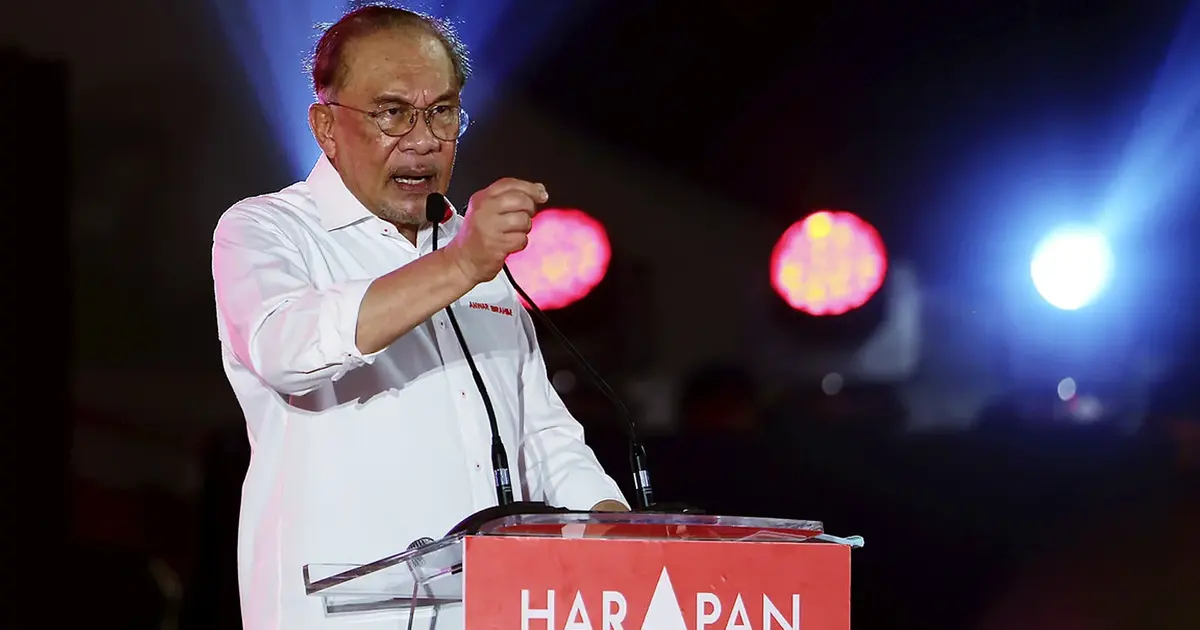
Prime Minister Anwar Ibrahim has issued a forthright appeal to political parties competing in the Negeri Sembilan state election, urging them to keep the state's royal institution beyond the boundaries of electoral contestation. Speaking in his capacity as chairman of Pakatan Harapan, Anwar stressed that matters pertaining to Negeri Sembilan's sultanate must remain insulated from the partisan pressures and tactical calculations inherent to election campaigns.
The appeal underscores a broader principle embedded in Malaysia's constitutional framework: the delineation between political competition and respect for the institution of the monarchy. The Negeri Sembilan royal institution, like its counterparts across Malaysia's constitutional monarchies, occupies a position that transcends party politics and electoral cycles. By explicitly cautioning against the politicisation of royal matters, Anwar is effectively reminding stakeholders that certain institutions deserve protection from the rough-and-tumble of campaign rhetoric and electoral manoeuvring.
Anwar's intervention carries particular significance given Malaysia's recent political volatility and the occasional tensions that have emerged around questions of royal prerogative and institutional boundaries. The appointment of state rulers, their constitutional roles in government formation, and their ceremonial functions have occasionally become points of contention during electoral periods. By enuncinating this principle before the Negeri Sembilan campaign gains momentum, the Prime Minister seeks to establish guardrails that could prevent such controversies from intensifying during what promises to be a competitive electoral contest.
Negeri Sembilan, a state with a unique administrative structure given its elective monarchy—wherein the Yamtuan Besar is selected from among the state's four chiefs rather than determined by hereditary succession—represents a distinctive constitutional arrangement within Malaysia's federation. This particular system makes the state's royal institution especially sensitive to perceptions of political interference or partisan influence. The Anwar's caution thus addresses the specific vulnerability inherent in Negeri Sembilan's governance model.
The timing of Anwar's statement reflects strategic political awareness. As the election campaign becomes increasingly intensive, competing narratives and accusations tend to proliferate. Political parties, in their eagerness to mobilise support, sometimes resort to controversial rhetoric or make claims that inadvertently implicate royal institutions. By establishing clear boundaries beforehand, the Prime Minister attempts to create a shared understanding among all parties about the limits of acceptable campaign discourse.
For Malaysian democracy, such guardrails matter considerably. The legitimacy of electoral processes depends not merely on procedural correctness but also on the maintenance of public confidence in institutions that stand above partisan divides. The monarchy, as a symbol of national unity and constitutional continuity, loses its stabilising function if it becomes entangled in the divisive rhetoric characteristic of election campaigns. Anwar's intervention implicitly recognises this democratic imperative.
The statement also carries implications for how different political factions within Negeri Sembilan structure their campaign messages. Parties on both sides of the political divide must now navigate the electoral competition while respecting the boundaries the Prime Minister has outlined. This constraint, whilst potentially limiting certain lines of attack or rhetoric, ultimately serves the interests of political stability and institutional integrity.
Anwar's role as Pakatan Harapan chairman lends particular weight to his appeal, as it signals that the ruling coalition itself is committed to maintaining this principle. Should any component parties within the government coalition breach this understanding, it would undermine the credibility of the appeal. Conversely, if the coalition successfully upholds this standard throughout the campaign period, it establishes a precedent that could influence future electoral contests across Malaysia.
The appeal also addresses international perceptions of Malaysian democracy. Foreign observers frequently assess the health of democratic institutions partly through how electoral competitors treat non-partisan state institutions. A campaign that respects constitutional boundaries around the monarchy reinforces Malaysia's standing as a constitutional monarchy with functioning democratic norms, whereas one marred by attacks on royal institutions risks projecting an image of institutional fragility.
From a Southeast Asian perspective, Malaysia's approach to managing the intersection of electoral politics and royal institutions carries broader significance. Other constitutional monarchies in the region face similar tensions, and how Malaysia navigates this challenge could inform approaches elsewhere. Thailand, Cambodia, and other nations with active monarchies watch how their neighbours balance democratic participation with institutional respect.
Looking forward, the true test of Anwar's appeal will lie in whether all contesting parties honour this commitment throughout the campaign period. Political discipline and voluntary restraint, particularly during heated electoral moments, require genuine commitment from party leadership across the spectrum. Should the election campaign proceed without significant breaches of this understanding, it would demonstrate that Malaysia's political actors recognise shared interests in preserving institutional integrity even amid intense electoral competition.
The Prime Minister's statement ultimately reflects a mature understanding of constitutional democracy: that competitive elections and respect for foundational institutions are not incompatible, and that political victory achieved through attacks on constitutional pillars carries costs that extend far beyond any tactical advantage it might provide.

