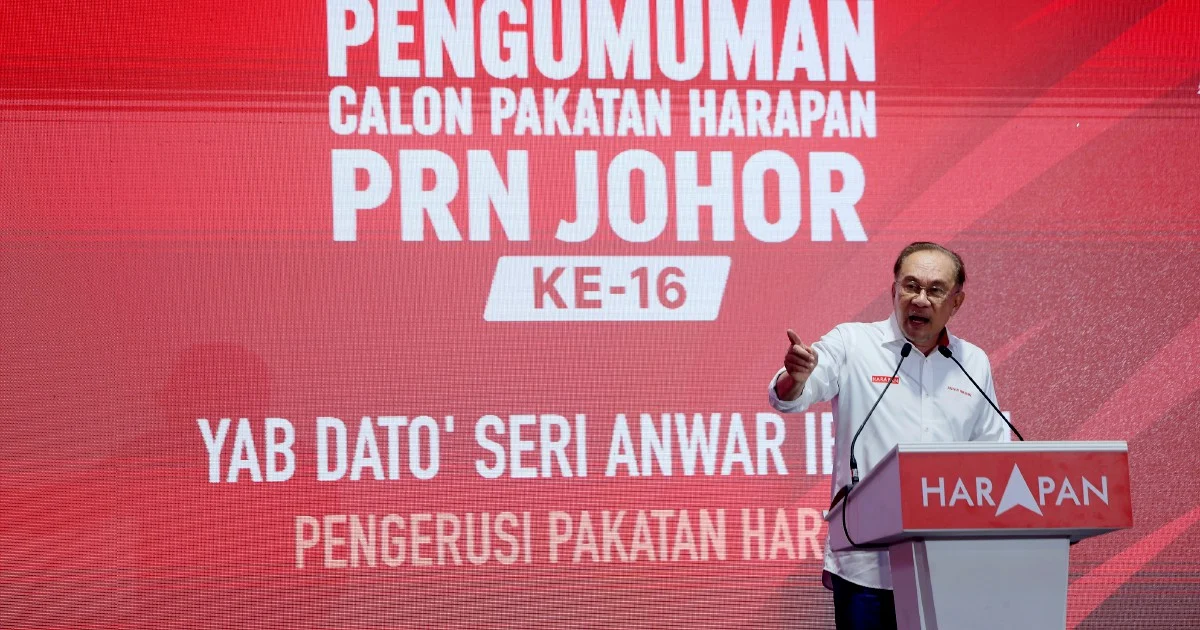
Prime Minister Datuk Seri Anwar Ibrahim has encouraged state leadership in Johor to take a firmer stance in questioning previous federal administrations over their handling of the state's revenue allocation, addressing longstanding grievances about whether Johor received equitable fiscal treatment from Kuala Lumpur. Speaking in Tangkak, Anwar directed his remarks toward members of the Johor executive council, suggesting they should pursue accountability from both the Barisan Nasional and Perikatan Nasional governments that preceded the current Pakatan Harapan-led federal administration.
The intervention underscores persistent tensions between Johor and the federal centre regarding financial distribution mechanisms. Malaysia's fiscal federalism system allocates revenues between federal and state governments through a complex arrangement of grants, allocations, and revenue-sharing agreements. Johor, as one of Malaysia's economically significant states with substantial oil and gas resources, has historically raised questions about whether it receives proportionate compensation for resources extracted within its jurisdiction. The state's concerns extend beyond simple cash transfers to encompass the broader question of economic equity in how national wealth is distributed across the federation.
Anwar's remarks carry particular weight as they come from the current federal government, which ostensibly should be in a position to redress any historical imbalances. His suggestion that state officials should "question" rather than accept previous arrangements implies that his administration recognises merit in Johor's grievances. This positioning allows the Prime Minister to appear responsive to state concerns whilst simultaneously placing blame for any shortcomings on his political predecessors. For Johor's leadership, the implicit message is that they have federal backing to pursue their revenue claims more aggressively than might have been possible during earlier administrations.
The Barisan Nasional government, which held federal power from 1957 until 2018, oversaw Johor for much of that period. During these decades, the state's relationship with Kuala Lumpur was generally smooth given that both were controlled by the same coalition. However, this did not necessarily translate into favourable revenue arrangements for Johor, as the BN-dominated federal government prioritised resource extraction and centralised fiscal control. The Perikatan Nasional government that governed from 2020 to 2022 maintained similar centralised approaches, though its brief tenure and focus on pandemic management meant limited opportunities to restructure federal-state fiscal relations.
Understanding why Johor's revenue dispute matters requires examining the state's economic importance. Johor contributes significantly to Malaysia's gross domestic product and is a major exporter of petroleum and petrochemical products. The Johor Strait separates the state from Singapore, making cross-border trade and investment crucial to its prosperity. If Johor believes it is not receiving adequate compensation for its resource wealth or economic contributions, this has implications not only for state development but also for interstate relations and potentially Malaysia's competitiveness relative to the city-state.
For Malaysian readers in other states, Anwar's intervention illustrates broader questions about fiscal federalism that extend beyond Johor. Sarawak and Sabah, as resource-rich states on Borneo, have also pursued negotiations over oil royalties and federal funding allocation. Anwar's approach in Johor could set precedent for how other state governments articulate their revenue demands. If the federal government proves receptive to such claims, it may encourage similar challenges from other states, potentially reshaping how Malaysia distributes national resources.
The political context adds another layer. Anwar's Pakatan Harapan government depends on support from various state administrations, including Johor's Barisan Nasional-aligned government. By publicly backing Johor's position against previous federal governments, Anwar shores up relationships with allies whilst avoiding direct confrontation. This diplomatic approach allows him to gain credit for supporting state interests without immediately committing to specific financial transfers that might create difficulties elsewhere in the federation.
From Johor's perspective, having the Prime Minister explicitly encourage state officials to press their revenue claims provides negotiating leverage. The executive council members now have presidential endorsement for pursuing what might previously have been dismissed as provincial complaints. This empowerment could lead to more structured demands and formal fiscal negotiations between Johor and the federal government. Whether these result in concrete changes to revenue distribution remains to be seen, but the political landscape has shifted to favour the state's position.
The practical mechanisms for resolving such disputes typically involve the Economic Planning Unit, the Ministry of Finance, and various intergovernmental committees. Johor would need to present detailed evidence of alleged shortfalls and comparative analyses showing how other states were treated. This could involve tracing historical revenue allocations, examining resource extraction data, and calculating what fair-share arrangements might look like under different methodologies. The complexity of such analyses means that genuine resolution requires sustained technical work, not merely political support.
Looking forward, Anwar's comments suggest that the federal government is willing to revisit revenue distribution formulae that previous administrations established. Whether this extends to actual policy changes or remains symbolic support for state grievances will become clearer in coming budget cycles and fiscal negotiations. For Johor, the challenge will be converting political encouragement from Kuala Lumpur into tangible improvements in its revenue position. For Malaysia as a whole, the question is whether rebalancing federal-state fiscal relations might be necessary to ensure all regions feel equitably treated within the federation.