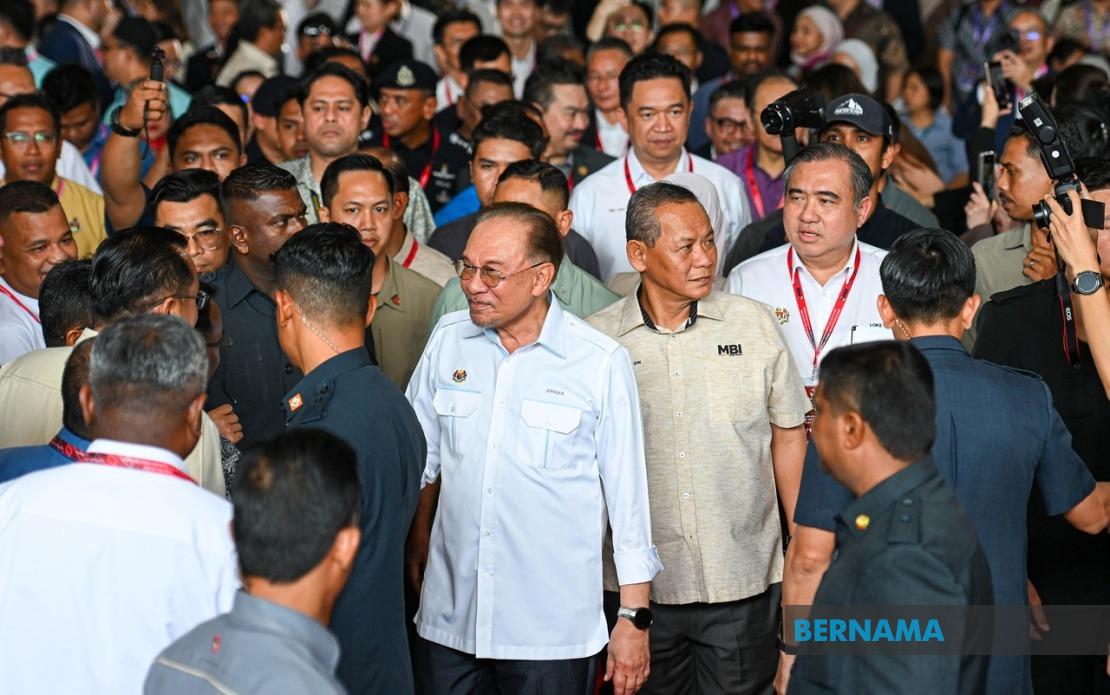
Prime Minister Datuk Seri Anwar Ibrahim has made a direct appeal to the Democratic Action Party's Melaka branch to reconsider its decision to immediately exit the state government, urging the party to postpone the move in order to preserve administrative focus on development and public welfare. Speaking at the Port Dickson AI-powered Midport Smart Container Terminal project inauguration on July 14, Anwar framed the request as a matter of political pragmatism and good governance, emphasizing that coalition partners should not allow disagreements to undermine state-level administration during what he considers a critical period.
The appeal comes in response to Melaka DAP's announcement earlier that day of its immediate withdrawal from the state government following the passage of constitutional amendments in the Melaka State Legislative Assembly that would permit the appointment of nominated assemblymen. Melaka DAP chairman Khoo Poay Tiong characterized the party's exit as a principled stand against what the party views as an assault on democratic values and electoral integrity. From DAP's perspective, the constitutional changes represent a troubling deviation from democratic norms that justified the party's departure regardless of broader coalition considerations.
As Pakatan Harapan chairman, Anwar has positioned himself as a mediator in the dispute, indicating that he has already engaged directly with DAP secretary-general Anthony Loke and Melaka Chief Minister Datuk Seri Ab Rauf Yusoh to explore negotiated resolution. His framing suggests that behind-the-scenes discussions continue and that all parties retain flexibility, though Melaka DAP's public announcement of an immediate withdrawal limits the room for quiet compromise. The Prime Minister's intervention underscores the delicate balance required to maintain coalition cohesion across Malaysia's complex multi-party governing arrangements.
Anwar's argument rests on a broader principle that component parties within ruling coalitions must accept periodic disagreement without allowing such differences to destabilize state administration. He acknowledged that coalition partners naturally harbor divergent views on various policy matters, but contended that such disagreements should be compartmentalized and never permitted to interfere with the pursuit of shared economic and welfare objectives. This philosophy reflects the practical reality of Malaysia's coalition politics, where ideologically distinct parties must find common ground on governance fundamentals despite their internal contradictions.
The constitutional amendment issue at the heart of Melaka DAP's departure raises significant questions about democratic representation and the appropriate balance between appointed and elected positions within state legislatures. The ability to appoint nominated assemblymen has historically served various functions in Malaysian state governments, from providing technical expertise to ensuring minority representation, though critics argue such appointments can be weaponized for factional advantage. Melaka DAP's objection signals that the party views the amendment in this latter category, as a move designed to erode the electoral mandate that determines rightful representation.
For Malaysian governance observers, this episode highlights the inherent tensions within coalition politics when component parties hold fundamentally different views on constitutional matters. While Anwar's appeal emphasizes continuity and developmental momentum, Melaka DAP's withdrawal reflects a conviction that certain principles transcend coalition loyalty. This dynamic will likely test the resilience of Pakatan Harapan's unity as the coalition prepares for electoral contests and navigates governance challenges across multiple states where power-sharing arrangements remain precarious.
The timing of this dispute carries additional weight given Malaysia's ongoing political calendar. State elections remain prospective rather than imminent in most jurisdictions, suggesting that the period until the next electoral cycle represents valuable time for the coalition to stabilize itself internally. Anwar's request for postponement essentially asks Melaka DAP to defer its withdrawal until after elections occur, allowing the state government to continue functioning as a unified entity rather than fragmenting into opposition configurations. From this perspective, his plea represents an attempt to preserve coalition leverage and stability during what promises to be a challenging political period.
The substantive disagreement between Melaka DAP and other ruling coalition members on the constitutional amendment reflects broader fault lines within Pakatan Harapan regarding the proper role of democratic institutions and appointed representation. DAP's traditional emphasis on electoral democracy and opposition to appointed positions sits uncomfortably with power-sharing arrangements that sometimes necessitate such mechanisms. This fundamental tension has surfaced periodically throughout the coalition's history and shows little sign of resolution through dialogue alone.
Anwar's intervention also carries implications for how the federal government manages its relationships with state-level coalition partners. By appealing directly to Melaka DAP to reconsider, the Prime Minister signals that Putrajaya will actively intervene in state coalition disputes to preserve overall coalition integrity. This approach maintains central leadership leverage but risks appearing heavy-handed if state parties feel their legitimate concerns are being dismissed in favor of coalition maintenance. The delicate negotiation occurring behind the scenes will likely determine whether Melaka DAP feels adequately heard and respected within the coalition framework.
The Melaka situation also reflects the broader challenge facing multi-party coalitions in managing ideological coherence while maintaining practical governing majorities. Pakatan Harapan's composition—spanning PKR, DAP, and various regional allies—requires constant negotiation and compromise on issues where component parties hold genuinely different philosophical positions. Constitutional amendments involving democratic representation sit precisely in this zone of fundamental disagreement, making them exceptionally difficult to resolve through the usual give-and-take of coalition politics.
Moving forward, the resolution of this dispute will likely establish precedent for how Pakatan Harapan handles similar disagreements in other states and at the federal level. If negotiations successfully convince Melaka DAP to postpone its withdrawal, the coalition will have preserved both administrative continuity and internal unity—a significant political achievement. Conversely, should Melaka DAP proceed with its exit despite Anwar's appeals, the coalition will face uncomfortable questions about its ability to manage internal conflicts and maintain component party loyalty during contentious governance situations.
The broader Malaysian political landscape will be watching closely to observe how this particular coalition dispute resolves, as it carries implications for the stability of power-sharing arrangements nationwide. In a political system where no single party commands consistent majority support across all states and federal parliament, the capacity of coalitions to maintain discipline while accommodating legitimate policy disagreements becomes essential to governance continuity. Anwar's plea to Melaka DAP thus transcends the specific constitutional amendment question and touches fundamental questions about how Malaysian democracy can accommodate both principled dissent and necessary coalition unity.

