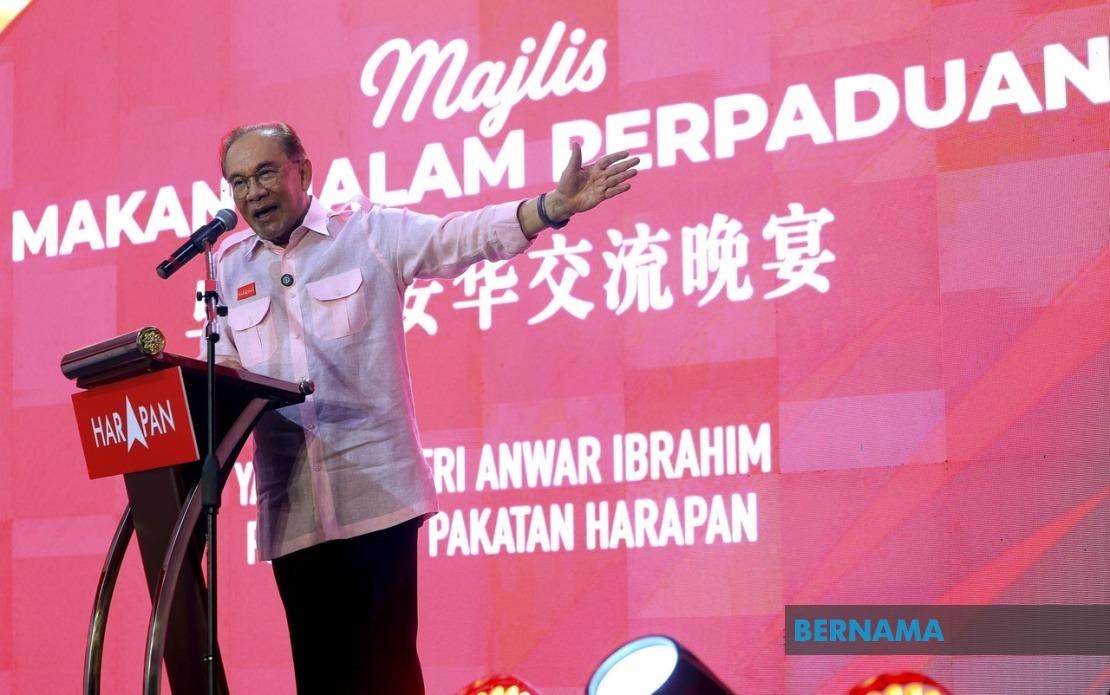
Negeri Sembilan's impending state election has become a platform for Prime Minister Datuk Seri Anwar Ibrahim to highlight what he characterises as internal discord within opposition ranks, a pointed critique delivered at a campaign event in Seremban on July 22. Speaking at the 'Perpaduan' Dinner in Taman Sri Penaga, Sikamat, the Pakatan Harapan chairman drew attention to what he described as multiple contenders jostling for the top administrative position even before votes are cast, suggesting that rival parties are already entrenched in destructive competition rather than focused on governance.
Anwar's remarks underscore a strategic messaging approach by the ruling coalition, which seeks to position itself as steady and experienced against what it portrays as a fractious opposition preoccupied with internal power struggles. His challenge to voters centres on a fundamental governance question: who demonstrates the capacity and commitment to deliver effective administration and protect the interests of all Negeri Sembilan residents? This framing attempts to shift the election narrative away from policy specifics towards a character and capability argument, one that favours the incumbent administrations represented by Pakatan Harapan.
The Prime Minister's intervention in the campaign reflects the significance of the August 1 state election in Negeri Sembilan, where all 36 state assembly seats are contested. His presence alongside sitting Menteri Besar Datuk Seri Aminuddin Harun, who is also the PH candidate for Linggi, reinforces party hierarchy and signals central government backing for the incumbent state leadership. By standing with Aminuddin in public, Anwar effectively endorses not only the menteri besar's track record but also the broader Pakatan Harapan coalition's vision for the state's future.
Aminuddin's tenure as menteri besar has become a focal point of Pakatan Harapan's campaign messaging. The Prime Minister specifically highlighted what he characterised as Aminuddin's leadership marked by integrity, administrative competence, and freedom from corruption and abuse of power—qualities that Anwar suggested are not universally guaranteed among those seeking power. This emphasis on clean governance and anti-corruption messaging has become a cornerstone of the Unity Government's political platform, particularly relevant in Malaysian state politics where issues of financial mismanagement and leadership credibility continue to resonate with voters.
Beyond leadership capability, Anwar used the campaign platform to address what he termed the weaponisation of racial narratives by certain quarters during the election campaign. His criticism points to a concerning trend in Malaysian electoral politics where communal divisions are emphasised to mobilise voting blocs rather than address shared interests and collective welfare. The Prime Minister positioned the Unity Government as committed to inclusive governance that transcends racial and religious boundaries, emphasising assistance extended equitably across all community segments regardless of ethnicity.
Pakatan Harapan's policy commitments articulated at the campaign event reflect an attempt to connect electoral promises with tangible outcomes. The coalition highlighted increased socio-economic allocations, expanded housing initiatives, and salary adjustments for civil servants as evidence of commitment to improving living standards across diverse demographic groups. Such concrete policy pledges serve as counterweights to opposition rhetoric and provide voters with measurable criteria against which to evaluate government performance.
The composition of Pakatan Harapan's candidate slate reveals the coalition's internal power dynamics. With PKR fielding 16 candidates, DAP 11, and Amanah nine across the 36 seats, the distribution reflects PKR's dominance within the coalition structure while ensuring representation for component parties. This arrangement affects not only the geographical distribution of resources and campaign attention but also post-election coalition negotiations should the electoral outcome be closely contested.
The campaign event also featured PH candidates for specific constituencies, including Nor Azman Mohamad for Sikamat and Datuk Muhammad Nazri Kassim for Ampangan, providing voters with direct access to prospective representatives. This grassroots engagement, supplemented by Prime Minister-level advocacy, represents a comprehensive campaign strategy designed to build momentum across the state's diverse electoral terrain.
Negeri Sembilan holds strategic importance within Malaysia's broader political economy. As a relatively smaller state with 36 assembly seats, a decisive victory for any coalition would strengthen its national political position and provide momentum for upcoming national considerations. For Pakatan Harapan, retaining control of Negeri Sembilan would validate its governance model and provide proof of concept for the Unity Government's appeal beyond federal territories.
The electoral timeline adds urgency to campaign activities, with early voting scheduled for July 28 and polling day set for August 1. This compressed campaign period requires efficient mobilisation of party machinery and strategic deployment of high-profile campaigners, which explains Anwar's direct involvement in what might ordinarily be considered a routine state-level election.
Anwar's framing of the election as a choice between proven competence and internal opposition rivalry reflects a broader strategic positioning ahead of what are anticipated to be consequential electoral contests in the coming years. By establishing narratives now about governance capacity, anti-corruption credentials, and inclusive administration, the Prime Minister is building a conceptual framework that extends beyond Negeri Sembilan's borders and speaks to national political considerations.
The opposition's response to such characterisations remains to be seen, though historically such challenges often provoke defensive reactions rather than substantive counter-arguments. Whether Negeri Sembilan voters will ultimately be swayed by Anwar's leadership and governance-focused messaging, or whether other considerations including local issues and candidate credibility will dominate their choices, will become apparent when polling concludes on August 1.

