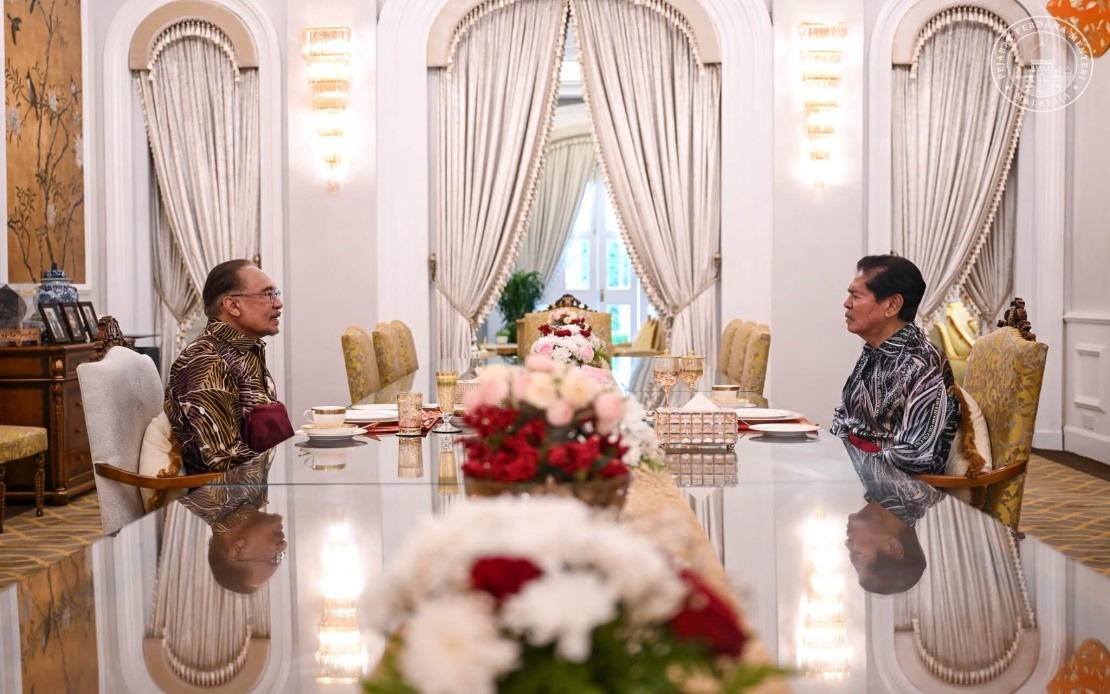
Prime Minister Datuk Seri Anwar Ibrahim wrapped up his intensive two-day working visit to Penang on Thursday with a formal tea reception at Seri Mutiara, the official residence of Governor Tun Ramli Ngah Talib. The occasion provided an opportunity to consolidate the relationship between Malaysia's federal administration and the northern state government, reflecting the collaborative approach that has characterised recent centre-state relations across the country.
Anwar seized the platform to underscore the deepening partnership between Putrajaya and Penang, leveraging his social media presence to communicate that the meeting reinforced existing cooperation frameworks and reaffirmed joint commitment to advancing the state's development agenda. The symbolic nature of such high-level engagements carries significance in Malaysia's political landscape, where maintaining visible harmony between federal and state administrations signals stability to investors, businesses, and the broader public. For Penang in particular, a state that has long occupied a distinctive position within Malaysia's political architecture, such moments of accord carry particular weight.
Governor Ramli extended a warm welcome, characterising the Prime Minister's visit as a valuable window for discussing pressing issues affecting both Penang and the nation at large. His remarks reflected the governor's appreciation for direct access to the federal leadership and the opportunity to table state-level concerns at the highest decision-making levels. Such exchanges between governors and federal executives remain critical mechanisms for addressing localised challenges while ensuring alignment with national priorities.
A notably human element featured in the governor's public reflection on the visit: his grandson, Aldrey Alfi, was present and engaged enthusiastically with Anwar during the reception. The governor's decision to highlight this intergenerational aspect in his Facebook commentary underscores how diplomatic engagements in Malaysia often blend formal governance with personal warmth, a cultural characteristic that shapes political communication and public perception of leadership.
Anwar's Penang itinerary throughout the two-day period proved extraordinarily packed, reflecting the government's emphasis on visible, on-ground engagement with various stakeholder communities. His participation in the Permatang Pauh Entrepreneur Revival Programme demonstrated a specific focus on small and medium-sized enterprise development, an area critical to Malaysia's economic diversification and employment creation goals. Permatang Pauh, a significant parliamentary constituency, holds additional political resonance as Anwar's own seat.
The 15th Malaysia Scout Jamboree represented engagement with youth development and nation-building through structured educational programmes. Scouting movements across Asia have traditionally served as platforms for inculcating national values, leadership skills, and community service ethos among younger generations. The Prime Minister's attendance at this gathering signalled federal government commitment to youth-focused initiatives during a period when Malaysia, like many developing economies, faces questions about skills development and intergenerational wealth creation.
The MADANI Sahabat 2026 National Day Countdown Programme reflected the administration's messaging framework, with the MADANI acronym representing the government's broader reform agenda. Such programmes, scheduled well in advance of the national day celebrations, serve multiple purposes: they energise grassroots engagement, test communication messaging, and build momentum around the government's policy narrative. For Penang, hosting such initiatives provides platforms to demonstrate state-level implementation of federal development themes.
Taken together, Anwar's Penang schedule illustrated a governing approach that deliberately combines high-level institutional meetings with direct public engagement. The strategy acknowledges that legitimacy in Malaysian politics flows through multiple channels simultaneously: formal federal-state coordination structures, engagement with organised groups like the scout movement, support for entrepreneurship and economic opportunity, and celebration of national symbolism and values.
The significance of the concluding tea reception lay partly in its timing and location. Concluding with the governor's reception, rather than a political rally or media conference, struck a tone emphasising institutional respect and governmental continuity. For Malaysian observers and regional analysts tracking federal-state dynamics in Malaysia's complex constitutional architecture, such moments provide readable indicators of the health of centre-state relations and the government's approach to collaborative federalism.
Penang's position as a commercially vibrant, relatively developed state with distinct political traditions makes federal engagement there particularly consequential. The state government's responsiveness to federal programmes and messaging can influence implementation outcomes across multiple policy domains, from infrastructure to education to business facilitation. Anwar's visible commitment to direct engagement with Penang's leadership thus carries implications extending well beyond ceremonial courtesy.

