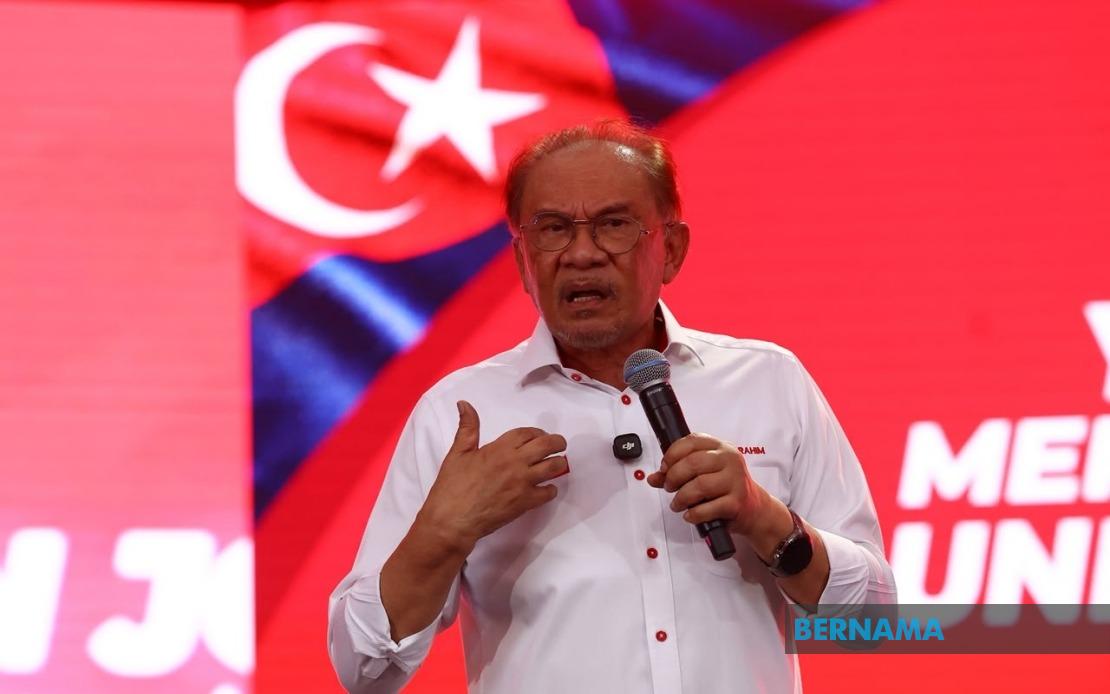
Prime Minister Datuk Seri Anwar Ibrahim has firmly rejected allegations circulating on social media claiming he had acquired a new BMW vehicle for his personal use, describing the narrative as false during a campaign appearance in Johor on Wednesday. Speaking at the 'Yok! Meriahkan Johor! Undi Harapan' programme in Senggarang, Anwar characterised the claims as misleading and countered that the vehicle in question was not a recent purchase but rather an existing government asset already in use.
The denial came after unsubstantiated rumours suggested that Anwar, who has built his political messaging around assisting lower-income Malaysians, had contradicted that positioning through an expensive personal acquisition. The Prime Minister responded with visible frustration to these allegations, questioning why such misinformation continued to circulate despite official clarifications from his office. His response underscores the broader challenge facing political leaders in Malaysia regarding online disinformation campaigns, particularly during election periods when social media narratives can rapidly influence voter perception.
Crucially, Anwar used the platform to address a separate matter regarding his official transportation, providing detailed context about his Mercedes-Benz vehicle. He explained that the car currently at his disposal represents a gift bestowed by His Majesty Sultan Ibrahim, King of Malaysia, and that he had deliberately ensured the vehicle was registered under the Prime Minister's Department rather than under his personal name. This administrative decision reflects a conscious effort to distinguish between his personal assets and official government property, establishing a clear demarcation that Anwar emphasised during his remarks.
The clarification regarding the Mercedes-Benz holds particular significance given Malaysia's historical concerns about the misuse of public resources and the blurred lines between official and personal property among some government officials. By registering the vehicle under the Prime Minister's Department, Anwar positioned himself differently from what he characterised as others who have historically engaged in financial impropriety. His statement—"I am not like others who siphon off and steal the people's money"—served as both a defence of his current conduct and an implied critique of predecessors' administrative practices.
The Prime Minister's Department and the Ceremonial and International Conference Secretariat Division had already issued a formal statement earlier in the week addressing the BMW vehicle controversy directly. According to their official communication, the BMW utilised by the Prime Minister recently constitutes an existing government asset within the management purview of BIUPA and has been designated specifically for official government logistics purposes. This statement represented the administration's attempt to establish documentary evidence countering the social media allegations, though Anwar's in-person denial suggests officials believed additional clarification was necessary to address public concerns effectively.
The campaign appearance itself formed part of broader Pakatan Harapan efforts to mobilise support ahead of the 16th Johor state election, scheduled for Saturday of that week. Accompanying Anwar at the event were Datuk Fahmi Fadzil, Communications Minister and PH communications director, alongside coalition candidates contesting three parliamentary constituencies in the region: Onn Abu Bakar for Senggarang, Mohd Khuzzan Abu Bakar for Semerah, and Felicia Poh Rui Ling for Penggaram. The coalition's participation across all 56 state seats demonstrated its commitment to contesting comprehensively throughout Johor, traditionally a state where political fortunes significantly influence overall national parliamentary dynamics.
For Malaysian voters, the BMW controversy reflects wider concerns about political accountability and the lifestyles of senior government figures. In a country where the personal spending habits of politicians frequently become campaign fodder, such controversies can substantially affect public trust and electoral calculations, particularly among constituencies sensitive to perceptions of elite detachment from ordinary citizens' economic struggles. The allegation that Anwar had purchased luxury vehicles while publicly positioning himself as an advocate for the underprivileged carried considerable rhetorical weight, regardless of its factual accuracy.
The timing of these allegations during active campaigning for a significant state election raised questions about their origin and intended impact. While Anwar attributed the claims to general social media misinformation, such coordinated narratives often emerge from organised opposition efforts designed to undermine specific candidates or administrations. The swift official response from the Prime Minister's Department indicated that communications staff recognised the potentially damaging nature of uncontradicted allegations, particularly when targeting personal behaviour and perceived hypocrisy.
Beyond the immediate Johor campaign context, the BMW controversy touches on broader governance issues relevant throughout Southeast Asia regarding official vehicle management and asset registers. Many regional governments have grappled with establishing transparent protocols distinguishing between official and personal property, with Malaysia's approach of registering vehicles under departmental rather than individual names representing one administrative model. Anwar's emphasis on this distinction suggested his administration viewed such clarity as strategically important for maintaining public confidence and differentiating from previous governance periods.
The incident also illustrates how social media allegations, once disseminated, require significant official effort to counter effectively. Despite the Prime Minister's Department's written statement and Anwar's personal denial at a public event, determining whether such clarifications actually reach voters who encountered the initial allegations remains uncertain. This asymmetry between claim propagation and rebuttal distribution presents persistent challenges for political communications in the digital era, particularly in markets like Malaysia where social media penetration remains high but fact-checking infrastructure remains limited.
Moving forward, the handling of this controversy may influence how Malaysian political figures and their administrations approach vehicle management and public asset transparency more broadly. If Anwar's deliberate registration of official vehicles under departmental rather than personal names becomes standard practice across government ministries, it could establish institutional precedent for clearer asset separation. Conversely, if allegations continue to circulate despite clarifications, it may signal that additional transparency measures beyond current practices would benefit public trust in official institutions managing state resources.

