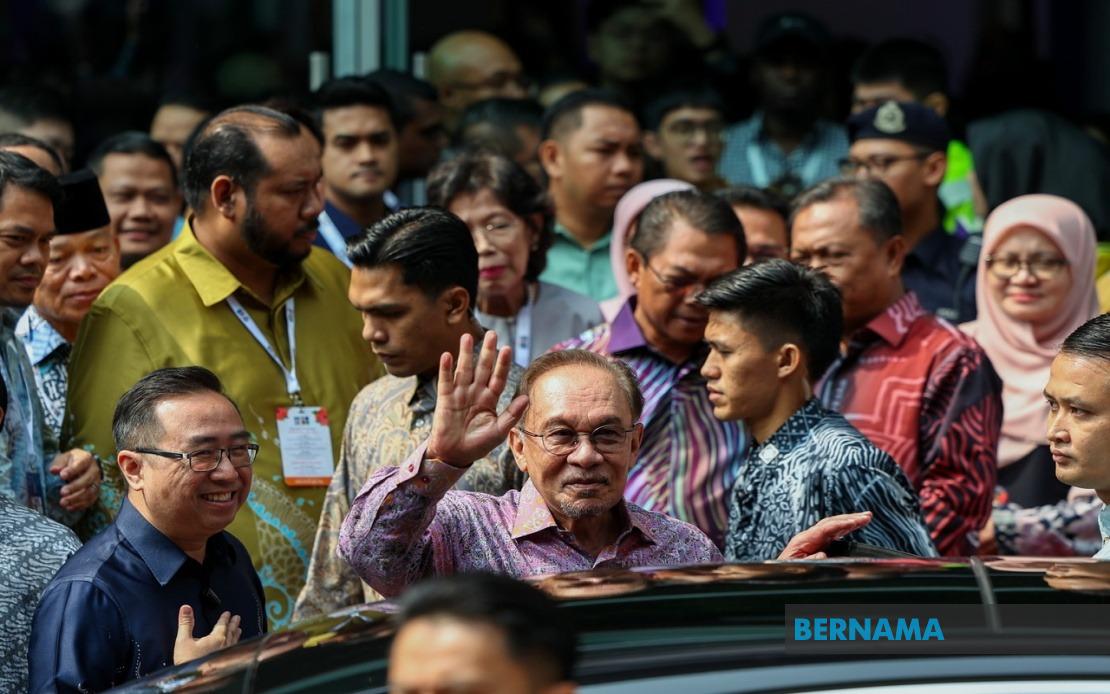
Prime Minister Datuk Seri Anwar Ibrahim has distanced himself from reports that PKR extended an invitation to former deputy president Datuk Seri Mohamed Azmin Ali to return to the party, stating emphatically that no such overture came to his attention. Speaking at the National Innovation and Commercialisation Expo (NICE) 2026 at the Kuala Lumpur Convention Centre (KLCC), the PKR president responded tersely when questioned about the matter, saying he had received no notification of any such approach.
The denial marks a notable disconnect within PKR's leadership, coming just days after Azmin, now serving as secretary-general of Parti Pribumi Bersatu Malaysia, publicly announced he would not be returning to PKR regardless of any invitations tendered. The Bersatu official's statement appeared to preempt growing speculation about whether high-profile figures from government-linked parties might cross over to the ruling coalition's dominant component party. In Malaysian politics, where party-switching has become increasingly routine, such rumours can quickly inflame factional tensions within coalitions.
Azmin's refusal to engage with PKR represents a particularly significant development given his seniority within the Anwar-led administration and his historical proximity to the Prime Minister. The two had cultivated a close working relationship during their time together in PKR, though Azmin departed the party in 2020 amid internal tensions. His current position within Bersatu, a component of the governing coalition, means any potential return to PKR would carry substantial political ramifications for both his personal trajectory and the broader balance of power within the coalition structure.
Yet PKR appears to be actively pursuing other prominent defectors from rival coalitions. Reports have circulated that former Bandar Tun Razak MP Datuk Kamarudin Jaffar and former Nibong Tebal MP Datuk Mansor Othman are being targeted for recruitment back into the party. The two lawmakers represent the type of experienced parliamentarians whose defection would bolster PKR's parliamentary bench strength and demonstrate organisational vitality ahead of the next general election.
Perhaps more concretely, former PKR vice-president Datuk Dr Xavier Jayakumar has already confirmed his intention to rejoin the party after his own departure. Jayakumar's return signals that at least some former members remain amenable to reconciliation with PKR leadership, even if prominent figures like Azmin remain unreceptive. The varying responses from different defectors suggest that PKR's reintegration efforts are meeting mixed results, with some doors open and others firmly shut.
Anwar's public declaration of ignorance regarding any Azmin approach raises questions about communication channels within PKR's hierarchy. Whether the invitation came from lower-ranking party officials acting without presidential sanction, or whether the claim of non-notification represents a political manoeuvre to maintain distance from a rejected overture, remains unclear. The Prime Minister's characteristically brief response left considerable room for speculation about the internal dynamics at play.
The broader context involves PKR's positioning within Malaysia's coalition government. As the largest component of the ruling alliance, the party has significant leverage to attract defectors from opposition-aligned coalitions and smaller government partners. Building parliamentary numbers through strategic recruitment has become a standard feature of Malaysian politics, particularly when electoral cycles approach and governing coalitions seek to reinforce their legislative majorities.
For Malaysian observers of politics, the Azmin situation illustrates the volatile nature of party affiliation in the current era. Despite his prominence in government, Azmin's categorical rejection of PKR overtures demonstrates that personal and factional considerations can outweigh organisational incentives to consolidate power. His commitment to Bersatu, even as that party's influence within the coalition remains subordinate to PKR's, suggests ideological or strategic commitments beyond simple power maximisation.
The episode also underscores the communication gaps that can emerge within governing coalitions. If PKR's recruitment efforts were indeed proceeding without Anwar's direct knowledge or approval, this raises questions about party discipline and centralised decision-making. Conversely, if Anwar was informed but chose to publicly deny it, the strategy reflects a calculated approach to managing expectations and avoiding the appearance of desperation in recruitment efforts.
Looking forward, the success or failure of PKR's recruitment drive will substantially influence the coalition's parliamentary arithmetic heading into the next electoral cycle. Each defector secured strengthens the government's position, while each rebuff like Azmin's demonstrates the limits of the party's persuasive power over prominent figures. The coming months will likely see intensified efforts to pursue other targets on PKR's apparent recruitment list, with Kamarudin and Mansor representing the next meaningful tests of the party's ability to restore lapsed members to the fold.

