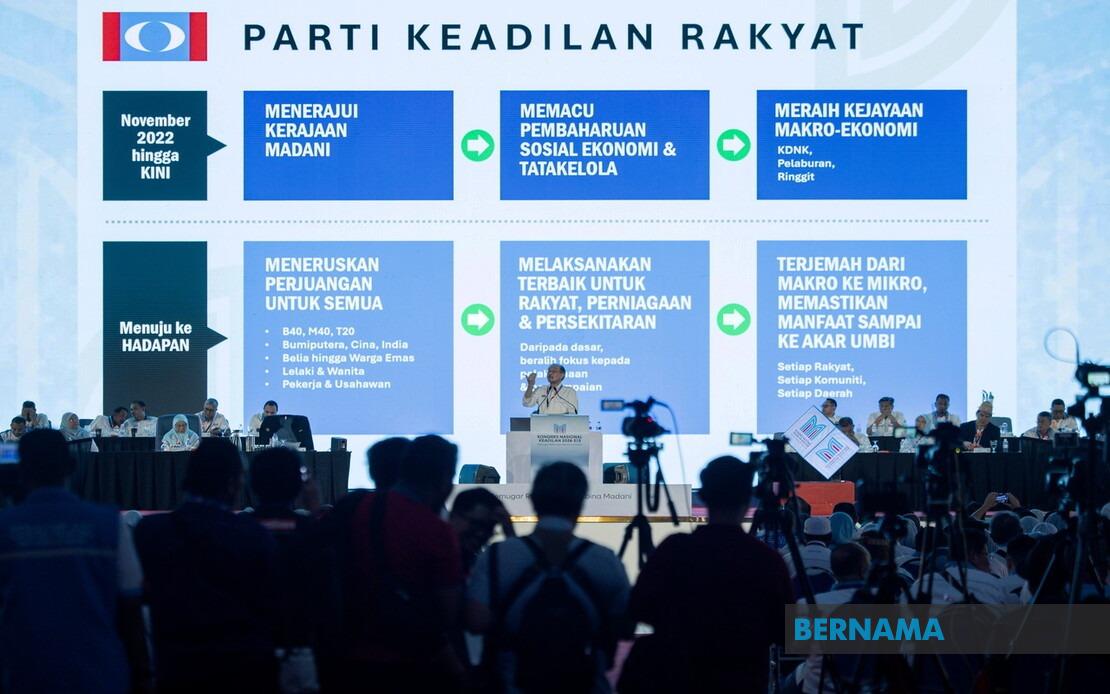
Prime Minister Anwar Ibrahim has formally delegated complete authority to Home Minister Saifuddin Nasution Ismail to execute the duties of PKR deputy president, marking a significant shift in the party's senior leadership structure. The announcement came during Anwar's closing remarks at the PKR National Congress 2026, held at the Melaka International Trade Centre in Ayer Keroh on August 16. The move follows the party's Central Leadership Council decision on August 6 to grant Nurul Izzah Anwar, the current deputy president and the Prime Minister's daughter, a temporary leave of absence from her position.
Anwar framed the appointment as a natural progression rather than merely filling a vacuum, emphasizing Saifuddin Nasution's loyalty, experience, and deep understanding of his leadership style. The Prime Minister acknowledged that while the additional responsibility represents an extra load for the Home Minister, who already carries significant national security duties, his track record within PKR warranted the confidence. Anwar stressed the importance of party unity in supporting the interim arrangement, appealing to PKR's organizational machinery to extend full cooperation to Saifuddin Nasution during this transitional period.
The decision to place Nurul Izzah on temporary leave, though not explicitly stated in terms of duration or underlying reasons, signals potential changes in how the party manages its highest echelons. This development reflects evolving dynamics within Malaysia's ruling coalition, where PKR holds a pivotal position. The appointment of Saifuddin Nasution, a figure with established credentials in both party and government structures, suggests continuity in PKR's governance even as adjustments occur at the leadership level.
Simultaneously, Anwar announced further repositioning within PKR's top tier. Amirudin Shari, another vice-president, has been assigned as the party's election director, a role that carries significant weight given Malaysia's electoral landscape and the party's ambitions in future contests. Separately, Tengku Zafrul Tengku Abdul Aziz has been designated as coordinator in the Prime Minister's Office, indicating an expansion of his organizational influence within government and party circles.
A delicate matter requiring Anwar's personal intervention involves the leadership situation in Negeri Sembilan, where PKR suffered electoral setbacks. Anwar has redirected Aminuddin Harun, a former Menteri Besar and current vice-president, to concentrate on his party role and training responsibilities for new cadres. Six divisional chiefs from Negeri Sembilan had petitioned for a review of Aminuddin's position as chairman of the state PKR leadership council, but Anwar has deflected blame away from individuals. Instead, he has framed the August 1 state election defeat as a collective responsibility, encouraging the party to learn from the experience and strengthen its future performance.
This approach reflects Anwar's pragmatic leadership style, particularly relevant for Malaysian readers observing how the Prime Minister balances internal party pressures with broader governance needs. Aminuddin's extensive experience in state administration is being leveraged for cadre development, a strategic pivot that acknowledges his value while redirecting his energies away from contentious state-level issues. By positioning this as part of party evolution rather than removal from influence, Anwar maintains coalition cohesion while addressing internal discontent.
The timing of these announcements during the PKR National Congress demonstrates Anwar's commitment to managing succession and structural changes transparently before the party grassroots. Malaysian political observers will note this as indicative of how coalitional government requires constant recalibration of roles and responsibilities to maintain balance among competing interests and personalities.
For the broader Southeast Asian context, PKR's internal reorganization carries implications beyond Malaysia's borders. As the largest Malay-majority opposition-turned-government party in the region, its stability and organizational effectiveness influence regional political trajectories. The emphasis on cadre training and electoral preparedness suggests PKR is consolidating its position ahead of potentially challenging electoral cycles.
Saifuddin Nasution's expanded role as interim deputy president positions him as a key institutional anchor within PKR, bridging his national security responsibilities with party organizational duties. This concentration of influence in his hands reflects confidence in his ability to manage competing demands, though it also raises questions about workload and potential conflicts between ministerial and party obligations.
Anwar's handling of the Negeri Sembilan situation reveals his preference for preserving party unity over removing individuals due to electoral disappointments. This approach, while potentially frustrating to those demanding accountability, may serve the party better by retaining experienced members and avoiding public splits that could embolden rivals. The strategy emphasizes learning and collective responsibility, messaging that should resonate with party members across divisions.
The temporary nature of Nurul Izzah's leave remains notably undefined, creating space for eventual return or potential permanent restructuring. This ambiguity, whether intentional or practical, allows flexibility as circumstances evolve. For Malaysian political watchers, the arrangements signal that PKR's leadership remains actively engaged in organizational evolution, adapting to both electoral realities and internal dynamics that shape coalition governance.

