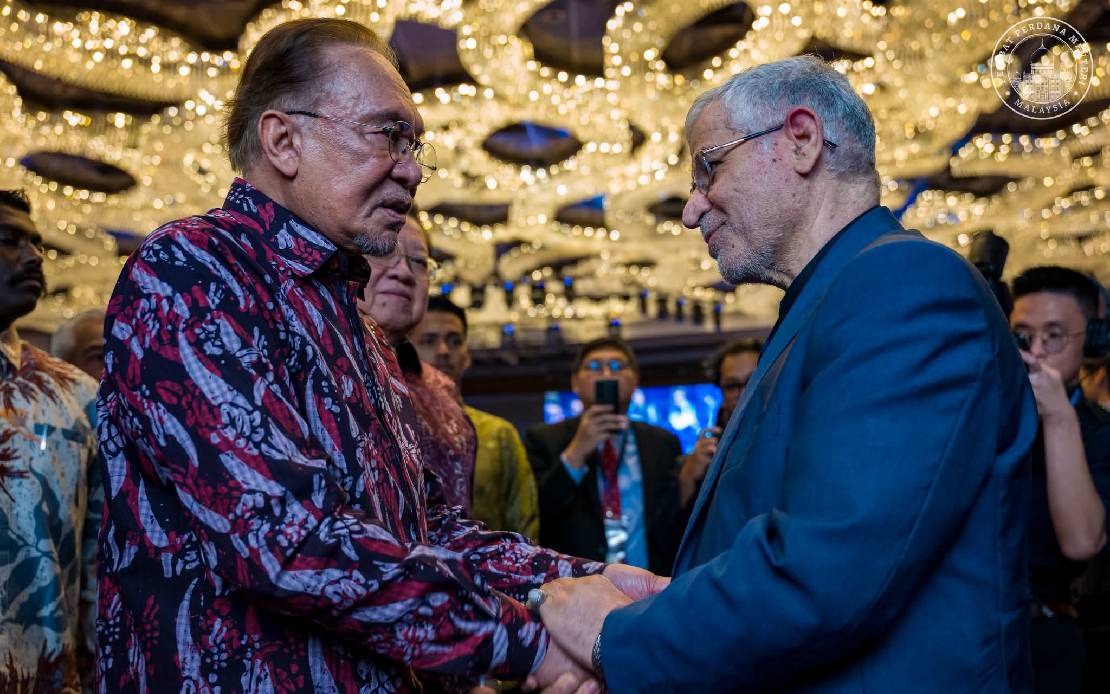
Prime Minister Datuk Seri Anwar Ibrahim has conveyed his formal regrets to the Islamic Republic of Iran following his absence from the state funeral and farewell ceremonies honouring the country's Supreme Leader, the late Ayatollah Ali Khamenei. The apology was delivered during a bilateral meeting between Anwar and Iranian Ambassador to Malaysia Valiollah Mohammadi, held on the sidelines of the 39th Asia-Pacific Roundtable conference in Kuala Lumpur. Through a social media statement, the Prime Minister acknowledged that pressing domestic governmental obligations prevented his personal attendance at these significant state proceedings.
The Malaysian delegation's representation at the Iranian ceremonies was instead entrusted to Agriculture and Food Security Minister Mohamad Sabu, who travelled to Iran to stand in Anwar's place and demonstrate Malaysia's solidarity with the Iranian nation during this period of mourning. This arrangement underscores the diplomatic protocols typically observed between nations when senior leaders face scheduling conflicts, particularly when such conflicts involve substantial domestic policy commitments that cannot be deferred. Malaysia's decision to send a cabinet-level representative signals the importance placed on the bilateral relationship despite the Prime Minister's inability to be present in person.
Ayatollah Ali Khamenei, who was eighty-six years old at the time of his death, passed away at his residence in central Tehran on February 28. Iranian state media attributed his death to complications arising from injuries sustained during a joint attack on Iranian soil involving the United States and Israel. The Supreme Leader's passing marked a significant moment not only for Iran's domestic political landscape but also for the broader geopolitical configuration of the Middle East, given Khamenei's quarter-century tenure as the highest-ranking state authority in the Islamic Republic.
The funeral and farewell proceedings were arranged as an extensive state ceremony spanning six days, reflecting the ceremonial importance accorded to Iran's Supreme Leader. Beginning on July 4, the schedule encompassed elaborate funeral processions through the cities of Tehran and Qom, two cities of paramount religious and political significance in Iran. The ceremonies culminated in a burial ceremony at the Imam Reza Shrine located in the holy city of Mashhad on July 9, one of Islam's most venerated pilgrimage sites and a location symbolically appropriate for honouring Iran's supreme spiritual and political authority.
For Malaysia, attendance at such high-level state funerals carries diplomatic weight beyond mere ceremonial participation. The attendance of senior government representatives at major international events serves multiple functions: it demonstrates respect for the deceased and their nation, affirms continuity of bilateral relationships, and provides opportunities for discrete diplomatic engagement on matters of mutual concern. By deploying Minister Mohamad Sabu to represent the country, Malaysia fulfilled its diplomatic obligations while Anwar attended to what were characterised as unavoidable official responsibilities on the domestic front.
The timing of Khamenei's death and the subsequent funeral arrangements occurred during a period of heightened regional tensions in the Middle East. The circumstances surrounding his death, linked to military confrontation, added geopolitical dimensions to what would ordinarily be a state funeral. Malaysia, as a Muslim-majority nation with historically warm relations with Iran, maintained diplomatic engagement through appropriate representation despite the Prime Minister's absence. Such nuanced diplomatic positioning allows Malaysia to sustain relationships across the region while managing its own domestic political calendar.
Anwar's expression of condolences extended not merely to Iran's political establishment but also to the broader Iranian population, acknowledging the national significance of Khamenei's passing. As Supreme Leader, Khamenei represented not simply a political figure but a foundational pillar of Iran's Islamic system of governance. His departure necessitated formal acknowledgement from international partners, particularly those within the Muslim world or with substantive ties to Tehran. Malaysia's response through official condolences and cabinet-level representation reflected these diplomatic considerations.
The 39th Asia-Pacific Roundtable conference where Anwar held his meeting with the Iranian ambassador provided an appropriate diplomatic forum for such exchanges. These multilateral gatherings offer structured opportunities for bilateral engagements between leaders and senior officials attending the conference. The conference setting provided a natural context for the Malaysian Prime Minister to meet with the Iranian ambassador and conduct the necessary diplomatic communication regarding Malaysia's delegation attendance at the Iranian ceremonies.
From Malaysia's perspective, maintaining steady diplomatic relations with Iran remains relevant given Malaysia's positioning within the Islamic world and its broader foreign policy objectives. Despite Malaysia's complex balancing act in Middle Eastern affairs—maintaining cordial relations with both Arab Gulf states and Iran—such ceremonial participation demonstrates Malaysia's commitment to respectful engagement across the Muslim world. The delegation of Minister Mohamad Sabu allowed Malaysia to fulfil diplomatic expectations while Anwar addressed what his office deemed pressing national commitments requiring his direct attention.

