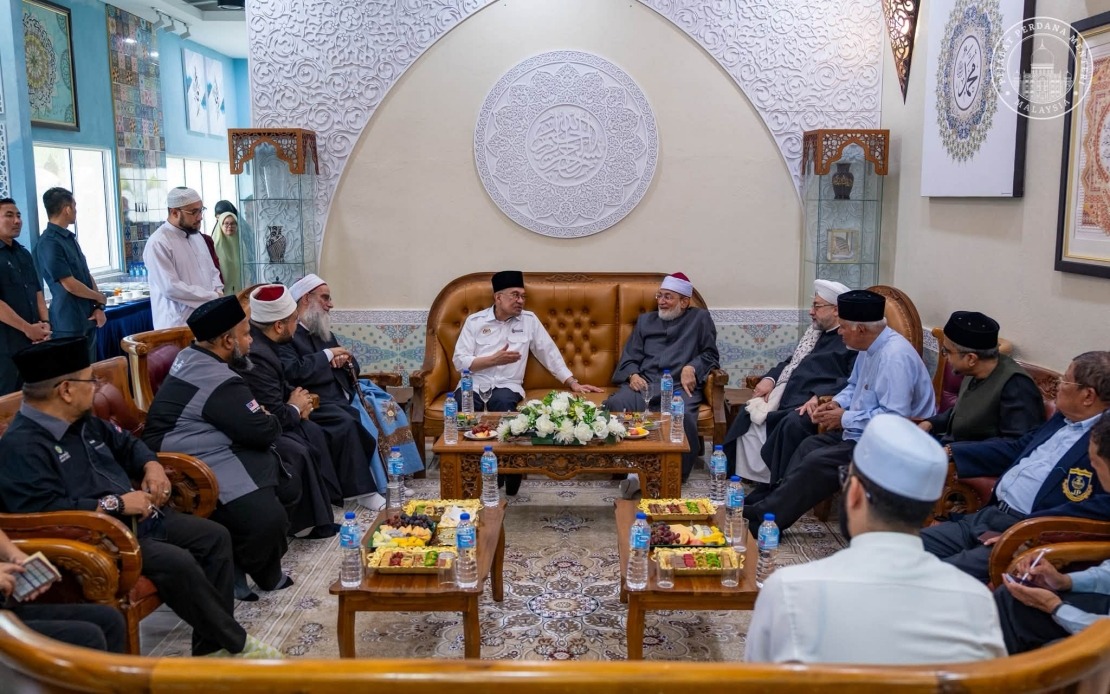
Prime Minister Datuk Seri Anwar Ibrahim has held meetings with three prominent Islamic scholars currently based in Malaysia, in what represents his latest engagement with leading figures from the Muslim world. The visits underscored the government's commitment to fostering intellectual and spiritual exchanges that strengthen Malaysia's standing as a centre for Islamic learning and dialogue.
The three scholars who received Anwar's attention are Al-Fadhil Al-Allamah Al-Muhaddith Syeikh Dr Mustafa al-Nadwi Al-Hasani, a prominent Egyptian hadith scholar with extensive credentials in Islamic jurisprudence and religious sciences; Al-Fadhil Al-Allamah Al-Muqri' Syeikh Dr Ahmad Isa Al-Ma'sarawy, recognised internationally for his mastery of Quranic recitation and memorisation; and Al-Fadhil Al-Syeikh Maulana Al-Sayyid Afeefuddin Al-Jailani, who oversees the waqf properties, mosque administration, and sacred mausoleum associated with the historically significant Syeikh Abdul Qadir Al-Jailani.
According to a statement shared on social media, Anwar utilised the meetings to enquire about the scholars' wellbeing and to gain their perspectives on matters of religious significance. The Prime Minister also sought their prayers and blessings, reflecting Malaysia's traditional respect for Islamic intellectual authority. These consultations appear part of a broader strategy to leverage the expertise of internationally respected Islamic figures who can contribute to shaping discourse around faith and morality within the Malaysian context.
Anwar's decision to personally visit these scholars, despite his demanding schedule as the nation's chief executive, signals the priority his administration places on religious scholarship and Islamic thought leadership. The meetings were conducted at Nasyrul Quran, an institution dedicated to Quranic studies and Islamic education, suggesting a deliberate choice to engage in an environment symbolically aligned with religious learning.
The Prime Minister expressed appreciation for the scholars' willingness to contribute their knowledge and wisdom to Malaysia's broader Islamic community. This reflects a recognition that Malaysia's religious institutions can benefit from exposure to different schools of Islamic thought and interpretation, particularly from scholars with deep roots in classical Islamic tradition and global standing. Such engagement helps position Malaysia as an intellectually vibrant Islamic nation rather than one merely observing religious practice.
In his public remarks, Anwar emphasised that the scholars' presence in Malaysia and their sharing of knowledge carries broader implications for Malaysian society. He connected their visit to the government's vision of fostering a population that is simultaneously virtuous in character, academically rigorous, and harmonious in its social relations. This framing suggests that the government views Islamic scholarship not as separate from secular governance but as integral to achieving its development objectives.
The timing of these visits comes as Malaysia continues to navigate complex questions about Islam's role in a multicultural democracy. By hosting distinguished Islamic scholars and facilitating high-level engagement with them, the government demonstrates its commitment to strengthening Islamic intellectual traditions while maintaining the country's constitutional framework and plural society. This balancing act has historically been central to Malaysia's approach to religious governance.
The three scholars represent different dimensions of Islamic expertise—hadith scholarship connects to the foundations of Islamic jurisprudence, Quranic recitation embodies a specialised art form with deep spiritual significance, and waqf administration involves practical management of religious endowments. Their collective presence thus offers Malaysia exposure to varied dimensions of Islamic knowledge and practice, from the theoretical to the administrative.
Anwar's public acknowledgment of these meetings through social media indicates the government's confidence in the value these engagements generate. By sharing details with Malaysian audiences, the administration effectively communicates its vision for a Malaysia that remains deeply rooted in Islamic intellectual traditions while engaging confidently with the contemporary world. This approach contrasts with some regional governments' more cautious handling of high-profile religious figures, suggesting Malaysia's institutional maturity in such matters.
The visit also reflects the practical reality that Malaysia's Islamic institutions increasingly rely on international networks and knowledge exchange to maintain intellectual vitality. With constraints on resources and sometimes limited access to certain scholarly traditions domestically, hosting visiting scholars and maintaining relationships with internationally recognised figures becomes strategically important. These interactions help Malaysian Islamic scholars stay connected to broader currents of Islamic thought.
Looking forward, the meetings may signal potential future collaborations between these scholars and Malaysian Islamic institutions, whether through lectures, educational programmes, or advisory roles. Such arrangements have historically enriched Malaysia's religious landscape while raising the country's profile in international Islamic academic circles. The government's facilitation of such connections reflects a sophisticated understanding of soft power and cultural diplomacy.
The government's engagement with these particular scholars also demonstrates selectivity in choosing interlocutors from the global Islamic community. The choice to meet with figures known for scholarly rigour and moderate interpretations, rather than more ideologically extreme voices, sends an implicit message about the kind of Islamic thought Malaysia's leadership values. This curation of relationships helps shape the intellectual environment within which religious discourse occurs.

