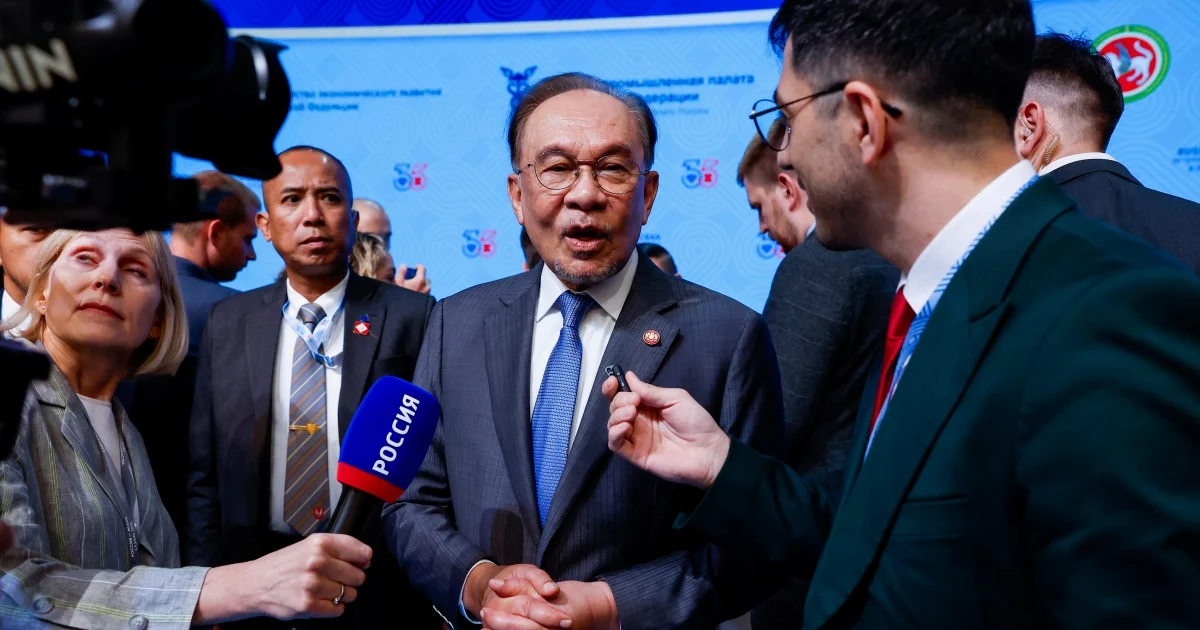
Prime Minister Datuk Seri Anwar Ibrahim has underscored the strategic importance of cultural engagement in international relations, revealing his personal affinity for Russian musical compositions and literary works during remarks made in Kazan. The disclosure reflects a broader diplomatic philosophy that positions artistic and intellectual exchange as a complement to conventional economic partnership, suggesting that Malaysia views Russia through a lens extending beyond commercial transactions and political protocol.
Anwar's remarks in Kazan represent a noteworthy articulation of soft power diplomacy at a moment when Malaysia is navigating complex geopolitical dynamics across the Indo-Pacific region. By openly acknowledging his engagement with Russian cultural products, the Prime Minister signals Malaysia's willingness to engage with diverse cultural traditions and perspectives, a positioning that carries particular resonance given the prevalence of Western cultural dominance in global discourse. This approach aligns with Malaysia's historical commitment to non-aligned principles and its effort to cultivate multifaceted relationships across different civilizational spheres.
The emphasis on literature as a vehicle for national understanding deserves particular attention. Literary works carry within them the philosophical frameworks, historical narratives, and collective sensibilities of a nation, making them powerful instruments for building empathy and mutual comprehension across borders. When leaders engage seriously with another nation's literary canon, they demonstrate a commitment to understanding that society's inner life rather than merely conducting transactional relationships. For Malaysia, a nation with a rich literary heritage of its own spanning multiple languages and cultural traditions, this recognition of literature's diplomatic potential carries particular weight.
Russia's cultural exports have maintained significant influence globally despite geopolitical tensions in recent years. Russian classical music, spanning from composers like Tchaikovsky and Rimsky-Korsakov to more contemporary figures, represents one of Europe's greatest artistic achievements and continues to resonate across diverse audiences. Similarly, Russian literature—from the introspective psychological novels of Dostoevsky to the sweeping historical epics of Tolstoy—has profoundly shaped global literary consciousness. These artistic traditions represent soft power assets that can operate independently of official state positions, creating channels for understanding that transcend diplomatic friction.
The Malaysian Prime Minister's comments reflect an understanding that sustainable international relations require more than institutional frameworks and trade agreements. When nations share cultural understanding, their populations develop greater tolerance and understanding for each other, creating a foundation for cooperation that survives temporary political disagreements or economic headwinds. This principle holds particular relevance for Malaysia, which has consistently emphasised multiculturalism and interfaith dialogue as central to its national identity and international engagement strategy.
Anwar's approach also speaks to Malaysia's effort to position itself as a bridge between different regions and civilisations. By demonstrating genuine interest in Russian cultural achievements, Malaysia reinforces its self-presentation as a nation genuinely committed to understanding diverse perspectives rather than serving as a proxy for Western interests. This positioning becomes increasingly important as Malaysia navigates pressures to align more exclusively with either Western or Chinese-led groupings, and cultural diplomacy offers a pathway to maintain strategic autonomy while deepening bilateral relationships across the board.
The timing of these remarks in Kazan carries additional significance, as Russia has intensified efforts to strengthen ties with Asian partners amid geopolitical isolation from Western economies. For Malaysia, cultural exchanges represent a relatively low-risk mechanism for deepening engagement with Russia without incurring the economic or political costs that might accompany more formal institutional commitments. Through cultural programmes, educational exchanges, and artistic collaborations, both nations can deepen their relationship while maintaining flexibility in their broader strategic alignments.
For Malaysian audiences, Anwar's appreciation of Russian culture offers a refreshing reminder that leadership need not be confined to purely instrumental concerns. The Prime Minister's willingness to speak about personal engagement with another nation's artistic traditions humanises diplomacy and demonstrates that national leaders can maintain individual intellectual and cultural interests whilst pursuing collective national objectives. This modelling of culturally informed leadership could inspire greater appreciation within Malaysian society for the importance of cultural exchange in an increasingly fractious global environment.
Beyond the bilateral dimension, Anwar's comments contribute to a broader regional conversation about the value of cultural diplomacy in Southeast Asia. As ASEAN nations increasingly emphasise people-to-people engagement and cultural programmes as pillars of their regional integration efforts, Malaysia's attention to cultural exchange with external partners offers a relevant model. The region's own extraordinary cultural diversity suggests that intercultural dialogue represents a distinctive strength that Southeast Asian nations can leverage in their international engagement.
Moving forward, Malaysia might consider deepening cultural programmes with Russia through expanded educational scholarships, museum exhibitions, literary translations, and performing arts collaborations. Such initiatives would operationalise the sentiment expressed by the Prime Minister whilst creating concrete mechanisms for sustained engagement. Russian language programmes in Malaysian universities, translated works of Russian literature in Malaysian bookstores, and cultural festivals featuring Russian artists could all serve to deepen public understanding and strengthen the people-to-people bonds that Anwar has identified as crucial to modern international relations.
The Prime Minister's remarks ultimately suggest a vision of Malaysian diplomacy that refuses to reduce international relations to purely transactional calculations. By championing cultural exchange as equally important as economic cooperation, Anwar positions Malaysia as a nation confident enough to engage with other societies on grounds that extend beyond material benefit. This philosophy, if consistently applied across Malaysia's bilateral relationships, could strengthen the nation's diplomatic standing whilst enriching the cultural life of Malaysians through exposure to the world's diverse artistic traditions.