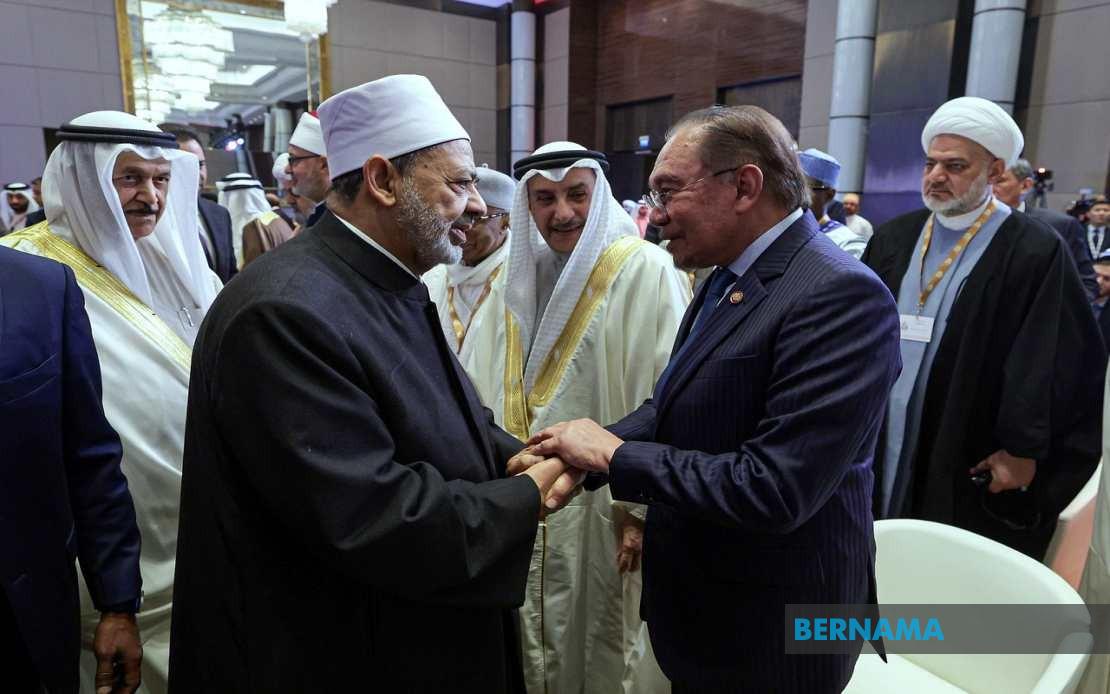
Prime Minister Datuk Seri Anwar Ibrahim has accorded high recognition to Prof Dr Ahmad Muhammad Ahmad Al-Tayyeb, the Grand Imam of Al-Azhar Al-Sharif, characterising him as a foremost proponent of wasatiyyah—the Islamic principle of moderation—in confronting today's multifaceted challenges. Speaking through contributions to a biographical publication honouring Al-Tayyeb's 80th birthday, Anwar positioned the prominent Egyptian scholar as an exemplary figure whose intellectual and spiritual leadership transcends institutional constraints and generational boundaries, offering vital guidance on the intricate relationship between faith, governance, and community cohesion in an increasingly complex world.
The Prime Minister's endorsement reflects broader Malaysian diplomatic engagement with influential Islamic thought leaders who advocate balanced, contemporary approaches to religious interpretation. Al-Tayyeb's prominence in the Islamic world stems from his consistent articulation of wasatiyyah principles—emphasising compassion, mutual respect, and peaceful coexistence—which align substantially with Malaysia's own constitutional framework of religious pluralism and the moderate Islamic values that the government routinely champions in regional and international forums.
Anwar emphasised that Al-Tayyeb's influence extends far beyond theological discourse. The Grand Imam has actively championed initiatives aimed at fortifying solidarity across the global Muslim community whilst simultaneously cultivating practical expressions of love, understanding, and shared dignity among believers of different traditions. These objectives, Anwar suggested, represent critical contributions to fostering coherent, integrated societies where diverse populations coexist peacefully—a goal of particular relevance for Malaysia given its multicommunal composition and government commitment to interfaith harmony.
The biographical work itself, commissioned by the Muslim Council of Elders and unveiled earlier in 2024 to commemorate Al-Tayyeb's milestone birthday, assembles reflections from religious scholars, spiritual leaders, and international intellectuals who have observed his multidecade career. This publication strategy—gathering diverse testimonials—underscores Al-Tayyeb's standing as a bridge-builder whose influence resonates across denominational, geographic, and civilisational boundaries, positioning him as a figure whose intellectual legacy extends beyond traditional Islamic scholarship into broader questions of global ethics and peaceful coexistence.
Anwar characterised Al-Tayyeb not merely as an orator delivering measured messages but as an individual whose personal conduct, erudition, and disciplined practice embody the principles he articulates. This distinction matters significantly in Islamic intellectual traditions, where scholars' lived examples authenticate their teachings. The Prime Minister's emphasis on this congruence between Al-Tayyeb's words and actions suggests that authentic Islamic leadership—particularly regarding moderation—requires intellectual consistency reinforced by personal integrity and scholarly rigour applied across evolving circumstances.
A cornerstone of Anwar's appreciation involves Al-Tayyeb's catalytic role in advancing interfaith dialogue at the highest levels. Most prominently, the Grand Imam collaborated with Pope Francis to author the Document on Human Fraternity, signed in Abu Dhabi in 2019. This landmark accord represents one of the most consequential modern statements of shared principles between Islam's foremost institutional representative and the Roman Catholic Church's spiritual leader, containing theological and ethical commitments to viewing adherents of different faiths as fundamentally equal in dignity and deserving of love, practical support, and institutional respect.
The significance of this interfaith initiative for Malaysian audiences cannot be overstated. Malaysia's constitutional arrangement—which safeguards Islam's special position whilst guaranteeing religious freedom to other communities—operates within a delicate balance requiring constant calibration. International examples of successful interfaith collaboration, particularly those advanced by globally respected Islamic authorities like Al-Tayyeb, provide valuable templates and philosophical foundations that buttress Malaysia's own multicultural governance model. When Islamic leaders of unquestionable scholarly credentials and institutional standing promote religious pluralism and interfaith understanding, they strengthen the intellectual and moral legitimacy of similar efforts within Malaysia's political and civil sphere.
Anwar's public commendation also reflects Malaysia's strategic positioning within broader Islamic geopolitics. By highlighting Al-Tayyeb's contributions to Muslim ummah unity and contemporary Islamic thought, Anwar aligns Malaysia with a particularly influential strand of Islamic intellectual leadership—one that emphasises pragmatism, cross-cultural engagement, and adaptive interpretations of Islamic principles without abandoning core theological commitments. This positioning distinguishes Malaysia from more rigid or adversarial Islamic movements, enhancing the nation's diplomatic credibility and soft power within both the Organisation of Islamic Cooperation and the wider international community.
The wasatiyyah framework that Anwar repeatedly invokes carries substantial implications for how Islamic societies address contemporary pressures—ranging from economic inequality to technological disruption to geopolitical instability. By highlighting Al-Tayyeb's modelling of this approach, Anwar implicitly advocates for analogous balanced responses within Malaysia's own political discourse and policymaking architecture. The message suggests that navigating modernity whilst maintaining Islamic identity requires neither wholesale westernisation nor isolated rejection of contemporary realities, but rather thoughtful synthesis guided by established Islamic ethical principles applied with contextual sensitivity.
Al-Tayyeb's sustained engagement at age eighty represents another dimension of Anwar's commendation. The Prime Minister's emphasis on the Grand Imam's continued intellectual vitality and relevance despite advanced age subtly reinforces narratives about wisdom accumulating through experience and mature leadership remaining essential in addressing complex societal questions. For Malaysian audiences observing their own political leadership composition, such observations implicitly support respect for experienced, established figures whose years of scholarship and diplomatic engagement provide invaluable perspective on enduring national challenges.
The broader implications of Anwar's statement extend to Malaysia's international positioning as a champion of Islamic moderation. Within Organisation of Islamic Cooperation structures and in bilateral diplomacy with Islamic-majority nations, Malaysia has cultivated an identity as a Muslim-majority democracy that reconciles religious commitment with pluralistic governance. By publicly celebrating Al-Tayyeb's parallel efforts internationally, Anwar strengthens this narrative and positions Malaysia within a global network of moderate Islamic voices—a coalition valuable for advancing shared interests in combating extremism, promoting development, and maintaining international stability.
Furthermore, Anwar's recognition of Al-Tayyeb's interfaith initiatives addresses persistent Western scepticism about whether Islam inherently supports religious pluralism. By elevating a senior Islamic scholarly authority who has invested decades in demonstrating compatibility between Islamic faith and interfaith respect, Anwar contributes to reshaping global perceptions of Islam beyond stereotypes of monolithic opposition to religious diversity. This diplomatic labour—reshaping international narratives about Islam—constitutes an essential component of Malaysian foreign policy and national brand-building in an era of heightened religious tensions globally.
Ultimately, Anwar's commendation of Al-Tayyeb encapsulates a coherent vision of Islamic leadership adapted to contemporary global circumstances: intellectually rigorous, ethically grounded, institutionally engaged, and fundamentally committed to fostering human dignity, peaceful coexistence, and mutual respect across religious and cultural boundaries. For Malaysia, an increasingly diverse and economically interdependent nation operating within a multipolar international system, alignment with such Islamic thought leaders provides both philosophical validation for the multicultural governance model the nation has constructed and practical intelligence on how societies can authentically balance religious identity with pluralistic commitment.

