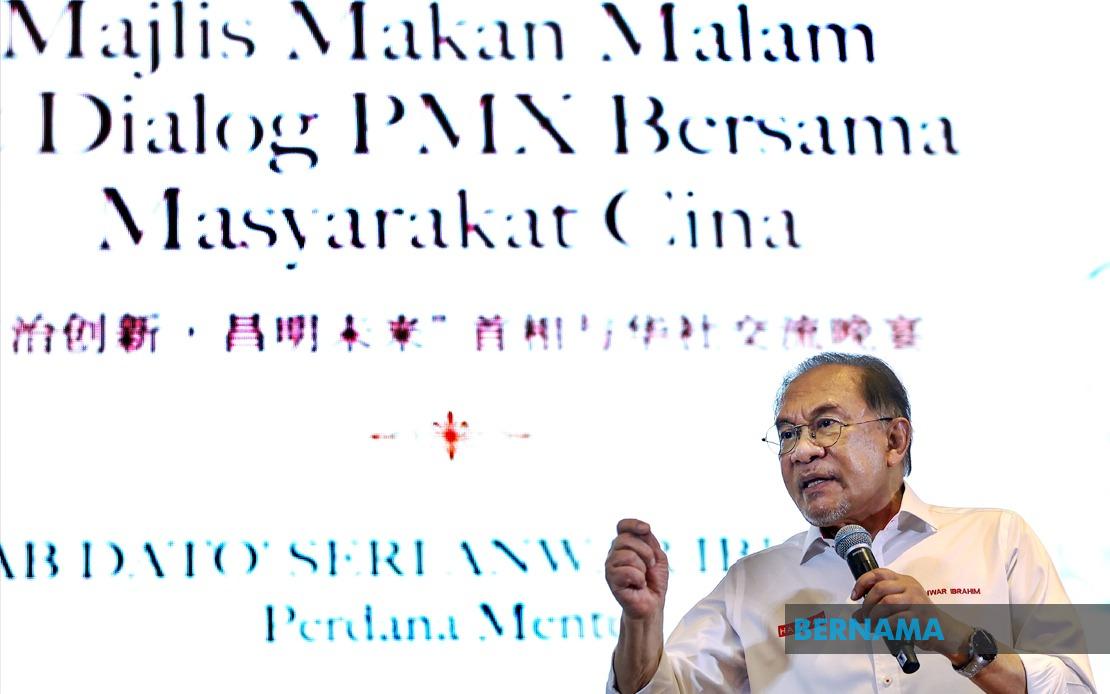
Prime Minister Datuk Seri Anwar Ibrahim has underscored his determination to guide Malaysia towards sustained national greatness and prosperity, delivering his message during an engagement with the Chinese community in Johor Bahru on July 4. The remarks, delivered at a community dinner, reflect an ongoing emphasis on inclusive governance that transcends traditional communal boundaries in Malaysia's multicultural context.
Anwar articulated a vision of leadership that prioritises meaningful engagement with every demographic segment within the nation. His approach signals a departure from purely transactional politics, instead emphasising the importance of genuine connection between the elected leadership and the populace across different ethnic, religious, and socioeconomic groups. This positioning holds particular significance in Malaysia's current political landscape, where concerns about polarisation and factional division have dominated recent discourse.
The Prime Minister framed his aspirations around the concept of legacy, a theme that resonates with his later-career positioning within Malaysian politics. Rather than focusing on short-term political victories or partisan consolidation, Anwar articulated a vision where his tenure would be remembered primarily through the quality and integrity of governance delivered to ordinary citizens. This framing suggests a recognition that public perception of political leadership increasingly hinges on demonstrated commitment to ethical conduct and equitable service provision.
Central to Anwar's articulation was the principle that every Malaysian citizen deserves attention and care from their elected representatives. He emphasised that the Prime Minister's role transcends ceremonial functions or partisan advocacy, instead demanding an authentic commitment to serve the entire population. This universal approach to governance represents a response to longstanding critiques about political elitism and the perception that certain communities receive preferential treatment in policy implementation or resource allocation.
Amirudin Shari, PKR vice president and Selangor Menteri Besar, accompanied Anwar at the Johor Bahru event, underlining the coordination between federal and state-level party leadership in promoting this governance narrative. The presence of senior figures from Peninsular Malaysia's largest state administration reinforces the message that this vision of inclusive leadership extends across multiple tiers of government administration.
Anwar's reflection on his age and career trajectory introduces a contemplative dimension to his political messaging. By acknowledging his advanced years and the finite nature of his tenure, he frames his remaining period in office as an opportunity for cementing a particular vision of Malaysian leadership. This candour about mortality and legacy differs from political rhetoric that often emphasises permanence or indefinite political relevance, instead focusing on what enduring impact his stewardship will have on national institutions and public consciousness.
The concept of mutual affection between leader and led constitutes another significant element of his address. Anwar's formulation—that citizens should remember him as someone who genuinely cared for the people, matched by reciprocal love from the population—invokes a model of governance that privileges emotional and moral connection alongside institutional performance. This rhetoric particularly resonates in Southeast Asian contexts where personalised leadership and public affection for individual leaders often shapes political outcomes and institutional legitimacy.
The call for collective responsibility in stewardship of the nation represents an implicit appeal for unity across communal lines. By invoking the metaphor of caring for the country as one's own shared responsibility, Anwar attempted to transcend the particularist identities that often dominate Malaysian political discourse. This universalist framing addresses a fundamental challenge for any Malaysian government: how to maintain national cohesion while respecting distinct communal interests and identities.
For Malaysian readers and the broader Southeast Asian audience, Anwar's statements carry implications for understanding the direction of federal governance and the ruling coalition's internal cohesion. The emphasis on clean, fair, and dedicated leadership directly addresses public concerns about corruption and political accountability that have featured prominently in Malaysian political discourse over the past decade. The government's legitimacy increasingly depends on demonstrating meaningful progress on these fronts rather than merely articulating aspirational rhetoric.
The timing of these remarks in Johor Bahru, Malaysia's second-largest state and an economically significant region, underscores the importance the Prime Minister attaches to maintaining support across diverse constituencies. Engaging specifically with the Chinese community signals attention to a demographic that exercises considerable political influence and whose voting patterns have shifted notably in recent election cycles. This targeted outreach forms part of a broader strategy to consolidate the ruling coalition's support across varied population segments.
Anwar's vision of legacy-building through inclusive governance reflects broader trends in contemporary Asian politics, where legitimacy increasingly derives from demonstrated delivery of services and maintenance of ethical standards rather than purely ideological or historical factors. His formulation suggests recognition that Malaysian voters, across all communities, increasingly evaluate political leaders based on tangible improvements to their circumstances and public trust in governmental institutions.
The message conveyed in Johor Bahru ultimately represents an attempt to reframe political leadership around principles of equity, transparency, and genuine public service. Whether this vision translates into sustained institutional change and shifts in actual governance patterns will significantly influence both the credibility of Malaysia's current administration and the broader trajectory of the nation's political development in the coming years.

