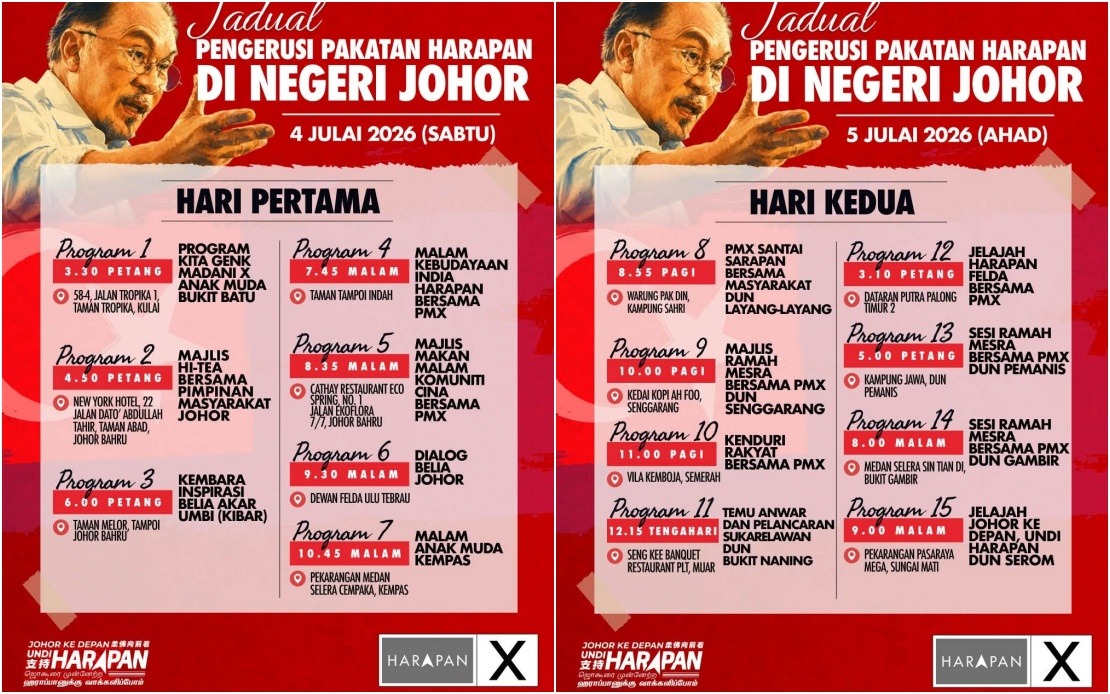
Pakatan Harapan's leadership is mounting a high-profile push to energise its campaign machinery in Johor ahead of the 16th state election, with chairman Datuk Seri Anwar Ibrahim committing himself to an exhausting schedule of 15 public programmes over a single weekend. The Opposition coalition is fielding 56 candidates across Johor, and Anwar's presence signals the importance PH places on recapturing or consolidating support in Malaysia's southernmost peninsula state, where electoral dynamics have shifted considerably in recent years.
Anwar publicly announced his weekend itinerary through social media, extending a broad invitation to all Johor voters to participate in the slate of engagement activities scheduled from Saturday through Sunday. His messaging emphasised the coalition's readiness and organisational capacity, framing the campaign as a collective effort that welcomes community participation. The invitation reflects a strategy to move beyond traditional party machinery and construct a broader coalition narrative around public inclusion and accessibility.
The campaign blitz begins Saturday afternoon with youth-focused programming. Anwar will open proceedings at the Kita Genk MADANI x Anak Muda Bukit Batu event in Kulai at 3.30 pm, targeting younger voters who represent a critical demographic for both traditional parties and the opposition coalition. This is followed by a community leaders gathering in Johor at 4.50 pm, indicating PH's intention to secure endorsements from established local figures whose networks extend into constituency-level politics. The subsequent programme in Tampoi at 6 pm continues this emphasis on grassroots mobilisation through the Kembara Inspirasi Belia Akar Umbi initiative.
The evening agenda reflects PH's strategy to engage Malaysia's diverse voter constituencies through culturally-sensitive programming. An Indian Cultural Night scheduled for 7.45 pm at Taman Tampoi Indah acknowledges the significant Indian Malaysian community's role in Johor politics, whilst a Chinese Community Dinner at 8.35 pm signals outreach to another crucial demographic bloc. These ethnic-focused events represent standard opposition coalition practice, yet their concentration within a single weekend underscores the intensity of campaign efforts as polling day approaches. Youth engagement continues into the night with a dialogue programme at 9.30 pm, before concluding with activities in Kempas at 10.45 pm.
Sunday's schedule maintains this relentless pace whilst expanding geographic coverage across multiple constituencies. Anwar begins with an early morning breakfast engagement in Layang-Layang at 8.55 am, demonstrating willingness to accommodate community preferences and participate in informal settings that foster personal connection. The subsequent meet-and-greet in Senggarang at 10 am targets another constituency, whilst a community feast in Semerah at 11 am continues the food-centred engagement strategy that characterises Malaysian political campaigning.
The afternoon and evening programmes in constituencies including Bukit Naning, Pemanis, Gambir, and Serom extend PH's reach across geographically dispersed areas. These focused constituency visits signal recognition that Johor's 56 state seats span diverse electoral landscapes, from urban centres to rural communities, each requiring tailored messaging and direct leader engagement. The schedule's design demonstrates campaign strategists' understanding that voter mobilisation in state elections depends on visible senior leadership presence across multiple locations rather than concentration in a few high-profile venues.
Johor's electoral calendar adds urgency to the weekend campaign intensity. Voters will cast ballots on July 11, with early voting permitted on July 7, meaning Anwar's appearance occurs during the critical final push before polling day. The compressed timeline between campaign announcement and voting day explains why opposition leadership deploys such concentrated resources. In Malaysian state elections, momentum and visible leader engagement often prove decisive in close contests or swing constituencies.
The choice of Johor as a campaign battleground reflects broader political calculations within Malaysian opposition politics. The state has historically alternated between government and opposition control, and recent electoral behaviour suggests volatility rather than entrenched party loyalty. Anwar's personal campaign investment signals that PH leadership views Johor as winnable territory where intensive effort could translate into seat gains, potentially reshaping peninsular politics if successful. The opposition coalition's fielding of 56 candidates across Johor's state seats represents substantial institutional commitment.
The campaign's scale and intensity carry implications for Opposition coalition cohesion and resource management. PH's largest component parties—PKR, DAP, and Amanah—must coordinate candidate selection, campaign messaging, and ground organisation across competing interests. Anwar's visible engagement helps project unity and purpose, but state-level elections frequently expose tensions within opposition coalitions regarding seat allocation, campaign strategy, and resource distribution. The Johor election will test whether PH has strengthened internal coordination mechanisms since the 2022 general election.
From a regional perspective, Johor's political trajectory influences broader Southeast Asian opposition dynamics. As Malaysia's largest opposition coalition, PH's electoral performance signals broader health of opposition politics in the region, where governing coalitions often enjoy structural advantages in campaign financing and media access. State elections in key constituencies like Johor generate momentum or fatigue that carries forward to subsequent national contests. A strong PH performance could energise opposition movements across Malaysia and neighbouring countries experiencing similar political dynamics.
Anwar's personal campaign presence also reflects the opposition coalition's leadership structure and strategic priorities. As PH chairman, his weekend deployment serves both immediate tactical goals of mobilising voters in Johor and broader positioning within the coalition regarding his role in opposition politics. The intensity of engagement demonstrates commitment to frontline campaign work rather than reliance on surrogates, a positioning strategy common in Malaysian opposition politics where charismatic senior leadership provides crucial legitimacy and mobilisation capacity.
The programme's emphasis on community engagement and cultural inclusivity represents contemporary opposition campaign strategy that distinguishes it from earlier iterations. PH's approach emphasises dialogue, participation, and recognition of community diversity rather than purely party-centric messaging. This reflects evolving voter expectations and changing Malaysian political culture, particularly among younger and more diverse constituencies that prioritise direct engagement and inclusive messaging over traditional party identities.
As Johor voters prepare for July 11 polling day, Anwar Ibrahim's intensive weekend campaign encapsulates the opposition coalition's strategy of maximum leader visibility, geographic breadth, and community engagement targeted across Johor's ethnically and geographically diverse constituencies. The scale of effort reflects both PH's assessment of Johor's electoral competitiveness and the opposition's broader efforts to maintain momentum and coalition cohesion ahead of future national contests.

