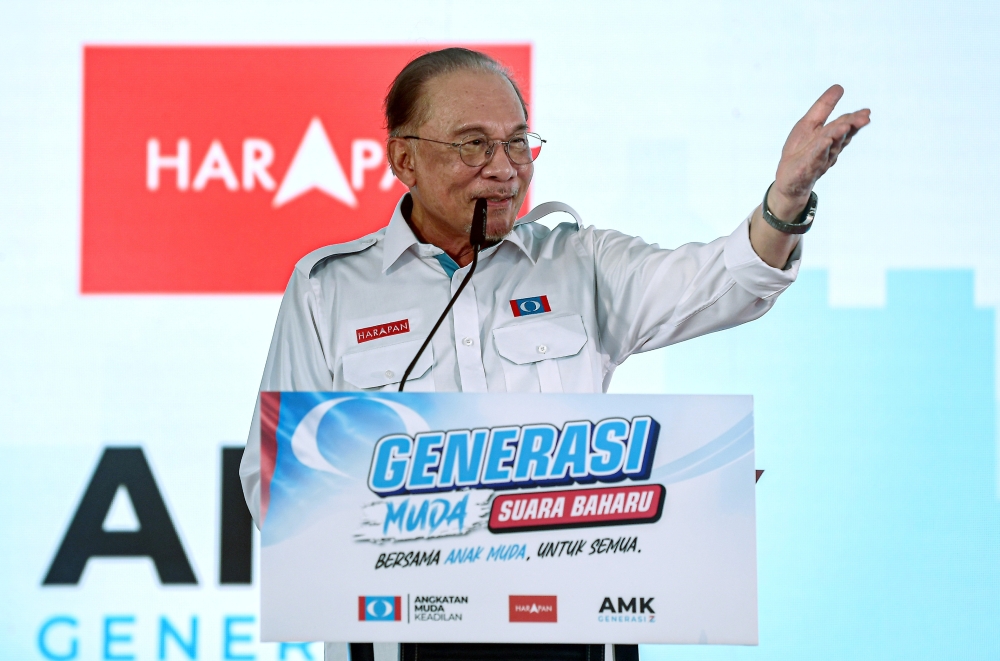
Prime Minister Datuk Seri Anwar Ibrahim has issued a forthright call for Malaysia's youngest voters to reject the entrenched political playbook that has dominated the nation's discourse for decades, arguing that politics grounded in fear and racial grievance no longer serves the country's development needs. Speaking in Petaling Jaya on July 25, Anwar articulated a vision in which leadership selection would be driven by merit, competence, and a genuine commitment to advancing national interests rather than perpetuating divisive narratives that have calcified Malaysian political culture since independence.
The Prime Minister's appeal to Generation Z represents a deliberate pivot toward a demographic cohort that has grown up with digital connectivity, exposure to international perspectives, and limited patience for the conventional wisdom that has sustained Malaysia's political establishment. By specifically targeting younger Malaysians, Anwar is acknowledging a fundamental generational shift in values and expectations—one in which voters increasingly demand substantive policy platforms over identity politics. This strategic repositioning suggests an recognition within the government that the traditional mechanisms of political mobilisation may be losing traction among those born after 2000, who have come of age during periods of rapid social change and heightened scrutiny of governmental performance.
The characterisation of current political practices as "old politics of fear and race" strikes at the historical core of Malaysian electoral competition. Since the 1969 racial tensions and the subsequent solidification of affirmative action policies favouring Bumiputeras, political parties have consistently leveraged anxieties about communal interests and zero-sum competition between ethnic communities. This framework has persisted through numerous election cycles, with both established and opposition parties frequently invoking communal sensitivities to mobilise voters. Anwar's critique implicitly acknowledges that such tactics, while historically effective, have contributed to polarisation and may be incompatible with the sophisticated economic and social challenges Malaysia faces in an increasingly competitive global environment.
The transition toward merit-based leadership selection carries significant implications for Malaysia's political structure. The current system often privileges party loyalty, factional affiliation, and established networks over individual capability or innovative thinking. Anwar's articulation of alternative criteria suggests a willingness to challenge patronage networks that have historically concentrated power within specific family clusters and party hierarchies. However, translating this rhetoric into institutional change presents considerable obstacles, given the vested interests embedded within existing political formations across the spectrum.
For Southeast Asian observers, Anwar's positioning reveals broader tensions within Malaysia's democratic evolution. The region has witnessed varying trajectories regarding political modernisation—some nations have moved toward technocratic governance models, while others have seen reassertions of identity-based politics. Malaysia's trajectory remains uncertain, with Anwar's calls for generational change competing against forces invested in preserving current arrangements. The extent to which younger Malaysians prove receptive to this appeal will significantly influence the nation's political direction over the coming decade.
The practical manifestation of Anwar's vision would require substantial institutional reforms within Malaysia's political parties, parliamentary procedures, and selection mechanisms for candidates and ministerial positions. Currently, decision-making structures remain hierarchical and concentrated, with significant power retained by senior party figures whose legitimacy often rests on historical credentials rather than contemporary performance metrics. Embedding genuine meritocratic principles would necessitate transparent evaluation frameworks, broader participation in selection processes, and accountability mechanisms that extend beyond traditional party discipline.
Generation Z in Malaysia represents a cohort with distinct characteristics that render them potentially responsive to such appeals. This generation has experienced unprecedented access to information, demonstrated engagement with environmental and social justice issues, and shown willingness to question inherited assumptions about governance and community relations. Their participation in previous elections has been scrutinised as evidence of either political disengagement or selective activism, depending on analytical perspective. Anwar's outreach suggests a calculated attempt to channel whatever political energy this demographic possesses toward specific policy objectives aligned with his administration's vision.
The broader implications extend to Malaysia's international standing and economic competitiveness. Global investment decisions increasingly factor in political stability, rule of law, and institutional quality—metrics that tend to suffer when politics revolves primarily around ethnic and religious tensions. By advocating for a shift toward merit-based governance, Anwar is implicitly acknowledging that Malaysia's prosperity depends on mobilising all available talent and expertise regardless of communal background, a necessity that becomes more acute as regional competition intensifies. This economic rationale, though less emotionally resonant than traditional political messaging, may prove persuasive to younger voters concerned about employment prospects and living standards.
Critiques of Anwar's position will likely emphasise the persistent reality of communal interests and identities within Malaysian society. Despite demographic and technological changes, fundamental questions about resource distribution, representation, and the social contract continue to manifest through ethnic and religious frameworks. Simply exhorting leaders to abandon these categories does not address underlying structural concerns that constituencies genuinely harbour. The tension between Anwar's universalist appeal and the particularistic concerns of different communities will require sophisticated navigation if his vision is to translate from rhetorical commitment into actual governance practice.
The timing of Anwar's appeal to Generation Z also reflects Malaysia's approaching electoral cycle and the government's strategic calculation about which demographic groups represent the most promising terrain for political consolidation. By positioning his administration as forward-thinking and generationally responsive, Anwar seeks to differentiate his leadership from opposition formations that may be perceived as either backward-looking or internally fragmented. Whether this framing proves persuasive will depend partly on whether government policies demonstrate genuine commitment to the meritocratic principles being articulated.

