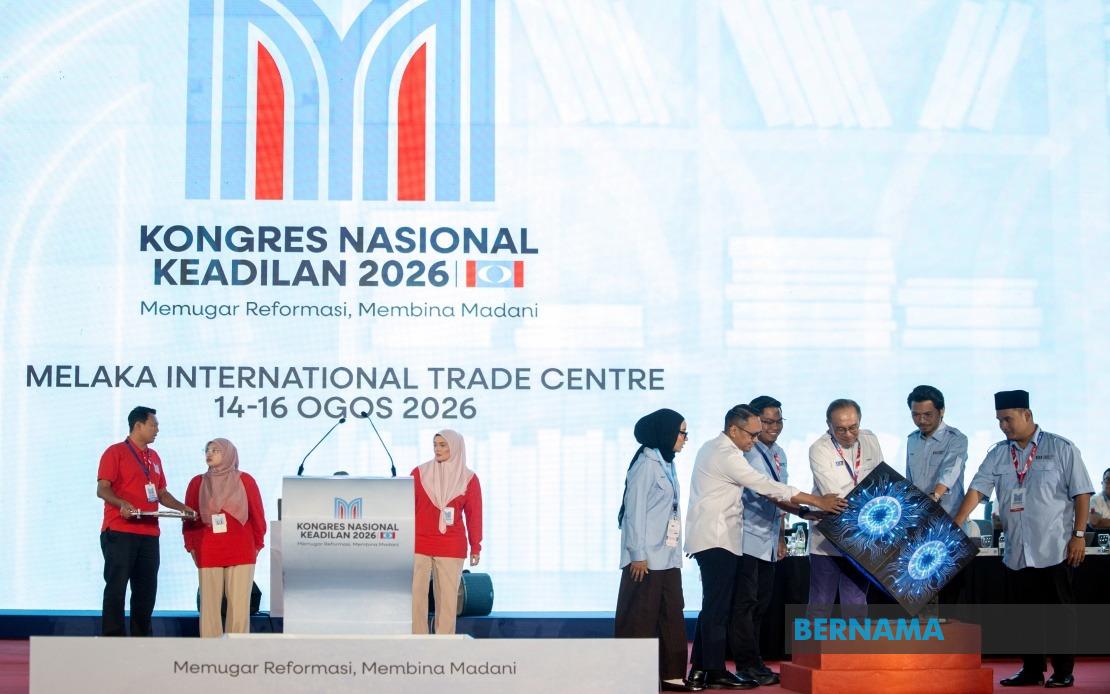
Prime Minister Datuk Seri Anwar Ibrahim formally introduced a substantial ideological document at an event in Melaka, positioning the publication as a foundational text for the Angkatan Muda Keadilan (AMK) movement. The 113-page work, compiled by AMK chief Muhammad Kamil Ahmad Munim and executive committee member Ashraf Ahmad Hadi, articulates the youth wing's contemporary approach to addressing Malaysia's multifaceted development challenges. The launch reflects a deliberate effort by PKR's leadership to establish intellectual scaffolding for its younger cadres at a critical juncture in the nation's political evolution.
Anwar's characterisation of the document centred on its departure from conventional political messaging. Rather than treating the publication as a superficial campaign tool or seasonal talking point, the Prime Minister framed it as a serious attempt at civilisational renaissance. This rhetorical positioning carries significant weight in Malaysian political discourse, where the divide between substance and performative governance remains a persistent critique. By invoking notions of "re-humanising" national development, Anwar articulated a counter-narrative to purely technocratic governance models that have dominated policy discussions across Southeast Asia. This framing suggests PKR's recognition that younger voters and party members increasingly demand ideological coherence alongside material outcomes.
The timing of the launch intersects with broader institutional developments within PKR and the federal government. The adoption referenced in Anwar's remarks appears to signal a formal endorsement of the AMK framework within party structures, embedding these principles into the movement's organisational DNA. For Malaysian readers following party politics, this represents a consolidation of PKR's intellectual positioning at a moment when coalition stability remains contested. The document's explicit grounding in the concept of "Reformasi" connects contemporary youth mobilisation to the historical reform movement, establishing lineage and legitimacy for younger members who may lack direct experience of the original democracy movement.
Anwar's address to AMK members emphasised the ethical dimensions of political responsibility, particularly addressing youth who now occupy positions of influence. The Prime Minister cautioned against interpreting political power as licence for material accumulation or celebratory self-regard. Instead, he reframed authority as a test of personal morality and religious commitment. This moralising dimension reflects a particular strain within PKR's political ideology, where Islamic ethical frameworks intersect with democratic reform principles. For Southeast Asian observers, this synthesis represents an alternative to both Western-centric liberal democracy models and authoritarian religious nationalism, though its practical application remains subject to ongoing scrutiny.
The characterisation of Malaysia as a nation "scarred by past injustices and leakages" embedded within Anwar's remarks a tacit acknowledgement of governance failures and corruption that preceded the current administration. This framing invites AMK members to understand their generation's role as redemptive rather than merely managerial. The appeal to "extraordinary creativity, intellectual courage and spiritual resilience" establishes high expectations for young political actors, suggesting that PKR recognises superficial reforms will prove insufficient for addressing systemic institutional weaknesses. This diagnostic framework has particular resonance for Malaysian youth grappling with perceptions of a political establishment that historically prioritised patronage over merit-based advancement.
The publication functions simultaneously as institutional memory and prospective roadmap. By serving as a cadre-building resource, the document attempts to anchor AMK members in historical consciousness of PKR's foundational struggles and ideological commitments. This pedagogical function addresses a genuine organisational challenge: maintaining ideological coherence across generational cohorts with varying exposure to the reform narrative. The explicit focus on ensuring members "internalise the meaning of Reformasi" suggests PKR leadership perceives a risk of ideological dilution as the movement professionalises and integrates into governing structures. For regional observers, this tension between revolutionary origins and bureaucratic institutionalisation reflects challenges facing reform movements across Southeast Asia as they transition from oppositional to governmental roles.
The emphasis on cultivating "knowledgeable and principled members" establishes quality benchmarks for party participation. This contrasts with patronage-driven recruitment models that have characterised much Malaysian political organisation historically. By prioritising intellectual formation and principled commitment, the AMK framework attempts to reshape expectations around party membership, positioning it as requiring ongoing engagement with ideological substance rather than merely transactional political participation. Whether this aspiration translates into actual organisational practice remains uncertain, but the rhetorical commitment signals PKR's institutional self-image at this juncture.
The document's positioning as a guide for upholding "the mandate of the party's struggle" invokes a quasi-sacred responsibility language that extends beyond conventional political party discourse. This framing connects individual AMK members to a broader historical mission, suggesting their actions carry significance beyond immediate electoral or policy outcomes. For Malaysian readers accustomed to viewing politics through competition-focused lenses, this appeal to transcendent purpose represents a deliberate rhetorical strategy to mobilise youth engagement beyond material incentives. The success of this approach depends substantially on whether PKR's governance performance validates the ideological promises embedded within such texts.
The launch's location in Melaka carries symbolic weight within Malaysian political geography. The state represents a critical battleground where coalition competition remains intense and voter sentiment volatile. By conducting the AMK publication launch there, PKR's leadership demonstrated commitment to consolidating grassroots mobilisation in contested terrain. This geographical choice reflects understanding that ideological frameworks require local grounding to achieve political efficacy. The presence of the Prime Minister himself underscored the national party's investment in youth wing development, suggesting recognition that generational political orientation substantially influences medium-term electoral prospects across Malaysia.

