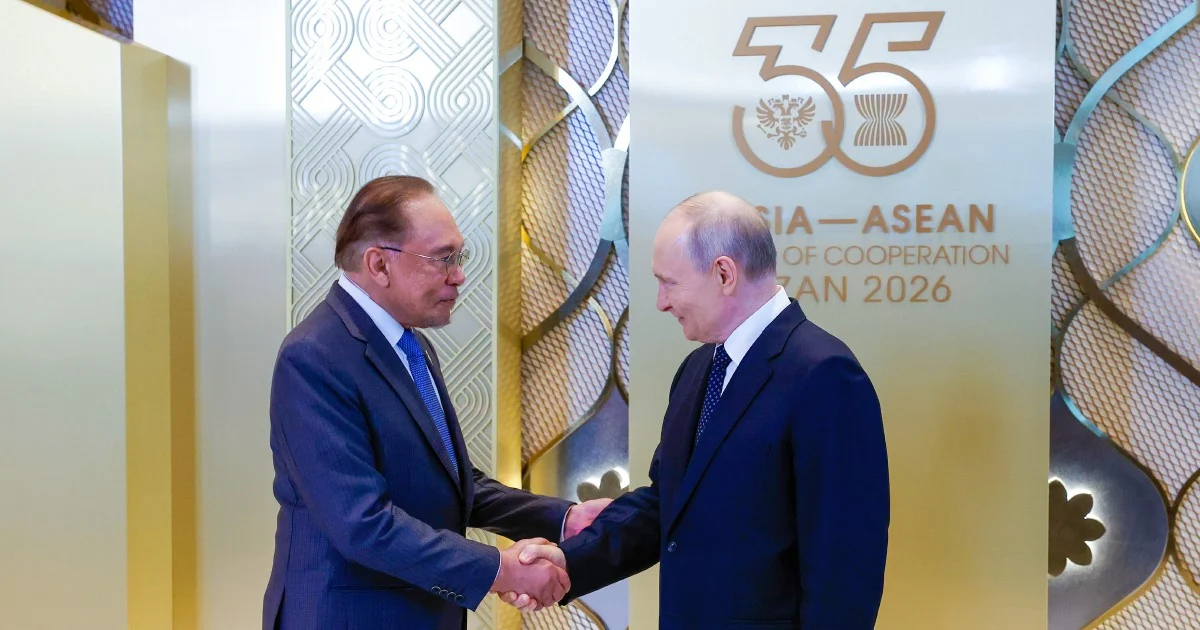
Prime Minister Datuk Seri Anwar Ibrahim and Russian President Vladimir Putin met in Kazan to explore expanded cooperation between the two nations, with discussions anchored on energy security and mechanisms to boost bilateral commerce. The encounter underscores Malaysia's strategic positioning in the evolving global landscape, where Southeast Asian nations are increasingly seeking diversified partnerships beyond traditional Western-aligned frameworks.
Energy security emerged as a cornerstone of the bilateral dialogue, reflecting both nations' recognition of hydrocarbon challenges facing the region and the wider world. Malaysia, as a significant energy producer in Southeast Asia with substantial crude oil and liquefied natural gas reserves, stands to benefit from enhanced collaboration with Russia, one of the world's largest energy exporters. Such cooperation could encompass technology transfer, investment in downstream facilities, and long-term supply agreements that insulate both economies from market volatility. For Malaysia, strengthening energy partnerships with Russia diversifies its dependency away from Middle Eastern suppliers and reduces vulnerability to geopolitical disruptions in crucial shipping lanes.
The discussion on trade conducted in local currencies represents a pragmatic response to international financial constraints and the desire to reduce reliance on the United States dollar. By settling transactions directly in Malaysian ringgit and Russian rubles, both countries can circumvent currency conversion costs, mitigate exposure to dollar fluctuations, and establish a more resilient bilateral trade framework. This approach aligns with broader regional trends, particularly among BRICS nations and their expanding sphere of influence, where de-dollarisation has become an explicit policy objective. Malaysia's participation in such arrangements signals its willingness to engage in alternative financial mechanisms that challenge post-World War Two monetary orthodoxy.
The bilateral meeting occurs within a broader context of intensified great-power competition in Asia, where Russia seeks to maintain relevance and influence despite Western sanctions imposed following its 2022 invasion of Ukraine. Malaysia's engagement with Moscow, conducted through official diplomatic channels rather than ideological alignment, reflects the government's non-aligned foreign policy tradition. This stance allows Malaysia to maintain pragmatic relationships with multiple poles of power while avoiding entanglement in zero-sum geopolitical rivalries that could compromise its regional standing or economic interests.
Energy cooperation specifically addresses Malaysia's medium-term challenges in maintaining domestic supply and export revenues. As global energy markets transition toward renewable sources, traditional petroleum exporters face structural headwinds. Collaboration with Russia on innovative extraction technologies, alternative energy sources, and downstream petrochemical industries could help Malaysia navigate this transition while sustaining industrial competitiveness. Furthermore, joint ventures in energy infrastructure development might facilitate knowledge exchange in areas where Russian expertise, accumulated over decades of operation in challenging environments, proves valuable.
The currency arrangement takes on additional significance given Malaysia's exposure to commodity price volatility and currency market swings. Ringgit-denominated trade reduces transaction costs for Malaysian importers and exporters, particularly small and medium enterprises lacking sophisticated hedging capabilities. For Russia, conducting trade in local currency provides a mechanism to sustain commerce despite international sanctions that restrict access to dollar-denominated financial channels. This mutual accommodation creates a model potentially replicable across Malaysia's broader trade network, particularly with countries similarly affected by financial restrictions or seeking alternatives to dollar dominance.
From a Southeast Asian perspective, Malaysia's enhanced ties with Russia carry implications for regional power balancing. As ASEAN navigates between major powers without compromising its centrality in regional architecture, individual member states pursue bilateral relationships reflecting national interests. Malaysia's engagement with Russia demonstrates that ASEAN nations continue diversifying partnerships regardless of geopolitical pressures from either Western-aligned or China-centric camps. This flexibility preserves regional autonomy and prevents the emergence of rigid blocs that could destabilise Southeast Asia.
The Kazan meeting also reflects the utility of platforms like the BRICS summits and broader multilateral forums in facilitating dialogue between nations operating outside Western-dominated structures. Russia's hosting of regional forums and investment in Asian engagement provides Malaysia with opportunities for partnership advancement that might be unavailable through traditional channels. Such forums increasingly shape global discourse on development, trade, and security matters, making participation strategically valuable for Malaysian policymakers.
Moving forward, the success of Malaysia-Russia energy and trade initiatives depends on translating diplomatic commitments into concrete commercial arrangements. Joint working groups and technical committees will likely emerge to operationalise agreements on energy investment, technology sharing, and currency settlements. Malaysian companies, particularly those in petroleum, petrochemicals, and maritime industries, may identify joint venture opportunities in Russia or third markets, creating employment and technology absorption benefits.
The broader strategic implication concerns Malaysia's demonstrated capacity to pursue independent foreign policy underpinned by national economic interests rather than ideological considerations. As global geopolitical fragmentation accelerates, such pragmatism becomes increasingly valuable. Malaysia's balanced approach—engaging Russia while maintaining relationships with Western countries and deepening ASEAN solidarity—positions the nation as a stable, predictable partner capable of advancing interests across ideological divides while safeguarding regional stability and prosperity.