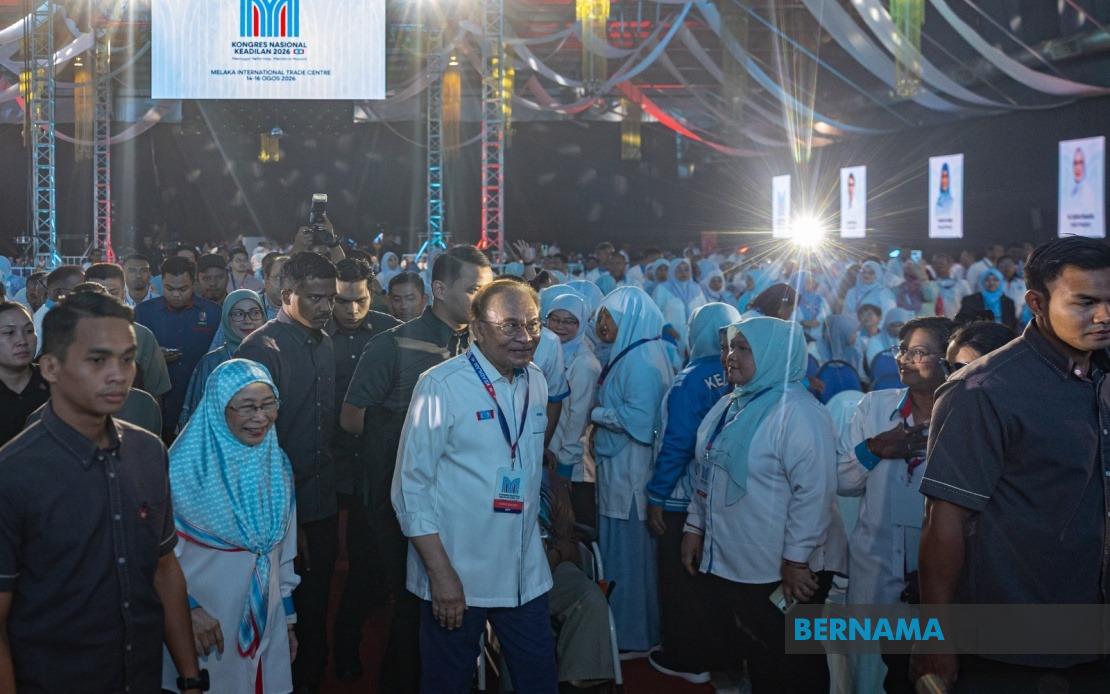
Prime Minister Datuk Seri Anwar Ibrahim has doubled down on his administration's strategy of maintaining the Unity Government coalition with UMNO-Barisan Nasional (BN), despite recent tensions that have prompted questions about the durability of the partnership. Speaking at the PKR National Congress 2026 held in Melaka, Anwar emphasised that the government's primary obligation is to the Malaysian people and the nation's long-term interests, not to temporary political grievances or personal ambitions.
The timing of Anwar's remarks is significant, coming amid speculation about strains within the Unity Government framework. His decision to publicly reaffirm the coalition at a party congress—a setting where he could have instead mobilised internal support for a more confrontational stance—signals a deliberate choice to privilege institutional stability over short-term political advantage. This positioning reflects a calculation that maintaining the current federal arrangement is more valuable to PKR and the broader government agenda than the risks of an acrimonious rupture.
Anwar's framing of the issue deliberately elevated the debate beyond personality clashes or ministerial disputes. He articulated a philosophical position that political decision-making should be insulated from emotional reactions, individual career ambitions, or desires for revenge. This rhetoric attempts to establish a normative boundary: that elected leaders have a fiduciary duty to consider national welfare rather than factional interests. For Malaysian politics, where patronage networks and personal rivalries often drive coalition dynamics, this appeal to principled governance carries symbolic weight, even if its practical influence remains contested.
The invocation of "stability" and "economic growth" as twin justifications for continuing the BN partnership reflects the government's strategic assessment of its vulnerabilities and assets. A Unity Government fracture could trigger a series of cascading consequences: the loss of BN's parliamentary votes would weaken the administration's legislative supermajority, potentially emboldening backbench dissidents from other coalition partners and inviting legal challenges to government decisions. Furthermore, the reputational damage of a coalition collapse would undermine investor confidence precisely when the government is attempting to attract foreign direct investment and stabilise the ringgit.
For PKR members listening to Anwar's speech, the message carried implications for internal party dynamics. The PKR president was essentially signalling that the party would not exploit anti-establishment sentiment or feed internal narrative of victimhood to mobilise grassroots energy. Instead, he was channeling that energy toward a narrative of responsible stewardship. This risks alienating PKR members who joined the party expressly to challenge establishment hierarchies and may feel that continued cooperation with UMNO—historically PKR's most bitter rival—dilutes the party's reformist credentials.
The relationship between PKR and UMNO within the Unity Government has always been asymmetrical and laden with historical baggage. UMNO, despite its depleted parliamentary representation, retains significant institutional resources, state-level power bases, and remains the dominant faction in the coalition. PKR, by contrast, brought ideological distinctiveness and claims to represent change, yet has found itself accommodating UMNO's interests at multiple critical junctures. Anwar's reaffirmation of the partnership implicitly acknowledges that PKR has concluded the costs of maintaining this arrangement—in terms of compromised agenda-setting and internal morale—are outweighed by the benefits of governmental incumbency and policy influence.
The broader context for Anwar's statement includes Malaysia's economic challenges, with growth moderating and inflation pressures persisting. The government's narrative has increasingly pivoted toward presenting stability and continuity as proxies for sound macroeconomic management. A political crisis triggered by coalition fragmentation would almost certainly spook markets and complicate the Finance Ministry's efforts to manage debt and currency volatility. From this perspective, Anwar's emphasis on prioritising prosperity through economic growth is not merely rhetorical; it reflects genuine concerns about how political turbulence could trigger economic consequences that would reverberate across the region.
Southeast Asia's broader political economy also contextualises this moment. Across the region, coalition governments are increasingly common, yet remain fragile. Thailand, Indonesia, and the Philippines have all experienced coalition instability leading to governmental dysfunction. Malaysia's relatively smoother transitions and institutional capacity, Anwar appears to be suggesting, depend precisely on leaders choosing durability over disruption. This invites comparison with Singapore's model of elite consensus, though the Malaysian context involves far greater pluralism and far more constrained state capacity.
Anwar's positioning also reveals calculation about his own political trajectory and legacy. As PKR president and Prime Minister, he has positioned himself as the arbiter of coalition stability. By publicly endorsing continued cooperation with UMNO, he is essentially claiming ownership of the strategic decision and framing it as evidence of statecraft rather than weakness. Critics may argue that PKR has subordinated its reform agenda, but Anwar's framing suggests he views long-term influence and gradual policy change as preferable to the uncertainty of opposition status.
Looking forward, the sustainability of the Unity Government will depend partly on whether such rhetorical commitments can be translated into tangible accommodations that satisfy both PKR and UMNO constituencies. BN leaders will be watching whether PKR's support translates into policy outcomes favourable to UMNO-aligned interests, particularly in patronage, procurement, and judicial matters. Conversely, PKR members will scrutinise whether the party extracts meaningful concessions on governance issues, anti-corruption measures, and institutional reform.
Anwar's speech ultimately represents a bet that Malaysian voters and political actors will prefer the predictability of a functioning coalition government to the risks of electoral instability. Whether that calculation proves correct will depend on how effectively the Unity Government delivers on economic performance and whether internal tensions can be managed without public eruptions that erode the coalition's legitimacy. The Prime Minister has essentially declared that political maturity means choosing governance over grievance—a principle that will face significant testing in the months ahead.

