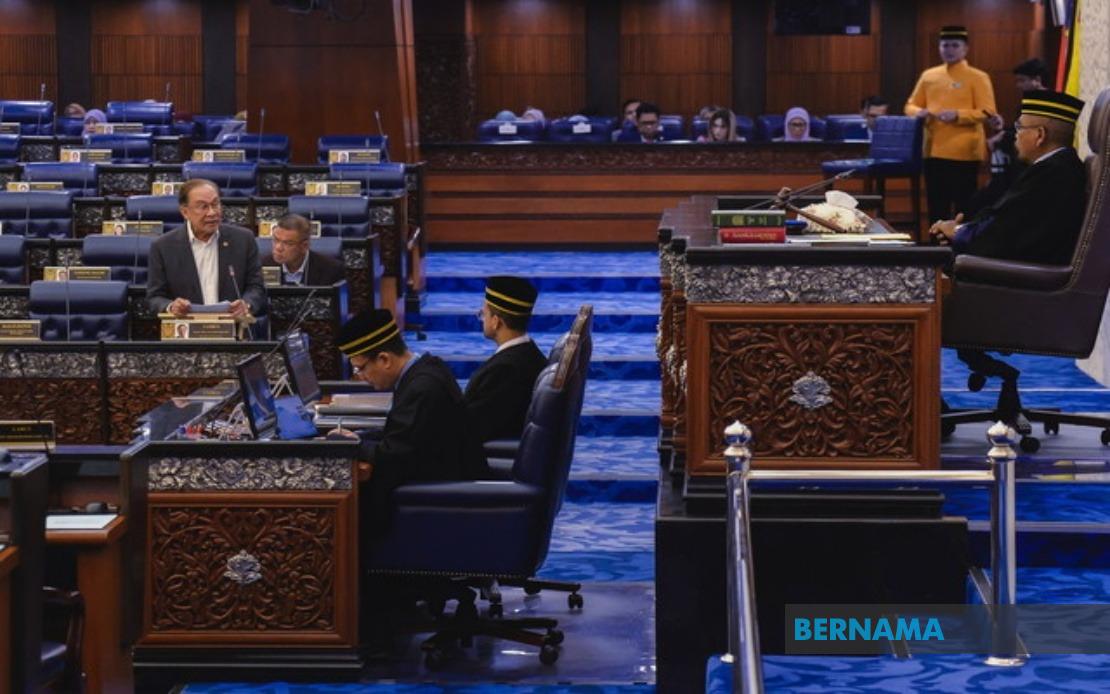
Prime Minister Datuk Seri Anwar Ibrahim has underscored the legal restrictions preventing government officials from announcing fresh projects or introducing new policies during active election campaigns, clarifying a distinction that remains frequently misunderstood in Malaysian electoral practice. Speaking during Minister's Question Time in Parliament, Anwar responded to concerns raised about enforcement mechanisms ahead of state elections in Johor, Melaka and Negeri Sembilan, reaffirming that once nomination day is declared, strict constraints apply to official communications and governmental announcements.
The Prime Minister referenced Section 24B of the Election Offences Act 1954 as the statutory foundation for this prohibition, establishing that the restriction operates uniformly across all levels of government administration. His statement clarifies that the rule extends beyond federal announcements to encompass state governments and local authorities such as city councils, meaning that elected representatives and civil servants at every tier must exercise caution during campaign periods. This comprehensive approach reflects Malaysia's intent to create a level playing field in electoral contests, where incumbents cannot leverage their access to government resources and publicity machinery to gain advantage over opposition candidates.
The distinction Anwar made regarding previously approved projects carries particular significance for understanding how the Election Commission and election oversight bodies interpret campaign finance and resource deployment rules. He confirmed that government initiatives which received approval and budget allocation in earlier fiscal years may proceed with announcements during campaigns, provided they do not represent newly conceived programmes or recently approved allocations. This nuance recognises the practical reality that government operations cannot entirely cease during election periods, yet maintains the principle that voters should not encounter announcements of fresh commitments that could sway their voting behaviour through promises of new spending or developmental initiatives.
For Malaysian voters and observers of electoral conduct, this distinction between old and new projects becomes critical when evaluating whether government announcements during campaign seasons comply with electoral guidelines. A road project that was budgeted and approved months prior may be announced; a newly conceived health clinic cannot be. The timing of announcement relative to nomination day thus becomes legally significant, creating complexity that requires careful documentation and transparent record-keeping by government agencies. Election Commission officials must verify project timelines and budget histories to distinguish legitimate announcements from improper campaign-related pledges.
Anwar's reinforcement of this position reflects ongoing concerns about maintaining electoral integrity in Malaysia's competitive political environment. Recent state elections in various Malaysian states have generated scrutiny regarding the timing of government project announcements and their proximity to nomination dates, with opposition parties frequently challenging what they characterise as abuse of incumbency advantage. The Prime Minister's parliamentary statement serves as a public reminder to all government apparatus that Election Commission rules remain in force and will be observed by the current administration, signalling commitment to fair electoral practice across the country.
The enforcement question raised by Datuk Seri Dr Shahidan Kassim underscores a persistent challenge in Malaysian electoral governance—namely, how authorities can effectively monitor and penalise violations when government machinery is vast and decentralised. The Election Commission must rely partly on complaints from election observers, political parties and candidates to identify potential breaches, as comprehensive real-time monitoring of all government communications proves logistically difficult. This creates vulnerability to violations that may go undetected unless parties actively contest questionable announcements through proper channels.
For Southeast Asian observers of electoral practice, Malaysia's approach illustrates the tension inherent in democracies where elected governments continue normal operations during election periods. Some democracies impose near-total restrictions on government announcements during campaigns, while others apply minimal constraints. Malaysia's middle-ground approach attempts to maintain administrative continuity whilst preventing use of state apparatus for partisan advantage, though implementation requires vigilance and good-faith compliance from government officials across all jurisdictions.
The upcoming Johor, Melaka and Negeri Sembilan state elections will provide test cases for how thoroughly these restrictions are observed and enforced. Opposition parties in these states will likely scrutinise government announcements for potential violations, and the Election Commission will face pressure to demonstrate impartial application of these rules. If patterns of violations emerge without consequence, public confidence in electoral fairness may erode, strengthening arguments for more stringent restrictions or enhanced enforcement mechanisms.
Anwar's statement also carries implications for how his own administration differentiates itself from predecessor governments regarding electoral conduct. By publicly reiterating these restrictions, the Prime Minister positions his government as committed to maintaining boundary lines between electoral campaigning and governance. This messaging matters for Malaysia's international reputation regarding democratic standards, particularly as the country engages with international election observation missions and regional peer reviews of governance quality. Clear articulation of legal constraints, coupled with visible enforcement, contributes to perceptions of democratic maturity.
Looking forward, the distinction between previously allocated and newly approved projects may require greater clarity through regulatory guidance or Election Commission circulars, reducing ambiguity that could lead to disputes or violations. Government agencies managing major development projects across states should proactively document project timelines and budget approvals to provide defensible records should questions arise. This administrative housekeeping, though procedurally burdensome, protects individual officials and agencies from allegations of electoral impropriety.
The restriction reflects broader Malaysian commitments to ensuring that electoral outcomes reflect voter preferences rather than government resource advantages. While perfect equality between incumbent and opposition remains impossible—incumbents inherently enjoy name recognition and institutional platforms—the law attempts to prevent the most egregious forms of advantage through new project pledges. Anwar's reinforcement of this principle demonstrates that governing parties can accept constraints on their own electoral behaviour as necessary costs of maintaining democratic legitimacy and public trust in election outcomes.

