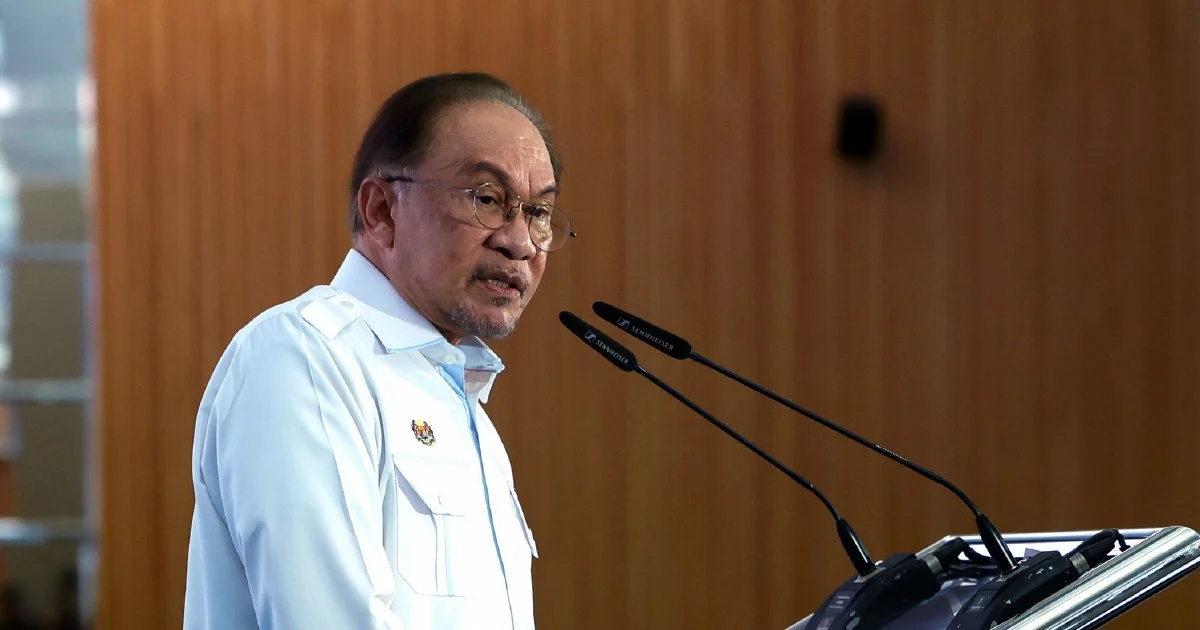
Prime Minister Datuk Seri Anwar Ibrahim has moved to counter persistent allegations that Kuala Lumpur distributes development resources inequitably across Malaysia's states, a sensitive issue that has periodically dominated political discourse and shaped federal-state relations. Speaking in the capital today, the premier directly addressed concerns that some states receive disproportionately larger allocations than others based on political affiliation or demographic factors, insisting instead that the government's approach remains balanced and justifiable under its established framework.
The question of fair resource distribution has long vexed Malaysian federalism. Opposition-controlled states and their representatives have historically complained that the federal government withholds or reduces allocations to regions where the ruling coalition lacks dominance, an accusation that carries particular weight in a country where development spending directly influences electoral sentiment and shapes public perception of government effectiveness. By publicly refuting these charges, Anwar signals an attempt to reduce friction with state governments regardless of their political composition and to present his administration as committed to meritocratic, non-partisan resource management.
The timing of Anwar's statement reflects mounting pressure from multiple quarters regarding regional development equity. Several states, particularly those governed by opposition coalitions, have voiced frustration over what they characterise as inadequate federal support for infrastructure, education, and welfare programmes. These grievances extend beyond mere budgetary disagreements; they touch on fundamental questions of national cohesion and whether citizens in certain regions receive equal government services as their counterparts elsewhere. For a coalition government that spans diverse political interests, addressing such concerns represents a critical test of its capacity to govern fairly across sectarian lines.
Understanding the mechanics of Malaysian federal allocation requires examining how the government determines which states receive what resources. The distribution system theoretically incorporates multiple variables including population size, infrastructure needs, development indicators, and demographic composition. However, the opacity surrounding specific weighting mechanisms and decision-making processes has created space for criticism and speculation. Anwar's intervention suggests the government recognises that perception matters as much as reality when it comes to public trust in institutional fairness.
The prime minister's dismissal of the accusations carries both political and administrative dimensions. Politically, it represents an attempt to shore up confidence among voters in states not currently governed by his coalition, signalling that federal support will not hinge on electoral considerations. Administratively, it reaffirms the government's commitment to implementing its allocation formula consistently and transparently. This dual messaging aims to separate the technical aspects of budget distribution from the charged atmosphere of partisan competition that often clouds such discussions.
Malaysia's federal structure inherently creates tensions around resource sharing. The constitution delegates certain powers to states while concentrating revenue-raising authority at the federal level, creating financial dependencies that become politically fraught. Development allocations represent one of the few tools through which the federal government can directly influence outcomes in state territories, making decisions about their distribution inherently significant. When allegations of unfairness circulate—whether based on substantive evidence or political rhetoric—they strike at the legitimacy of federal governance itself.
Regional disparities in development outcomes across Malaysian states have widened in recent years, driven by factors including divergent state government capacities, private investment patterns, and historical industrialisation legacies. Whether these disparities reflect genuinely unfair federal allocation decisions or stem from other structural factors remains contested. Anwar's position implicitly claims that federal distribution mechanisms have not significantly contributed to these gaps, attributing variance instead to other considerations beyond his government's direct responsibility.
The backdrop to this statement includes broader efforts by the federal government to improve federal-state coordination mechanisms. Various committees and task forces have been established to facilitate better communication and joint planning between Putrajaya and state capitals. These institutional innovations aim partly to reduce misunderstandings about allocation decisions and to create spaces where disputes over resource distribution can be addressed constructively rather than through public recrimination. By reiterating his government's commitment to fairness, Anwar places these efforts in the broader context of institutional reform.
For opposition-controlled states, Anwar's public assertions offer limited reassurance without accompanying mechanisms for independent verification. These states have periodically requested transparency measures including detailed breakdowns of how allocations are calculated, published formulas for distribution decisions, and opportunities for greater state input into federal planning processes. The absence of such measures leaves room for continued scepticism, even as the prime minister maintains that his government's approach is fundamentally sound.
Southeast Asian neighbours have grappled with similar federalism tensions, though Malaysia's particular combination of electoral competition and resource concentration at the centre creates a distinctive context. Regional observers watching how the Anwar government manages these federal-state frictions gain insight into Malaysia's broader institutional health and the quality of its democratic practices. Fair and transparent resource distribution stands among the foundations necessary for maintaining cohesion in a diverse, multi-ethnic federation.
Looking forward, the real test of Anwar's assertions will lie not in rhetorical defence of current practices but in whether his government takes steps to increase transparency, improve consultation mechanisms, and demonstrate—through systematic evidence—that its allocation formulas operate fairly across all states regardless of political affiliation. Public declarations of fairness, while important, ultimately require substantiation through action. The government's willingness to enhance verification and disclosure around allocation decisions would constitute the most persuasive counter to persistent allegations of partisan distribution.

