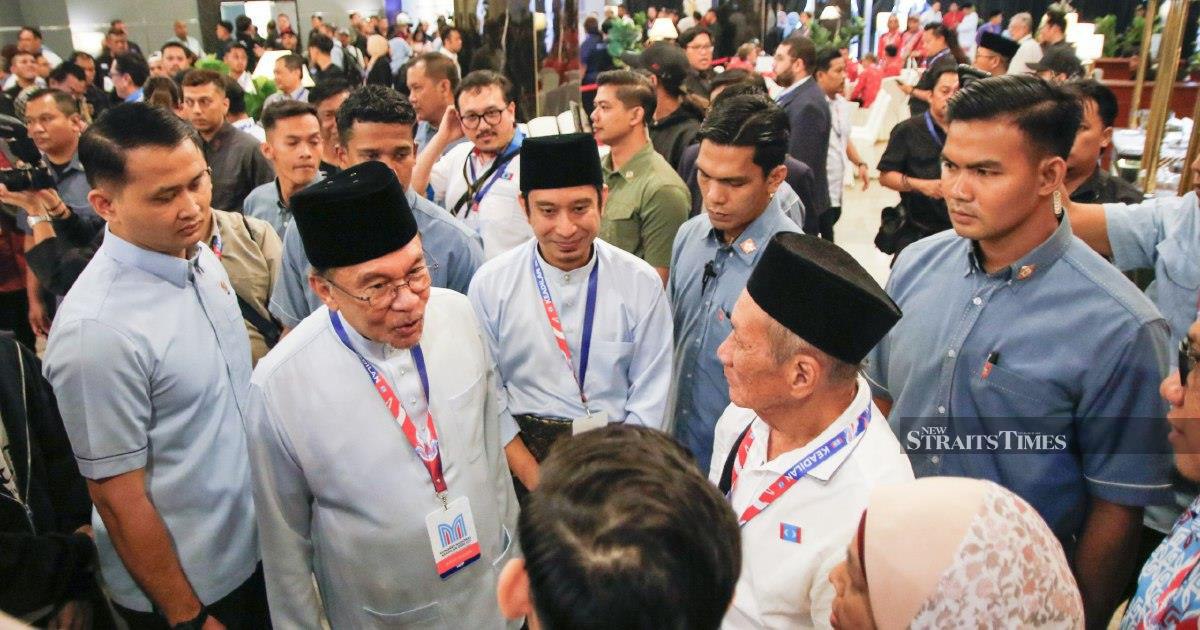
During a visit to Ayer Keroh, Prime Minister Datuk Seri Anwar Ibrahim moved swiftly to quash rumours suggesting friction between himself and Deputy Prime Minister Datuk Seri Dr Ahmad Zahid Hamidi, publicly declaring that their professional relationship has not deteriorated. The statement represents an attempt to project unity and stability within the federal government's top leadership tier, especially as Malaysia navigates complex economic and political challenges that require cohesive cabinet-level coordination.
Anwar's remarks come against a backdrop of occasional speculation within political circles about potential tensions between coalition partners, a not uncommon occurrence in multi-party governing arrangements. The Prime Minister's explicit confirmation that national-level ties with the Deputy PM remain in good standing signals an intent to suppress any narrative that might undermine confidence in the administration's internal stability. Such public reassurances serve an important signalling function to investors, the civil service, and the broader Malaysian public that decision-making structures remain intact and functional.
The coalition government, which comprises parties representing diverse political constituencies and ideological positions, has generally maintained operational unity despite inherent strains that arise from power-sharing arrangements. Anwar's intervention to clarify the state of affairs between the two most senior executive officers demonstrates an understanding that perceptions of leadership discord can translate into practical governance challenges, ranging from delayed policy implementation to reduced legislative effectiveness in parliament.
For Malaysian stakeholders observing the political landscape, such reassurances carry particular weight given the nation's recent political volatility. The formation of stable cross-coalition partnerships required compromise and negotiation at multiple levels, and maintaining these arrangements depends substantially on visible goodwill between principal figures. The Prime Minister's comments thus represent an investment in preserving the architecture of consensus that has held the current government together since its formation.
Anwar's intervention also reflects the practical necessity of demonstrating that Malaysia's federal administration can manage internal differences without allowing them to metastasise into organisational dysfunction. Cabinet-level disagreements on policy or resource allocation remain inevitable features of any plural government, but their containment and resolution through established channels—rather than public dispute—reinforces institutional credibility. By explicitly addressing the matter at a public forum rather than allowing speculation to fester, the Prime Minister attempted to reset the narrative around his relationship with his deputy.
The significance of maintaining visible coalition harmony extends beyond merely theatrical gestures of unity. Investors making long-term decisions about Malaysia's economic prospects factor in assessments of political stability and the reliability of policy frameworks. Economic advisers in multinational corporations and institutional fund managers closely monitor signals emanating from Malaysia's top leadership to gauge whether legislative priorities and reform agendas will proceed as announced or face obstruction from internal political tensions. Anwar's statement thus carries tangible implications for foreign and domestic investor confidence.
Within parliament, governing coalitions require consistent coordination to advance legislative programmes and respond to opposition challenges. If significant daylight emerged between the Prime Minister and Deputy PM on substantive policy matters or if their respective political bases began openly agitating for greater influence, the executive's capacity to implement its agenda could face material constraint. By publicly affirming strong working relations, Anwar reinforced the coalition's ability to maintain parliamentary discipline and legislative momentum on priority initiatives.
The rebuttal also speaks to managing diverse party interests within the coalition framework. Each component party brings distinct constituencies, supporter expectations, and policy preferences to the governing arrangement. Perceptions of unequal treatment or marginalisation of particular coalition members can generate friction that ultimately destabilises the entire arrangement. Anwar's willingness to explicitly address relationship concerns with a co-principal indicates awareness that such grievances, if allowed to accumulate without acknowledgment, can eventually trigger withdrawal or non-cooperation from coalition partners.
Observers of Malaysian politics recognise that coalition governments function optimally when their leaders invest visibly in maintaining personal and professional relationships that ground the institutional arrangements. Trust between Anwar and Zahid provides lubricant for the machinery of government, enabling faster resolution of disagreements and smoother execution of coordinated policy. The Prime Minister's remarks essentially affirmed that such trust remains operational, despite any particular disagreements that may arise on specific issues.
Looking forward, the sustainability of Malaysia's current political configuration will depend substantially on whether top-tier leaders continue demonstrating commitment to the coalition's viability. Anwar's statement at Ayer Keroh should be understood as a reaffirmation of that commitment and an attempt to anchor expectations among both coalition partners and the broader public that the government possesses the internal coherence necessary to deliver on its policy objectives and navigate the various challenges confronting the nation.

