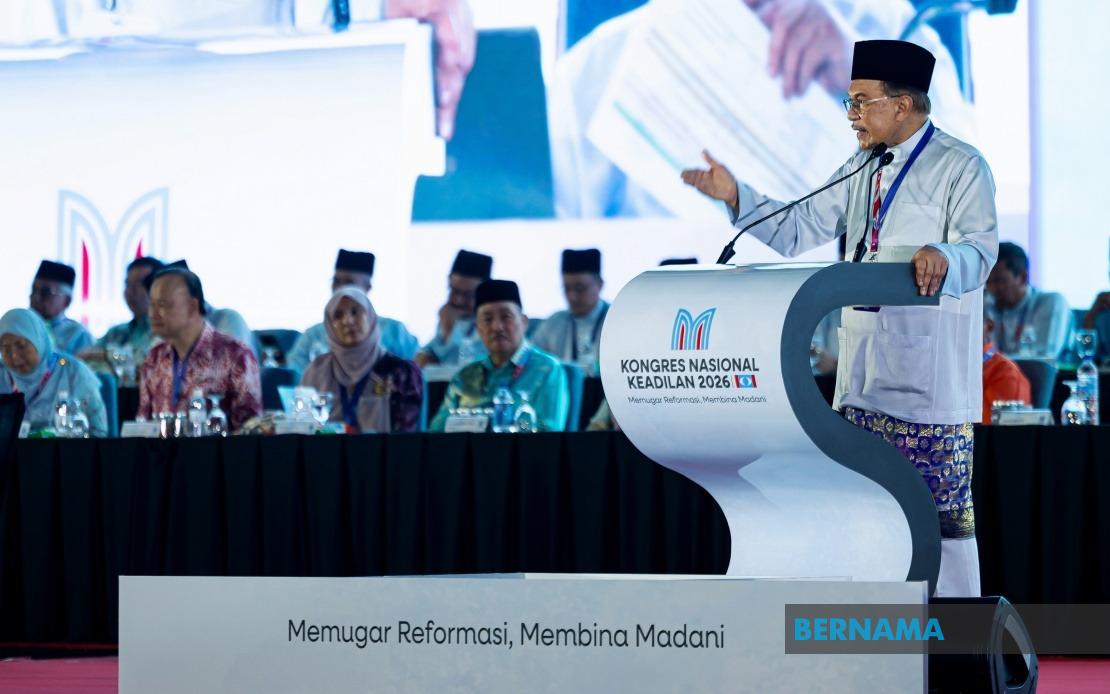
Prime Minister Datuk Seri Anwar Ibrahim has moved swiftly to defuse suggestions that his working relationship with Deputy Prime Minister Datuk Seri Dr Ahmad Zahid Hamidi has deteriorated, characterizing such claims as reflections of a confrontational mindset rather than accurate assessments of the partnership. Speaking to reporters at the 2026 PKR National Congress in Melaka on August 15, Anwar firmly rejected the narrative advanced by former Rembau Member of Parliament Khairy Jamaluddin, who had suggested trust between the two leaders had sunk to historic lows within the Unity Government framework.
The Prime Minister's response underscores a deeper philosophical divide he perceives between different political actors. Where Khairy, he suggested, tends to interpret Malaysian politics through a lens of inevitable conflict and competition, Anwar positions himself as an advocate for dialogue-driven solutions and collaborative governance. This distinction matters considerably for how the Unity Government navigates the complex landscape of multi-party coalition politics, where competing interests from Barisan Nasional and Pakatan Harapan must coexist while maintaining sufficient cohesion to govern effectively.
Anwar's public affirmation of his relationship with Ahmad Zahid carries particular weight given the formal acknowledgment he offered during his presidential address at the congress. The Prime Minister explicitly thanked Ahmad Zahid and UMNO for their instrumental role in facilitating the Unity Government's formation following the 15th General Election in 2022. This public expression of gratitude suggests that despite underlying tensions inherent in any cross-party coalition, the two leaders share a commitment to the institutional arrangements that have kept their unusual partnership intact for nearly three years.
Khairy's intervention the previous day had specifically pointed to a cooling relationship between Anwar and Ahmad Zahid, alleging that deepening tensions between BN and PH had created unprecedented strains. He attributed part of this deterioration to BN's decision to cooperate with Perikatan Nasional in the recent Negeri Sembilan state election, a move that appeared to signal BN's willingness to explore alternatives to the federal coalition arrangement. Such strategic maneuvering inevitably raises questions about the durability of partnerships formed out of immediate political necessity rather than ideological alignment.
For Malaysian political observers, the timing and content of these exchanges reveal fundamental realities about the Unity Government's precarious equilibrium. The coalition emerged not from a unified vision but from pragmatic calculations by three major political blocs—UMNO-led Barisan Nasional, Anwar's Pakatan Harapan, and subsequently accommodations with other parties—all seeking to prevent Perikatan Nasional from returning to federal power. This transactional foundation means that periodic tensions and public disagreements should perhaps be expected rather than surprising.
Anwar's insistence that differences between coalition partners can be resolved through discussion and peaceful approaches reflects the management strategy that has sustained the government through various crises since 2022. The Prime Minister appears to view his preferred approach—dialogue and consensus-building—as inherently superior to more confrontational posturing, positioning himself as the adult in the room willing to look past individual grievances for the sake of broader institutional stability. Whether this framing accurately reflects Khairy's intentions or represents a more generous interpretation remains debatable.
The substance of Anwar's response matters less than what it reveals about the government's current vulnerabilities. If prominent figures like Khairy feel emboldened to publicly declare that trust between the PM and Deputy PM has hit record lows, this suggests either genuine deterioration in their working relationship or, alternatively, a perception problem that the coalition has failed to adequately manage. For the stability of Malaysian governance, both scenarios present challenges. The first threatens functional paralysis at the highest levels; the second indicates a communications crisis where public perception no longer aligns with political reality.
Southeast Asian governments operate within regional contexts where political stability directly impacts investor confidence, currency valuations, and foreign relations. Malaysia's Unity Government, despite its inherent contradictions, has provided sufficient stability for economic policy continuity and maintained regional diplomatic engagement. Public doubts about whether the Prime Minister and Deputy Prime Minister genuinely trust one another inevitably ripple outward, affecting how international partners assess Malaysia's reliability and forward trajectory. This broader context makes Anwar's public reassurances more than merely internal party management; they carry strategic implications for the nation's external standing.
The philosophical difference Anwar identifies—between seeing politics through conflict versus seeking peaceful resolution—also hints at differing visions for Malaysia's political future. Khairy's interventions suggest a belief that the current coalition arrangement may be temporary and that positioning for eventual realignment remains strategically prudent. Anwar's emphasis on dialogue and cooperation implies a longer-term commitment to making the Unity Government function despite its internal strains. These competing visions will likely continue shaping political dynamics as the government approaches mid-term challenges and positions itself for future electoral contests.
Looking ahead, the frequency with which such reassurances become necessary will serve as a useful barometer for the coalition's genuine health. If Anwar finds himself repeatedly denying reports of rifts with Ahmad Zahid, observers may rightfully conclude that underlying instability has become a defining characteristic of his administration. Conversely, if these declarations prove sufficient to quiet speculation, it would suggest that the government retains enough resilience and trust among its core stakeholders to weather periodic public criticism and maintain its institutional commitments through the remainder of its constitutional term.

