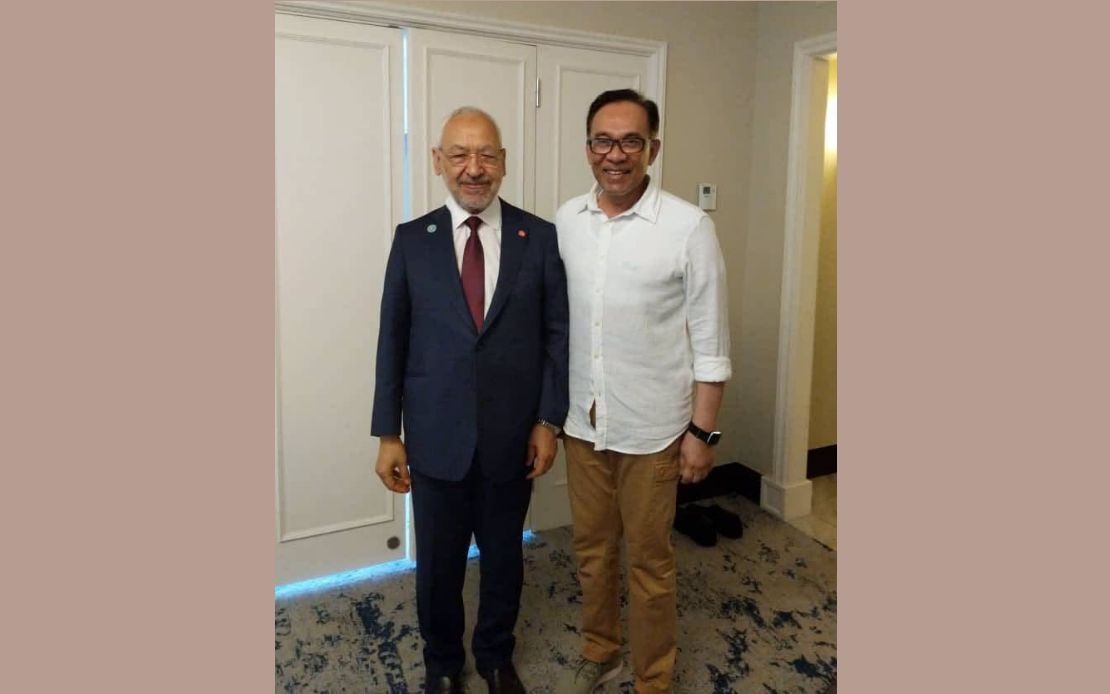
Prime Minister Datuk Seri Anwar Ibrahim has made a personal diplomatic appeal to Tunisian President Kais Saied, requesting consideration for the release of prominent Islamist politician Sheikh Rached Ghannouchi on compassionate grounds. The Malaysian leader sent a formal letter to Tunisia's leadership expressing serious concern about the health status of the 84-year-old detainee, whom Anwar describes as a longstanding friend. The intervention represents a notable instance of Malaysia's premier engaging in quiet diplomacy on behalf of a regional political figure facing prolonged detention.
Ghannouchi, who founded and led Tunisia's Ennahda movement—a major Islamist party that played a central role in the country's democratic transition after 2011—has remained imprisoned despite international calls for his release. The aging politician's health deterioration in custody has become an increasingly acute concern for observers tracking his situation. His detention is part of broader tensions in Tunisia following President Saied's consolidation of power, which included the dissolution of parliament in 2021 and subsequent crackdowns on political opponents and Islamist figures deemed a threat to national stability.
Anwar's letter emphasises a framework of universal humanitarian principles rather than political calculation. In his statement to media, the Prime Minister explicitly framed the appeal around compassion, mercy, and human dignity—values he positioned as transcending national boundaries and legal jurisdictions. This rhetorical approach allows Malaysia to advocate for Ghannouchi without directly challenging Tunisia's judicial sovereignty or appearing to meddle in the North African nation's internal affairs. The distinction matters considerably in diplomatic circles, where framing determines whether an intervention registers as constructive engagement or inappropriate interference.
The Malaysian leader was careful to affirm full respect for Tunisia's legal processes and constitutional authority while simultaneously arguing that humanitarian considerations ought to weigh in any decision regarding Ghannouchi's continued detention. This balanced positioning reflects Malaysia's broader diplomatic strategy of maintaining relationships across the Muslim world while advocating selectively for causes aligned with Anwar's own political brand—one that emphasises democratic values, religious pluralism, and moderate Islamism. By coupling respect for Tunisia's sovereignty with appeals to human rights, Anwar attempts to occupy a middle ground acceptable to diverse international audiences.
The appeal carries particular significance given Malaysia's own complex relationship with Islamist politics. Anwar's trajectory from imprisoned opposition leader to sitting Prime Minister—a journey that included a conviction for sodomy that many observers attributed to political persecution—shapes his standing to advocate for the rights of detained political figures. His government has positioned itself as guardian of democratic norms and protector of minorities, lending credibility to humanitarian appeals that might seem hypocritical from other quarters. This personal history also explains why Ghannouchi's case resonates with Malaysia's leadership; the parallel experiences of politically motivated detention create natural affinity.
Ghannouchi's detention has attracted growing international concern, particularly from civil society organisations and human rights groups monitoring Tunisia's democratic backsliding. Since President Saied's 2021 power consolidation, Tunisia has witnessed a troubling pattern of arbitrary arrests, media restrictions, and legal proceedings against opponents that critics argue fall short of due process standards. Ghannouchi faces multiple charges related to alleged security threats and terrorism financing—allegations his supporters dismiss as pretextual. The extended detention of an octogenarian with documented health problems has become emblematic of these broader concerns about Tunisia's judicial system.
The intervention also reflects Malaysia's position as a significant voice within Islamic and Non-Aligned Movement circles. As a Muslim-majority nation with diplomatic weight in regional forums, Malaysia's appeal for Ghannouchi carries symbolic weight beyond its immediate humanitarian content. The message signals to other governments in the Muslim world that Malaysia's leadership takes seriously the protection of Islamic political figures, while simultaneously demonstrating commitment to universal human rights principles that transcend religious or ideological boundaries. This positioning helps Anwar project an image of principled leadership capable of defending vulnerable populations regardless of political affiliation.
The letter represents one of several instances where Anwar's government has engaged diplomatically on behalf of detained individuals from across the ideological spectrum. However, the Ghannouchi case holds particular poignancy given the subject's historical significance in Tunisia's democratic development. Ghannouchi led Ennahda through the party's evolution from underground movement to governing coalition partner to present opposition force, embodying the contradictions and challenges of political Islam in the modern Arab world. His continued detention under increasingly arbitrary conditions reflects Tunisia's departure from the constitutional framework he helped negotiate.
Tunisia's response to Anwar's appeal remains unclear, though the country's government has shown limited receptiveness to international pressure regarding high-profile detainees. President Saied's administration has bristled at external criticism, framing it as interference in Tunisia's domestic affairs and sovereign right to prosecute security threats. Nevertheless, accumulating diplomatic interventions from countries like Malaysia may eventually create sufficient international pressure to prompt reconsideration of cases like Ghannouchi's. The Malaysian appeal contributes to a growing chorus of concerned voices questioning both the appropriateness of Ghannouchi's continued detention and the erosion of democratic safeguards in Tunisia.
For Malaysia's regional standing, the appeal underscores Anwar's commitment to leveraging the country's diplomatic influence on behalf of causes aligned with his vision of progressive Islamic governance and democratic accountability. The intervention carries domestic political dimensions as well, signalling to Malaysia's own Muslim constituencies that their Prime Minister remains attentive to the fates of significant Islamic figures facing persecution elsewhere. As regional powers increasingly compete for influence and standing within Muslim-majority societies, such diplomatic gestures carry weight beyond their immediate humanitarian content, positioning Malaysia as a principled advocate for vulnerable populations regardless of geopolitical convenience.

