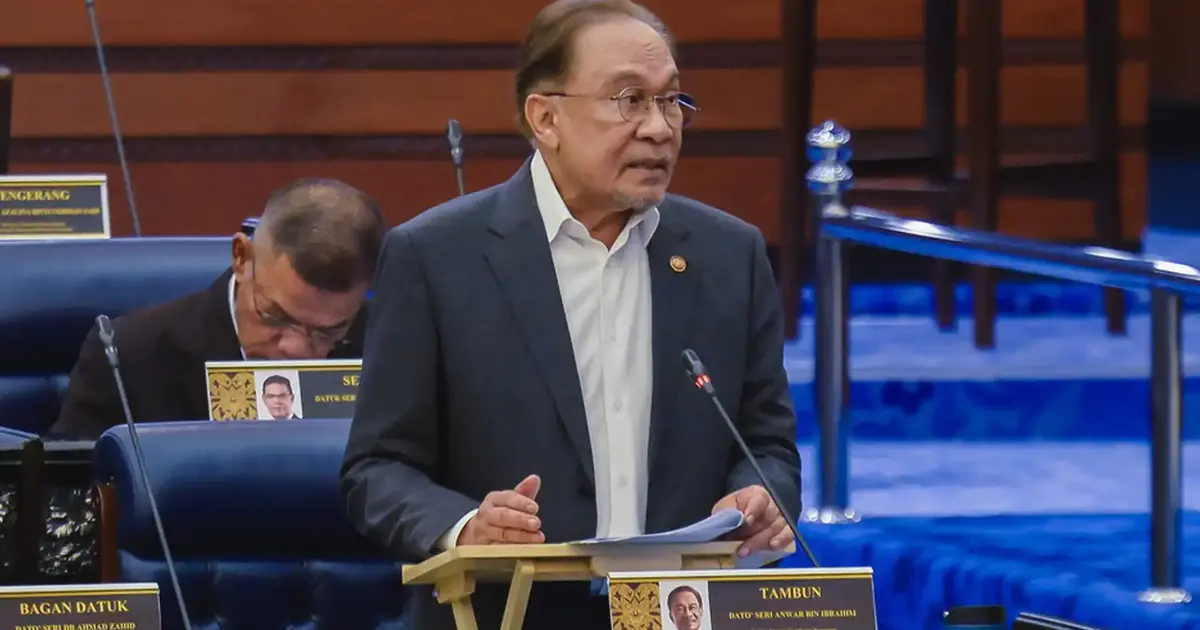
Prime Minister Anwar Ibrahim has drawn a clear line on federal finances, declaring that Putrajaya will not absorb cost escalations stemming from decisions made at the state level without formal renegotiation. The pronouncement reflects a hardening stance on intergovernmental fiscal accountability and signals that the federal administration intends to enforce stricter discipline on how public resources are allocated and justified across Malaysia's multi-layered governance structure.
Anwar's comments underscore a growing tension within Malaysia's federal system, where state governments have historically relied on supplementary central government support when projects exceed their initial budgets. By making this position explicit, the Prime Minister appears intent on reversing a pattern where the burden of managing expenditure overruns has defaulted to federal coffers, often without transparent scrutiny or proper project planning at the source. The shift represents part of a broader fiscal consolidation effort by his administration, which has repeatedly stressed the need to stabilise Malaysia's debt trajectory and improve the efficiency of public spending.
The timing of this declaration carries significance for several state administrations that have faced rising construction costs, inflation, and supply chain disruptions in recent years. Projects initiated during previous economic cycles may have been budgeted at rates that no longer reflect current market conditions, creating genuine pressure on state treasuries. However, Anwar's stance makes clear that pleading unforeseen cost inflation will no longer automatically trigger federal support. Instead, states will be required to enter into formal renegotiations with Putrajaya, a process that implicitly demands they present revised proposals, justify cost increases, and demonstrate improved project governance.
For Malaysian readers, this policy shift has practical implications that extend beyond boardroom negotiations. When state projects face funding gaps, the resulting delays or scaling-back of services—whether roads, schools, or water infrastructure—ultimately affect the communities those projects are meant to serve. Anwar's insistence on renegotiation rather than automatic supplementation effectively places the onus on state administrations to improve planning, risk management, and cost estimation from the outset. It also introduces an element of accountability that many observers argue has been lacking in how state-level capital projects are managed and monitored.
The Prime Minister's position reflects international best practices in public financial management, where the entity responsible for a project's conception and approval typically bears primary responsibility for its successful execution within budget. However, in Malaysia's federal context, this principle has not always been strictly observed, particularly when politically significant projects face financial difficulties. Anwar's intervention suggests a desire to establish clearer demarcation lines between federal and state budgetary responsibilities, reducing the moral hazard that arises when states expect the centre to resolve their fiscal mismanagement.
From the perspective of federal treasury management, the policy addresses a real problem. When state governments know they can rely on additional federal funding if costs balloon, there is less incentive to conduct rigorous cost-benefit analyses, build adequate contingencies into budgets, or monitor expenditure carefully during implementation. By requiring renegotiation, the federal government introduces friction into the process—states must formally justify why more money is needed, undergo scrutiny, and potentially accept revised project scopes if full funding is deemed unjustifiable. This approach aligns with efforts by the Ministry of Finance to improve the quality of public investment across all levels of government.
The statement also has implications for how Malaysia's regional states view their fiscal autonomy. While states possess constitutional powers to initiate development projects within their territories, those powers exist within a financial ecosystem where federal transfers constitute a substantial revenue source. By conditioning additional support on explicit renegotiation, the federal centre reasserts its role as guardian of national fiscal stability. This balance between state autonomy and federal oversight is delicate; push too hard in either direction and either states become underfunded relative to their responsibilities, or the centre loses control over aggregate public spending.
Anwar's insistence on renegotiation also serves a preventive function. When project planners know that federal backstopping is not assured, they have stronger incentives to request appropriately sized initial allocations. The requirement to return to the bargaining table with revised figures introduces a signalling mechanism—projects that cannot be justified to federal scrutineers despite cost increases may genuinely lack sufficient merit to proceed. Over time, this filtering mechanism should improve the quality of state-level capital investment by discouraging marginal or poorly-designed projects from advancing to stages where they consume scarce public resources.
For Southeast Asian readers observing Malaysia's governance evolution, this move reflects a broader regional trend toward fiscal discipline and institutional strengthening following pandemic-related borrowing surges. Many nations in the region have faced pressure to stabilise debt-to-GDP ratios and improve the productivity of public spending. Anwar's stance places Malaysia alongside governments that are reassessing intergovernmental transfer arrangements and demanding greater accountability from sub-national authorities. It also suggests that the federal government views improved project management and realistic budgeting as critical to addressing Malaysia's medium-term fiscal challenges.
The practical enforcement of this policy will be crucial in determining its actual impact. If the federal government indeed resists requests for supplementary funding without renegotiation, state administrations will face genuine pressure to improve their planning capabilities, risk assessment protocols, and project oversight mechanisms. Conversely, if exceptions are granted for politically influential projects or states, the policy will be perceived as performative rather than substantive. The coming months and years will test whether Anwar's firm pronouncement translates into consistent implementation across all state governments, regardless of their political alignment with the federal administration.

