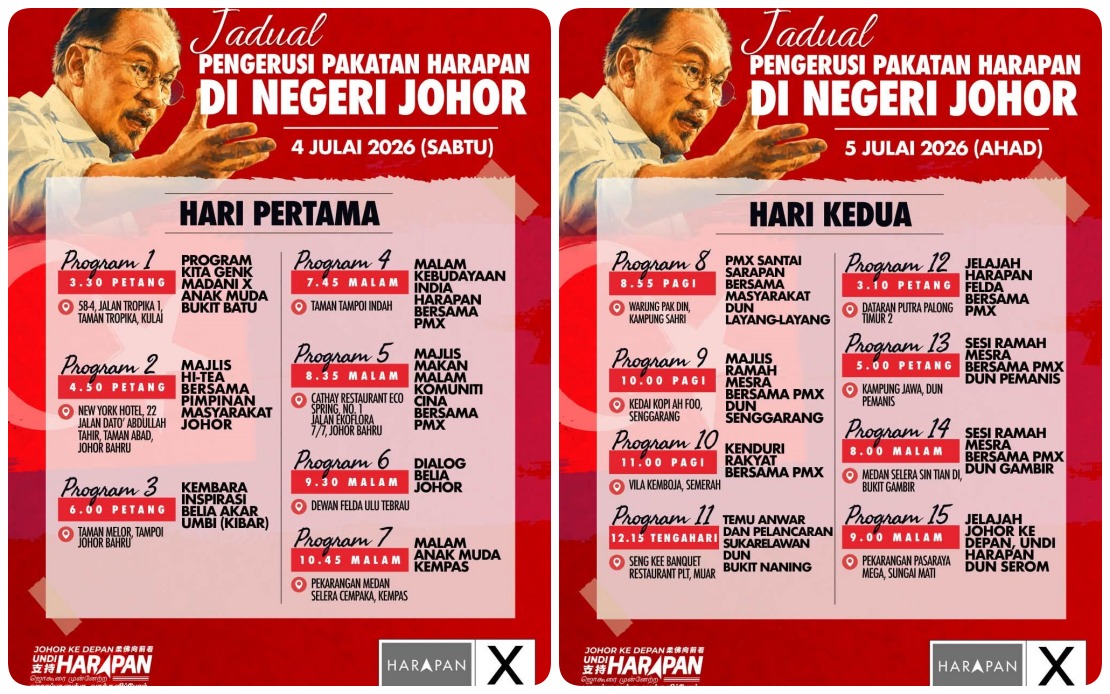
Prime Minister Datuk Seri Anwar Ibrahim is mounting an intensive campaign day in Johor with seven separate programmes designed to mobilise support for Pakatan Harapan (PH) ahead of the state election scheduled for July 11. The ambitious itinerary signals the coalition's determination to energise its campaign machinery and consolidate voter backing across diverse constituencies in Malaysia's southern economic powerhouse.
Anwar's campaign strategy reflects the competitive nature of the upcoming poll, with 172 candidates in total vying for 56 state assembly seats. The PH coalition, which currently controls the Johor state government, faces pressure to demonstrate voter confidence through a visible and dynamic campaign presence. By personally undertaking multiple engagements in a single day, the Prime Minister is sending a clear message about the national government's commitment to the contest.
The morning portion of Anwar's schedule will begin with direct voter engagement, a campaign element designed to connect with ordinary constituents and address their concerns face-to-face. This grassroots component remains crucial in Malaysian electoral politics, where personal connections between politicians and voters significantly influence voting behaviour. The session allows the Prime Minister to showcase accessibility and genuine interest in community issues beyond scripted political messaging.
In the afternoon, Anwar will host a high tea gathering with Johor community leaders at a hotel in Johor Bahru at 4.50 pm. This segment targets influential figures across various professional and social sectors whose endorsement carries weight among their respective networks. Community leaders—whether business figures, religious authorities, or civil society representatives—function as opinion-shapers within their communities, making their engagement strategically valuable for any political campaign seeking to broaden its appeal beyond core supporters.
The evening programming includes a youth dialogue session scheduled for 9.30 pm at the Felda Ulu Tebrau Hall, addressing what many analysts consider the most unpredictable and volatile voter segment in contemporary Malaysian politics. Young voters frequently surprise established parties with their electoral choices, and their participation rates continue to grow. By dedicating specific programming to youth engagement, PH is acknowledging their importance while attempting to address their specific concerns about economic opportunity, climate policy, and governance accountability.
PH is fielding candidates across all 56 contested seats, with the coalition's traditional structure reflected in the candidate distribution: PKR contributing 20 candidates, Amanah 19, and DAP 17. This balanced allocation reflects the coalition's ongoing efforts to maintain inter-party harmony while respecting each component party's electoral expectations. The distribution also signals confidence in the coalition's organisational capacity to contest comprehensively rather than selectively focusing resources on winnable seats.
Anwar's campaign momentum is scheduled to continue into the following day with eight additional programmes, demonstrating the intensive effort PH intends to invest in the final campaign period. The cumulative effect of 15 major campaign events across just two days underscores how closely the national government is monitoring the Johor contest and how significantly national leadership is willing to invest personal political capital in this particular state election.
The timing of this campaign intensity is strategically significant. Early voting is scheduled for July 7, with the general poll following on July 11, meaning Anwar's activities fall within the critical final week before voters head to polling stations. This timing maximises media coverage and voter attention while maintaining campaign momentum through to polling day. The concentration of high-profile events during this window is typical of Malaysian electoral strategy, where the final week frequently features the most visible and resource-intensive campaign activities.
For Pakatan Harapan, retaining control of Johor carries implications beyond the state level. Johor has historically served as a significant economic and political base, and state-level performance frequently influences perceptions of a coalition's overall governing competence. A strong showing strengthens the national government's mandate and provides political leverage for potential policy initiatives. Conversely, any electoral setback would provide opposition parties with ammunition to question PH's popular support and governing effectiveness.
The multi-demographic approach evident in Anwar's campaign schedule—encompassing general voters, community leaders, and youth specifically—reflects contemporary political campaign sophistication. Rather than assuming a uniform electorate with identical priorities, PH is segmenting its audience and tailoring messaging accordingly. This approach acknowledges that Johor's diverse population comprises constituencies with distinct concerns: traders worried about economic competitiveness, youth concerned about employment prospects, and community leaders focused on development and governance issues.
The competitive nature of this election cannot be understated. With 172 candidates contesting just 56 seats, each election district features multiple candidates from different parties competing intensely for voter support. This crowded field makes voter mobilisation campaigns particularly critical, as winning margins in some constituencies may prove narrow. The extensive campaign presence by the Prime Minister personally is designed to leverage his popularity and national profile to influence outcomes in closely contested districts where his intervention might prove decisive.
For Malaysia's broader political landscape, the Johor election serves as an important indicator of voter sentiment heading toward potential federal-level electoral contests. How Malaysian voters respond to PH's campaign messaging and governance record in Johor will provide valuable data about the coalition's electoral prospects and the effectiveness of its current political strategy. The resources being deployed suggest that party leadership views this election as consequential for establishing political momentum rather than merely defending an existing state government mandate.

