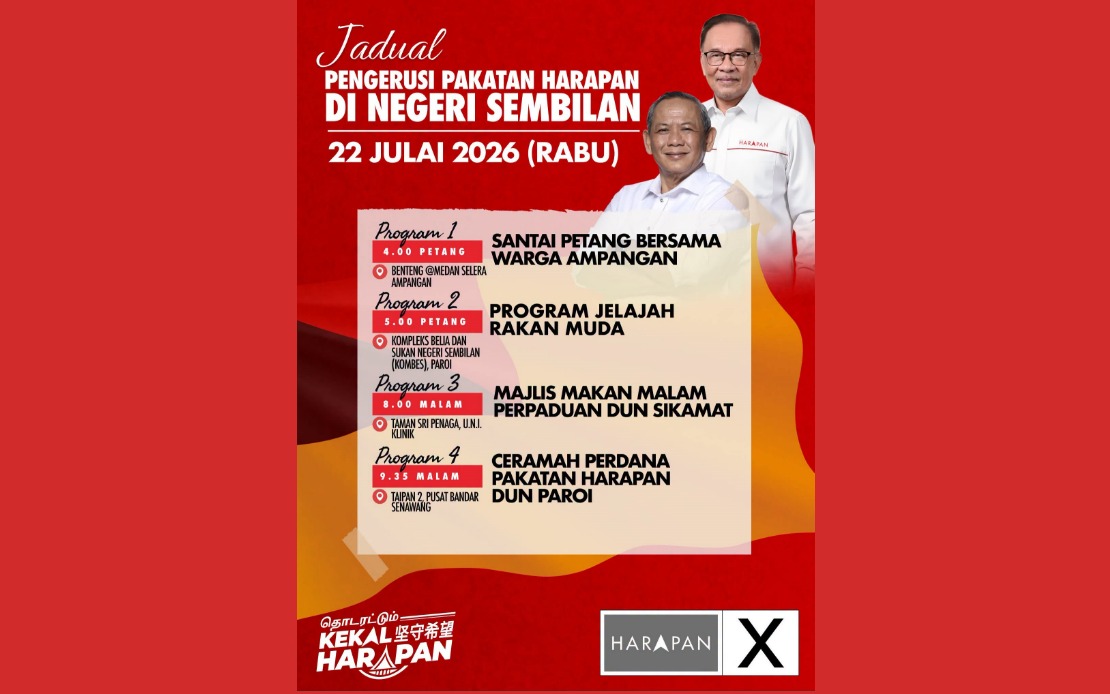
Prime Minister Datuk Seri Anwar Ibrahim is descending on Negeri Sembilan today with an ambitious campaign schedule designed to galvanise Pakatan Harapan's base and consolidate the ruling coalition's advantage ahead of the state election. The timing of his visit on the fifth day of campaigning signals the strategic importance the federal leadership places on retaining Negeri Sembilan, a state where PH currently holds power under Chief Minister Datuk Seri Aminuddin Harun.
Anwar's presence on the campaign trail represents a calculated deployment of the coalition's highest-profile asset in a critical moment. As both PH chairman and PKR president, his appearance carries symbolic weight beyond mere vote-counting; it underscores the national stakes of what might otherwise appear as a routine state election. The timing also reflects internal PH calculations about where the coalition faces its greatest vulnerability and where the heaviest political lifting needs to occur.
The Prime Minister has scheduled four distinct engagements across different constituencies, beginning at 4 pm with an informal community gathering in Ampangan at Benteng @ Medan Selera. This grassroots approach, dubbed 'Santai Petang Bersama Warga Ampangan', suggests PH is determined to move beyond formal podium politics and engage directly with ordinary voters. By rotating through Ampangan, Paroi, Sikamat and Senawang, Anwar is effectively covering critical demographic clusters across the state.
At 5 pm, Anwar will pivot to youth engagement at the Negeri Sembilan Youth and Sports Complex in Paroi, where he will participate in 'Jelajah Rakan Muda'. This focus on younger voters reflects PH's awareness that generational politics has become increasingly consequential in Malaysian elections. Young voters, particularly in semi-urban areas like those in Negeri Sembilan, represent a volatile electoral constituency that demands specific messaging and personal attention from national leadership.
The evening agenda intensifies with a unity dinner in the Sikamat constituency, followed by the headline event: a major PH rally at Pusat Bandar Senawang. These escalating events are choreographed to build momentum throughout the day, culminating in a high-energy gathering where Anwar can deliver the coalition's core campaign message to a large audience. The progression from informal to formal settings follows a well-established campaign playbook designed to maximise media coverage and grassroots enthusiasm.
PH's campaign messaging has crystallised around the manifesto unveiled on Monday, which articulates ten key commitments centred on developing Negeri Sembilan into a more prosperous and inclusive state. These pledges likely address bread-and-butter concerns—economic development, education, healthcare and infrastructure—that resonate across different voter demographics. By having Anwar personally reinforce these commitments, PH hopes to elevate them from mere policy proposals to personal guarantees from the nation's leader.
The coalition's electoral footprint in Negeri Sembilan reflects an all-out push to dominate the state. PH is contesting all 36 state assembly seats through a carefully calibrated power-sharing arrangement: 16 seats go to PKR, 11 to DAP and nine to Amanah. This distribution suggests internal negotiations that balance party interests while maintaining coalition unity. The decision to leave no seat uncontested demonstrates confidence, though it also signals that PH views this election as winnable and strategically important.
For Malaysian readers, the significance of this election extends beyond Negeri Sembilan's borders. The state has traditionally been a political bellwether; its electoral trajectory often foreshadows broader national sentiments. A strong PH performance would validate Anwar's leadership and strengthen his position within both the government and his coalition. Conversely, any loss of ground would embbolden opposition forces and raise questions about PH's electoral resilience heading toward the next general election.
The Electoral Commission's timeline is compressed: early voting occurs on July 28, with polling day on August 1. This short campaign window makes Anwar's personal intervention all the more critical. The coalition cannot rely solely on ground machinery or advertising; it requires visible, energetic leadership presence to cut through the noise and remind voters of PH's continued relevance and vitality. The multi-constituency tour is designed to generate news coverage that extends beyond Negeri Sembilan itself, feeding national narratives about PH momentum.
For Southeast Asian observers, Malaysia's state elections offer insights into how democratic politics function in a mature, competitive environment. Unlike some regional democracies where elections are foregone conclusions, Malaysian polls remain genuinely contested, with genuine uncertainties about outcomes. The mobilisation of the Prime Minister himself reflects democratic norms where electoral competition matters and voter choice is taken seriously by those in power.
The convergence of multiple PH components—PKR, DAP and Amanah—also demonstrates how coalition politics operate in practice. Rather than fragmenting into competing power bases, the three parties have negotiated a coordinated campaign and unified electoral strategy. This internal discipline, when visible to voters, can project an image of competence and unity that independent candidates or opposition parties struggle to match.
Anwar's willingness to spend an entire day in intensive campaigning also sends a message about accountability. Prime Ministers in democracies cannot simply govern from capital cities; they must periodically reconnect with voters in different regions, listen to local concerns and demonstrate that they take state-level politics seriously. This retail politics dimension, though it requires significant time and energy, remains essential for maintaining political legitimacy and popular connection.

