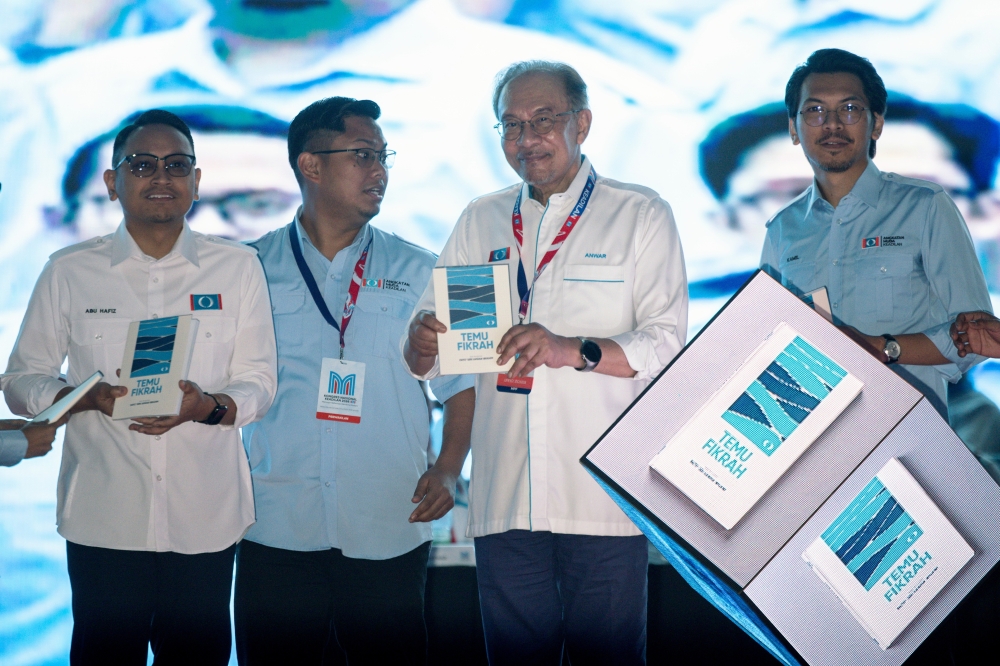
Prime Minister Datuk Seri Anwar Ibrahim formally introduced Temu Fikrah, an ambitious policy framework developed by PKR Youth, during a gathering in Melaka yesterday. The initiative represents a deliberate attempt by the ruling Parti Keadilan Rakyat to crystallise its ideological position around Madani governance—a concept that has become central to the coalition's governing narrative since its return to power in November 2022. By positioning Temu Fikrah as both manifesto and practical handbook, PKR Youth signals an intention to bridge the gap between visionary political ideals and ground-level implementation, acknowledging that governance requires both intellectual coherence and actionable frameworks.
The launch underscores a strategic priority within PKR's current trajectory: cultivating a younger generation of party members versed in contemporary progressive principles while remaining firmly anchored to Malaysia's constitutional and multicultural foundations. Madani governance, the administration's preferred governance philosophy, emphasizes inclusive development, democratic participation, and technological integration—concepts that resonate with younger demographics increasingly concerned about environmental sustainability, digital rights, and economic inequality. By entrusting PKR Youth with articulating this vision through Temu Fikrah, Anwar effectively delegates youth engagement to the party structure most capable of connecting with millennial and Gen-Z voters who remain sceptical of traditional politics.
The emphasis on "courage" within the manifesto carries particular weight in Malaysia's contemporary political landscape. Following the fall of the Pakatan Harapan government in 2020 and the subsequent complex coalition dynamics that preceded Anwar's appointment as Prime Minister, the opposition coalition has positioned itself as willing to take principled stands on accountability, reform, and institutional strengthening. Temu Fikrah's articulation of courage as a governing virtue subtly differentiates PKR's brand from competitor narratives and appeals to voters motivated by demands for transparent governance and reduced political opportunism. This framing becomes especially significant as the country approaches the next electoral cycle, where youth turnout could prove decisive in several urban-majority constituencies.
Creativity, the second pillar of Temu Fikrah, addresses Malaysia's persistent challenge of developing sustainable economic and social solutions in an increasingly complex global environment. The government has struggled with messaging around industrialisation, environmental protection, and technological adoption—domains where creative policy solutions are essential. By explicitly championing creativity as a governing principle, PKR Youth positions the party as forward-thinking rather than merely reactive, appealing to professionals in creative industries, technology sectors, and knowledge-based enterprises. This positioning also distinguishes PKR from more traditional or conservative political voices within Malaysia's broader establishment.
The Madani governance component of Temu Fikrah represents a continuation of the administration's efforts to build a coherent political ideology that transcends mere coalition management. Since taking office, Anwar has repeatedly invoked Madani as a unifying concept—one that promises development rooted in Islamic principles while remaining compatible with democratic governance and religious pluralism. By formally documenting this framework through PKR Youth's initiative, the government creates an institutional mechanism for transmitting these principles to future party members and sympathetic voters. The handbook function of Temu Fikrah transforms abstract governance philosophy into practical guidance, potentially influencing how party members approach constituency work, policy advocacy, and constituent services.
The timing of the launch in Melaka carries subtle geographical significance. The state has emerged as a battleground in recent electoral cycles, with shifting voter allegiances between ruling coalitions and opposition blocs. A Melaka event featuring the Prime Minister and PKR Youth leadership serves as both symbolic assertion of government commitment to the state and a demonstration of party vitality to local constituencies. The choice to combine a formal launch with grassroots engagement reflects recognition that such initiatives gain traction through distributed party networks rather than mere elite pronouncement. This approach acknowledges lessons from previous policy campaigns where top-down communication failed to generate sustained engagement.
From a Malaysian political economy perspective, Temu Fikrah emerges at a moment when the ruling coalition faces multiple pressures: managing inflation and cost-of-living anxieties, delivering on promised institutional reforms, and preventing fragmentation as partners within Pakatan Harapan navigate competing interests. By channelling youth energy toward articulating governing principles, PKR creates constructive internal engagement that may reduce factional tensions while building buy-in for broader government directions. Young party members invested in developing and promoting Temu Fikrah become stakeholders in government success, potentially strengthening party discipline and coherence.
Regionally, Malaysia's investment in formalised governance frameworks aligns with broader Southeast Asian trends toward institutionalising political philosophies. Thailand's Buddhist-inflected governance models, Indonesia's ongoing negotiation between Pancasila principles and democratic practice, and Vietnam's efforts to present ideological consistency all reflect recognition that modern governance requires explicit philosophical grounding. Temu Fikrah positions Malaysia within this regional conversation, suggesting a mature approach to political communication and institutional development.
The manifesto's focus on creativity and courage also implicitly addresses concerns about democratic erosion and innovation capacity. Across Southeast Asia, populist and authoritarian political movements have gained ground by promising simple solutions to complex problems. By contrast, PKR's emphasis on creative problem-solving and courageous decision-making appeals to voters preferring evidence-based, iterative approaches to governance. This intellectual positioning becomes increasingly important as Malaysian society becomes more educated and informationally sophisticated, with voters capable of distinguishing between shallow political theatre and substantive policy frameworks.
Moving forward, Temu Fikrah's success will depend on consistent implementation and visible promotion across PKR's sprawling party structure. The handbook format suggests recognition that written documentation helps standardise messaging and training, preventing the dilution that frequently afflicts political initiatives lacking clear operational blueprints. Whether constituencies and grassroots leaders actively engage with Temu Fikrah as a governing tool rather than ceremonial launch material will ultimately determine whether this initiative strengthens PKR's institutional capacity or remains a high-profile communication gesture. The coming months will reveal whether Madani governance translates from theoretical framework into observable improvements in service delivery, transparency, and constituent responsiveness that justify the ambitious claims underlying Temu Fikrah's development.

