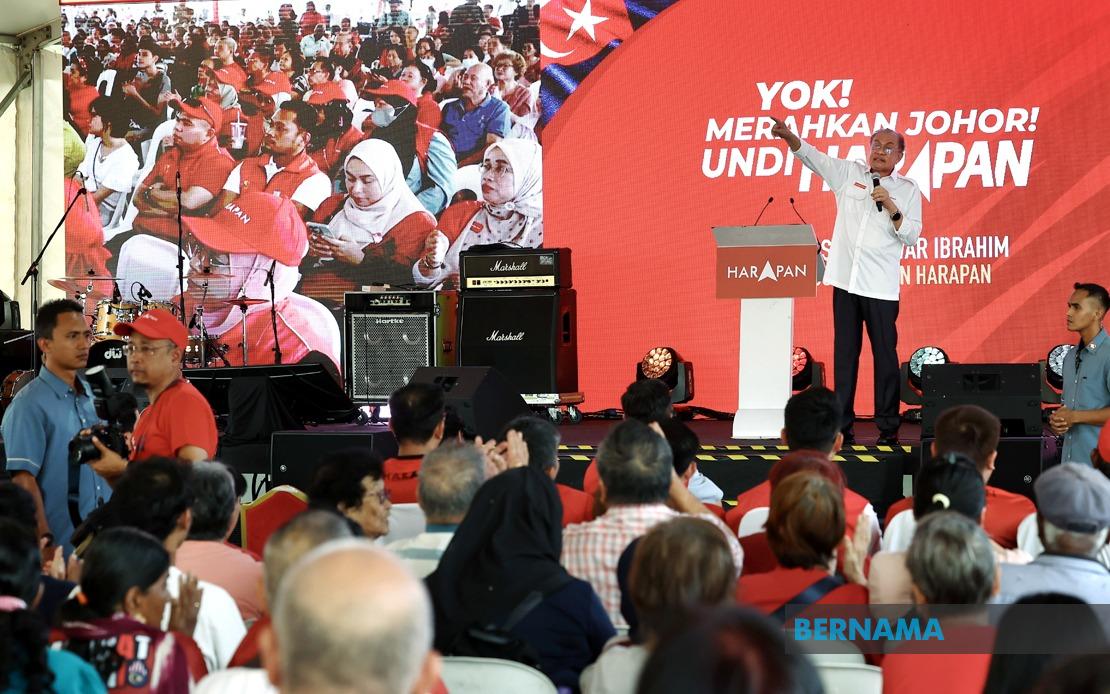
Prime Minister Datuk Seri Anwar Ibrahim has called upon all political parties vying for seats in the Johor state election to move beyond the contentious question of Datuk Seri Najib Razak's release, arguing that prolonging this debate serves no constructive purpose while the nation grapples with far more pressing challenges. Speaking at a campaign event in Kulai on July 10, Anwar stressed that with the former prime minister currently incarcerated, further politicisation of his detention only distracts from the real work of governance and resource allocation that voters should be evaluating their candidates on.
The Prime Minister's intervention reflects a strategic pivot within the government coalition's messaging as the Johor campaign intensifies. Rather than allowing opposition parties to dominate discourse around criminal justice and accountability—matters which remain deeply polarising across Malaysia's political landscape—Anwar has chosen to reframe the conversation around economic stewardship and social spending. His statement that "Datuk Najib is now in prison, so leave him alone" carries an implicit message to his own coalition members as well: that dwelling on the consequences of the previous administration's failures risks appearing vindictive rather than visionary.
Underscoring his position, Anwar drew attention to the RM51 billion in 1MDB-related debt that continues to burden the national budget and constrain public investment. This figure represents not merely a historical accounting of past misdeeds but an ongoing drain on resources that could otherwise fund essential services. The linkage Anwar drew between historical financial mismanagement and current budgetary constraints speaks to a fundamental challenge facing any government inheriting significant liabilities: the difficulty of simultaneously addressing inherited obligations while advancing new policy priorities.
The Prime Minister articulated a powerful counterfactual argument to voters, suggesting that without the necessity of servicing 1MDB debts, the government could allocate substantially more capital to schools, hospitals, roads, and social safety nets. This rhetorical framing attempts to transform abstract discussions about debt repayment into tangible calculations about foregone public goods. For Malaysian voters, particularly those in economically disadvantaged areas of Johor, this connection between past financial criminality and present constraints on public services represents a meaningful lens through which to evaluate political candidates and their platforms.
Anwar's remarks come at a delicate moment in Malaysian politics. The Johor state election serves as a significant electoral checkpoint for the ruling Pakatan Harapan coalition, which has faced mounting pressure from various quarters since taking federal office. The state itself has historically been a stronghold for UMNO and coalition partners, making the electoral contest particularly competitive. By attempting to elevate the conversation beyond personalised attacks and discussions of individual accountability, Anwar appears to be calculating that voters will reward a government focused on demonstrating competent economic management and visible delivery of public services.
Youth and Sports Minister Mohammed Taufiq Johari, Deputy Investment, Trade and Industry Minister Sim Tze Tzin, PKR Youth chief Muhammad Kamil Abdul Munim, and Pakatan Harapan candidate for Bukit Batu Arthur Chiong Sen Sern appeared alongside Anwar at the Yok! Merahkan Johor! Undi Harapan programme, symbolising unity within the coalition on messaging strategy. The presence of youth leadership figures suggests the government coalition recognises the importance of mobilising younger voters who may be less emotionally invested in the 1MDB scandal and more focused on employment opportunities, education access, and economic prospects.
The 1MDB scandal fundamentally reshaped Malaysian politics and contributed to the electoral defeat of Barisan Nasional in 2018. Its consequences continue to reverberate through Malaysian institutions, international relations, and public discourse on governance standards. Yet the scandal's resolution through judicial process has created a peculiar political dynamic: the facts are largely settled, the guilty have been convicted, yet the political implications remain contested. Opposition parties may continue invoking Najib's imprisonment as evidence of Pakatan Harapan's commitment to accountability, while the government seeks to demonstrate that commitment through substantive policy outcomes rather than relitigation of historical grievances.
Anwar's assertion that "enough is enough" suggests a government seeking to move beyond what it perceives as backward-looking political discourse. This stance carries risks: it could be interpreted as an attempt to suppress legitimate discussion of accountability mechanisms or as political calculation aimed at winning over voters whose sympathies may lie with Najib or who view his conviction through a factional lens. Conversely, it may resonate with voters fatigued by years of scandal-focused politics and yearning for campaigns centred on concrete proposals for economic growth and service delivery.
For Southeast Asian observers, Anwar's approach reflects broader tensions across the region regarding how newly reformist governments should relate to the criminal legacies of their predecessors. Whether such legacies should remain permanently salient political issues or gradually recede as new leaders establish their own track records represents an ongoing debate in post-authoritarian and post-corrupt transitions globally. Malaysia's particular challenge involves managing this transition while maintaining coalition cohesion and democratic legitimacy.
The strategic decision to sideline Najib-related discussions in campaign messaging reflects confidence—or perhaps calculation—that the government's record on specific policy deliverables will prove more persuasive to voters than extended engagement with questions of past wrongs. This approach demands that Anwar and his coalition demonstrate tangible improvements in areas voters directly experience: job creation, educational quality, healthcare access, and infrastructure development. The Johor election will provide an early test of whether this pivot successfully appeals to voters or whether opposing camps can maintain the salience of accountability questions regardless of government efforts to shift the conversation.
More broadly, Anwar's statement signals a government attempting to consolidate legitimacy through future-oriented governance rather than past-oriented accountability narratives. Whether this strategy proves electorally sound and politically sustainable will significantly influence how Malaysian politics evolves in coming years, particularly as the government faces mounting domestic and regional challenges requiring sustained policy focus and resource allocation.

