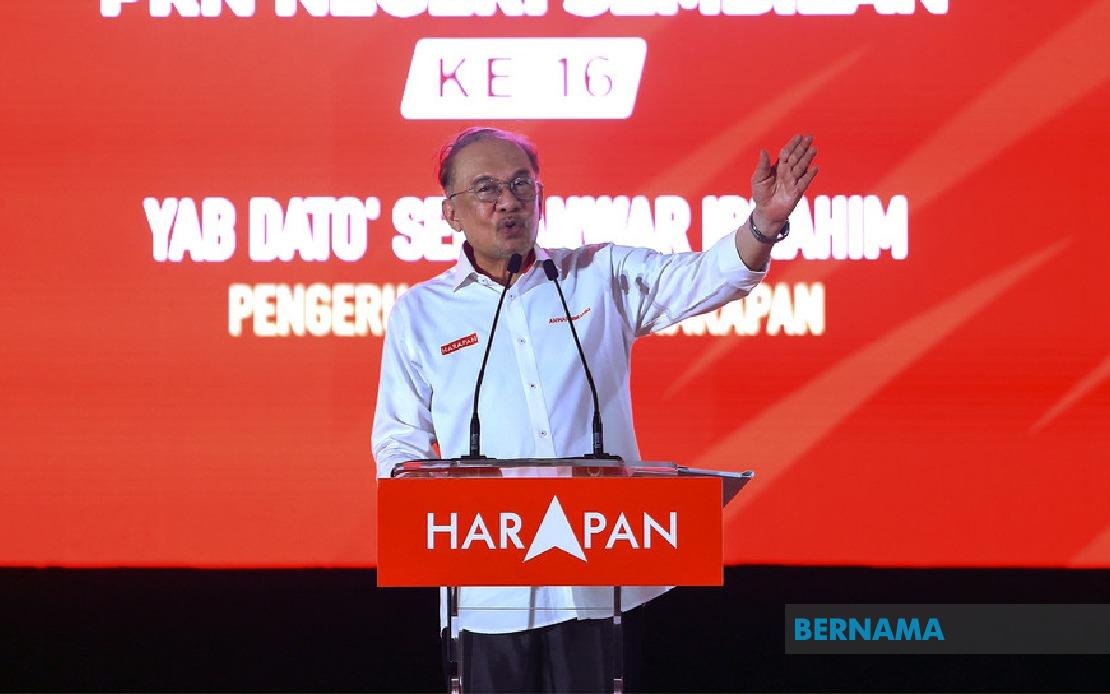
Prime Minister Datuk Seri Anwar Ibrahim has made a direct appeal to voters in Negeri Sembilan to maintain their support for Pakatan Harapan (PH) in the forthcoming state election, framing the choice as pivotal to sustaining the development trajectory the state has achieved in recent years. Speaking through a Facebook post ahead of the 16th Negeri Sembilan state election, Anwar, who holds the dual position of Prime Minister and PH chairman, emphasized that the relationship between the state administration and federal government has proven instrumental in bringing multiple development initiatives to fruition, though he acknowledged that the work remains incomplete.
The appeal comes as Negeri Sembilan prepares for a critical electoral moment. Nominations for the state election are scheduled for Saturday, with early voting opening on July 28 and polling day set for August 1. The timing of Anwar's intervention underscores the significance the federal PH leadership attaches to retaining control of the state, a consistent coalition stronghold that has remained under PH governance since the 2018 general election.
Central to Anwar's message is the performance of Menteri Besar Datuk Seri Aminuddin Harun, whom he characterized as having governed with integrity, humility, and strong accountability since 2018. By elevating Aminuddin's personal qualities alongside his administrative record, Anwar sought to position the Menteri Besar as a trusted custodian of public resources and state development agenda. This personalized endorsement reflects a broader PH strategy of anchoring voter confidence in individual leadership credibility rather than relying solely on party machinery or institutional arguments.
The development narrative that Anwar constructed carries particular weight in Negeri Sembilan's electoral context. The state, while relatively smaller than Selangor or Johor, has experienced visible infrastructure projects and economic initiatives in recent years. By characterizing further development as contingent upon PH's continued mandate, Anwar tapped into voter expectations of tangible progress and service delivery—concerns that resonate across Malaysian state elections regardless of geographic or demographic differences.
However, Anwar's framing also reveals the challenges confronting the coalition. The phrase "do not let the progress we have built together come to a halt halfway" suggests an implicit acknowledgment that voter momentum may have shifted or that complacency poses a genuine threat. This defensive posture, couched in aspirational language, reflects the competitive electoral environment in which PH now operates. Unlike the heady optimism of 2018, when PH swept to power nationally on the back of voter desire for change, subsequent elections have demonstrated that maintaining electoral dominance requires sustained effort and continued delivery.
The coalition's emphasis on administrative cleanliness and stability also indicates where PH believes it holds comparative advantage over political opponents. In an era when governance probity and institutional reliability have become contested terrain across Malaysian politics, PH has consistently marketed itself as the custodian of institutional reform and anti-corruption values. Negeri Sembilan, under Aminuddin's watch, has not been embroiled in the high-profile governance scandals that have affected other states, allowing this narrative to retain credibility.
From a broader Southeast Asian perspective, the Negeri Sembilan election carries implications for Malaysia's democratic health and coalition politics. The election will test whether PH can sustain voter loyalty in a state where the opposition has mounted serious competitive challenges in recent electoral cycles. A strong PH performance would validate the coalition's continued viability as a governing force, while a diminished mandate could signal shifting voter preferences or organizational weakness that could ripple through to the next general election cycle.
The coordination between federal and state governments that Anwar highlighted reflects the increasingly integrated nature of Malaysian governance, where development funding flows through multiple channels and regulatory authority spans both administrative levels. This interdependence means that state elections no longer function as purely local affairs but instead become referendums on national government performance as perceived through the lens of local constituency interests. Negeri Sembilan voters, in deciding whether to return PH, will effectively be casting judgment on both the state administration and the Anwar-led federal government's overall trajectory.
Looking ahead, the election result will also shape the political landscape heading toward the next general election. A loss in Negeri Sembilan would not only diminish PH's state-level footprint but could generate momentum for opposition parties and undermine the narrative of PH as an ascendant political force. Conversely, a decisive victory would bolster Anwar's standing within the coalition and reinforce his ability to mobilize PH machinery at critical electoral moments. The Prime Minister's personal intervention through social media, therefore, represents not merely a courtesy to a ruling state coalition but a strategic investment in broader political positioning.
The developmental and administrative arguments that Anwar deployed reflect the evolution of electoral competition in Malaysia, where policy performance and governance capacity have become increasingly salient voter concerns. This shift away from purely identity-based or patronage-oriented appeals suggests a maturation of electoral discourse, though the degree to which such arguments actually sway voters remains an open empirical question that the August 1 results will help clarify.

