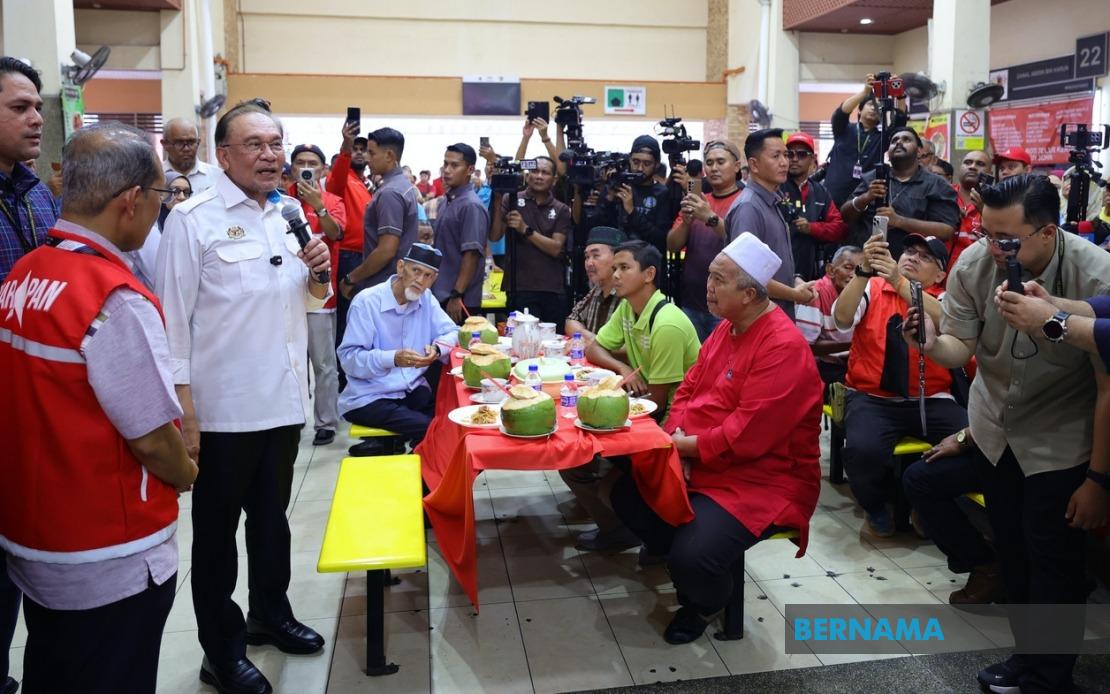
Prime Minister Datuk Seri Anwar Ibrahim travelled to Seremban on July 22 to rally support for Pakatan Harapan ahead of the Negeri Sembilan state election, making a direct appeal to voters to sustain the coalition's grip on power by renewing its parliamentary mandate. Speaking as both head of government and chairman of the bloc, Anwar framed the upcoming August 1 polls as a referendum on continuity, positioning political cohesion as the cornerstone of effective state governance and equitable resource distribution.
Anwar's campaign message hinged on the symbiotic relationship between state and federal administrations. He contended that a robust electoral outcome for Pakatan Harapan would facilitate seamless coordination between Kuala Lumpur and Seremban, streamlining the implementation of infrastructure projects and social programmes across Negeri Sembilan. This argument reflects a broader coalition strategy to emphasise institutional alignment as a prerequisite for tangible improvements in citizens' daily lives, particularly in a state that has historically occupied a middle position in Malaysia's development hierarchy.
The Prime Minister singled out Menteri Besar Datuk Seri Aminuddin Harun for praise, crediting three years of collaborative governance under the Pakatan Harapan banner with sustaining Negeri Sembilan's political equilibrium. Anwar's endorsement of the incumbent chief minister underscored the coalition's investment in retaining control of the state assembly, where internal fractures could have emerged had opposition forces capitalised on governance missteps. By framing stability as a shared achievement across multiple political stakeholders, Anwar attempted to inoculate the coalition against accusations of partisan governance.
However, Anwar's comments also contained an implicit acknowledgement of administrative imperfection. The Prime Minister conceded that Negeri Sembilan's state government had not executed flawlessly over the preceding three years, signalling to voters that room for refinement existed within the current dispensation. This measured candour served a dual purpose: it allowed the coalition to maintain credibility by avoiding blanket self-congratulation, whilst simultaneously requesting continued voter forbearance as Pakatan Harapan pursued incremental improvements. Such framing attempted to counter any narrative suggesting that the state's development trajectory had stalled or deteriorated.
Anwar's campaign strategy extended to direct engagement with the electorate, encouraging citizens to provide constructive criticism that would shape future policy adjustments. By positioning feedback mechanisms as integral to governance, the Prime Minister sought to cultivate a sense of participatory partnership between government and governed, potentially addressing voter frustration that might otherwise materialise as defection to opposition benches. This rhetorical move positioned Pakatan Harapan as a responsive entity capable of adaptation, a crucial framing for a coalition that has faced accusations of complacency in other constituencies.
The Negeri Sembilan state election represents a significant test of Pakatan Harapan's electoral durability outside peninsular strongholds and reflects broader questions about the coalition's resilience in retaining support across diverse socioeconomic and demographic cohorts. With polling scheduled for August 1 and early voting set for July 28, the 36-seat state assembly presents a concentrated arena for measuring voter sentiment regarding federal leadership's performance. The composition of Pakatan Harapan's candidate slate—16 from PKR, 11 from DAP, and nine from Amanah—indicates the coalition's internal power calculations and its geographic prioritisation within Negeri Sembilan's electoral landscape.
For Malaysian voters in other states observing developments in Negeri Sembilan, the election carries implications beyond the state's immediate boundaries. Results will signal whether Pakatan Harapan has successfully consolidated support amongst constituencies concerned about infrastructure investment, fiscal management, and interethnic governance, or whether residual dissatisfaction with aspects of federal policy has begun eroding the coalition's reach into state-level politics. A decisive victory would bolster Anwar's assertion that political stability drives prosperity, whilst a narrowed margin or unexpected setbacks would invite scrutiny of whether the coalition's national narrative translates effectively into localised policy outcomes.
Anwar's campaign itinerary, encompassing multiple Negeri Sembilan venues, reflects the coalition's recognition that Seremban alone cannot secure victory; the surrounding districts, including those with different demographic profiles and development needs, require targeted messaging. The bifurcated governance structure—whereby state-level policies must align with federal frameworks—means that Negeri Sembilan voters are simultaneously evaluating both incumbent state leadership and the broader competence of Anwar's federal administration. This compounded assessment increases stakes for Pakatan Harapan, as dissatisfaction with either tier of government could translate into consolidated opposition support.
The strategic emphasis on political stability reflects a calculated choice by Pakatan Harapan to prioritise predictability and institutional continuity over transformative change narratives. Whilst opposition coalitions may highlight unfulfilled reform promises or demand accelerated policy innovation, the government's campaign in Negeri Sembilan pivots towards risk mitigation—framing an alternative outcome as destabilising and disruptive. This positioning assumes voter preferences for incremental progress over potential upheaval, an assumption that holds particular weight in states like Negeri Sembilan, where economic prosperity has historically rested on moderate diversification and measured development rather than dramatic sectoral transformation.
As the election approaches, Anwar's messaging will continue filtering through state-level channels, amplified by party apparatus and local representatives who contextualise national talking points within Negeri Sembilan's specific governance challenges. The convergence of federal and state electoral calculations means that outcomes in August will reverberate through Malaysian politics more broadly, informing analyses of whether Pakatan Harapan can sustain electoral vitality beyond 2022's foundational transition and whether voters across different state constituencies maintain confidence in the coalition's ability to deliver tangible improvements in living standards and service delivery.

