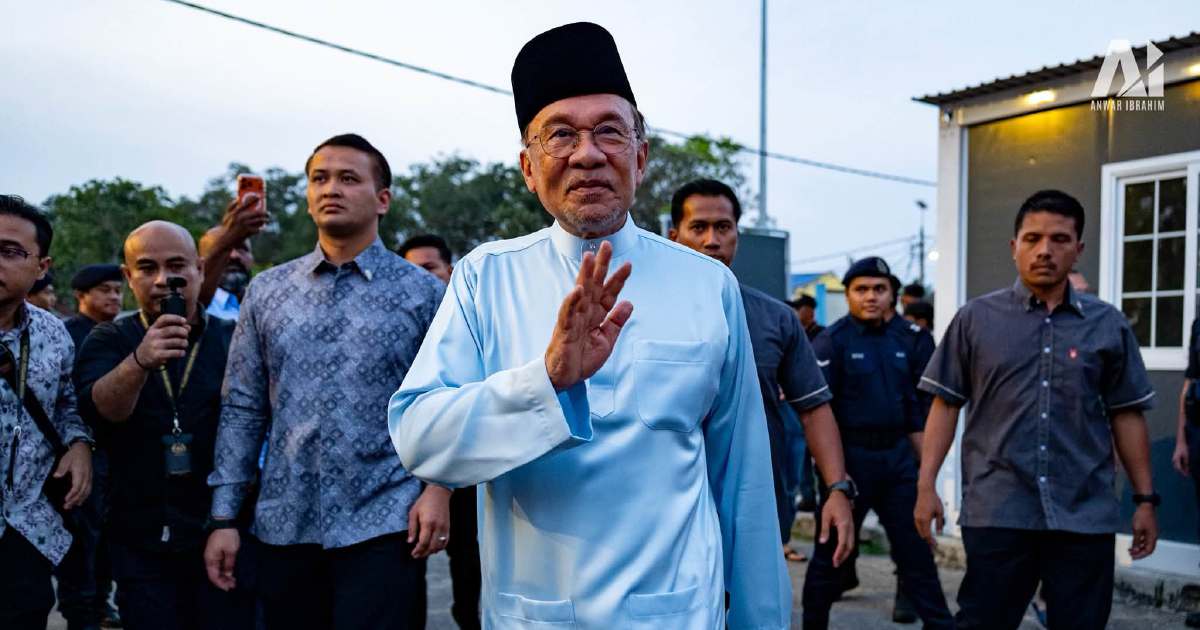
Prime Minister Datuk Seri Anwar Ibrahim made a final push for electoral support in Negri Sembilan as campaigning for the state election entered its closing phase, urging voters to set aside partisan divisions and grant the unity government a fresh mandate. The Pakatan Harapan chairman's appeal came as the coalition faced the critical test of maintaining its political grip on the state ahead of polling day.
Anwar's closing campaign message centred on the theme of continuity and stability, emphasising that the unity government required voter endorsement to pursue its development agenda without interruption. This framing suggests an awareness that consolidating control over Negri Sembilan would provide crucial momentum for federal coalition politics, especially at a time when Malaysia's political landscape remains fractionalised and outcomes in state-level contests significantly influence broader power dynamics.
The timing of Anwar's intervention in Negri Sembilan reflects the strategic importance the federal leadership places on the outcome. State elections often serve as barometers of public sentiment toward the central government, and losses or narrow victories can embolden opposition forces while narrow wins can provide political legitimacy for unpopular policy decisions. For Pakatan Harapan, maintaining control of Negri Sembilan carries symbolic weight beyond the state's economic or demographic significance.
Anwar's specific call for voters to set aside political differences suggests recognition that Negri Sembilan, like many Malaysian states, contains pockets of support across the political spectrum. Rather than focusing on narrow partisan appeals, the unity government sought to present itself as a unifying force capable of transcending traditional political rivalries. This approach may resonate with voters fatigued by sustained political conflict and seeking stable governance.
The broader context of Pakatan Harapan's positioning is important for understanding this campaign moment. The coalition has faced internal tensions between its constituent parties and pressure from opposition forces seeking to erode its support base. By emphasising continuity over change, Anwar positioned the unity government as a stabilising force, implicitly arguing that alternating control would introduce uncertainty and disrupt ongoing development initiatives.
Negri Sembilan's voters have shown themselves capable of shifting allegiances in recent electoral cycles, making the state neither safely secured nor hopelessly lost for the ruling coalition. This competitive positioning likely drove the urgency of Anwar's final campaign appeal, as marginal votes could determine which coalition emerges with a mandate to govern the state for the next five years.
The appeal to unity government principles reflects a deliberate rhetorical strategy adapted to contemporary Malaysian politics. Since the establishment of the unity government following the 2022 general election, successive electoral contests have tested whether voters view this arrangement as a pragmatic necessity or a legitimate governing framework. Results in state elections provide crucial feedback on whether coalition partners and supportive voters maintain confidence in this model.
For Malaysian readers, particularly those in Negri Sembilan, the election carries significance beyond state-level governance. A strong Pakatan Harapan performance would signal voter endorsement of the unity government's direction on national issues including economic management, development priorities, and institutional reform. Conversely, a weakened showing could embolden opposition forces and create openings for alternative political coalitions to reshape federal politics.
The final days of any election campaign often see intensified efforts by party leadership to mobilise their base and persuade undecided voters. Anwar's personal involvement in closing arguments suggests the federal government viewed the contest as sufficiently competitive to warrant direct intervention by its most senior political figure. This personalisation of the campaign also reflects how Malaysian electoral politics remains dominated by high-profile national leaders rather than decentralised state-level figures.
As polling approached, observers across the region watched how Negri Sembilan voters would respond to the unity government's continuity message. The state election results would carry implications not only for Negri Sembilan's governance but also for assessments of the unity government's broader political viability and the strength of opposition challenges in subsequent electoral contests throughout Malaysia.

