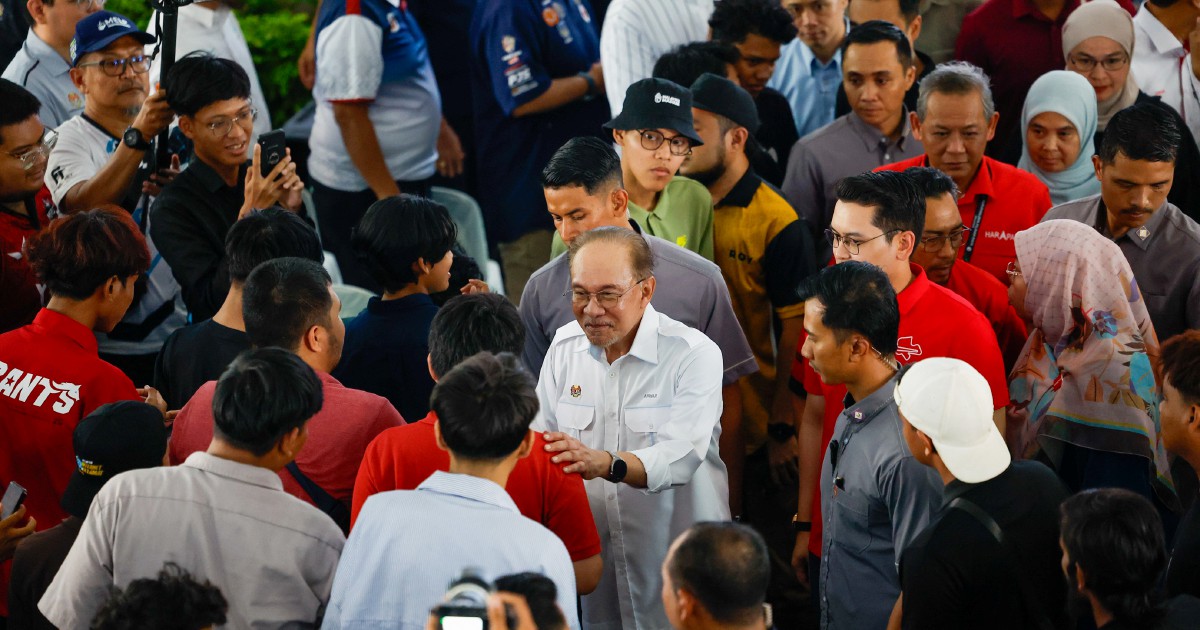
Prime Minister Datuk Seri Anwar Ibrahim has advised the Pakatan Harapan coalition to channel its energies into intensive grassroots campaigning during the final stretch before tomorrow's Negri Sembilan state election, cautioning against becoming distracted by the constant stream of polling predictions circulating in the media and political circles.
Speaking in Port Dickson, Anwar emphasised that the coalition's campaign apparatus would benefit far more from boots-on-the-ground activity in the coming hours than from monitoring or analysing various forecasts about the likely election outcome. His remarks reflect a strategic calculation that the most productive use of remaining campaign time lies in direct voter engagement, door-to-door outreach, and mobilisation efforts rather than in strategic discussions premised on survey data.
The Prime Minister's intervention underscores a broader tension within electoral campaigns across Southeast Asia, where polling organisations and media outlets proliferate predictions that can sometimes overwhelm substantive messaging. In Malaysia's competitive political environment, where state elections carry significant symbolic weight and can influence momentum ahead of federal contests, such guidance from a sitting Prime Minister carries particular weight within the coalition machinery.
Anwar's comments arrive at a critical juncture for Pakatan Harapan, which has been working to consolidate support across peninsular Malaysia following the 2022 general election. The Negri Sembilan contest represents an important test of the coalition's organisational capacity and electoral appeal in a state where it currently holds significant representation. Strong performance would reinforce the coalition's narrative of growing popular support, while a disappointing result could invite unwanted scrutiny from within allied parties and opposition figures.
The electoral landscape in Negri Sembilan reflects broader dynamics shaping Malaysian politics. The state has historically exhibited competitive two-party contests, with outcomes often reflecting shifting voter sentiment towards particular coalitions rather than showing consistent ideological loyalty. This volatility makes ground-level intelligence and voter contact potentially more valuable than broad-brush survey data, which may struggle to capture last-minute momentum shifts or micro-level variations in sentiment across different constituencies.
By downplaying the significance of polls, Anwar also sidesteps the awkward reality that competing surveys often produce conflicting narratives about likely outcomes. The proliferation of polling organisations with varying methodologies and sample sizes means that selective use of survey data can support almost any predetermined conclusion. Encouraging his supporters to ignore such noise and focus instead on systematic voter outreach represents a pragmatic recognition that campaign discipline and organised effort frequently prove more decisive than punditry in determining actual election results.
The timing of such guidance also suggests internal confidence within Pakatan Harapan's campaign headquarters about their organisational readiness and voter reception on the ground. If coalition surveys had suggested unfavourable trends, a call to focus purely on campaigning might ring hollow to demoralised supporters. The fact that Anwar felt confident making such remarks implies that internal data sources and on-ground feedback suggested sufficient momentum to justify sustained campaigning intensity.
For Malaysian voters and observers, the Prime Minister's approach offers a useful reminder that election outcomes ultimately depend on who actually votes and how voting preferences align across constituencies, rather than on aggregate percentage-point predictions. The Negri Sembilan election will be decided through the traditional mechanisms of electoral competition: voter mobilisation, candidate viability, local issue resonance, and the effectiveness of party machinery in ensuring supporter turnout. These mechanical realities generally respond better to organised effort than to any single survey.
The coalition's efforts in Negri Sembilan will also generate important lessons for other political forces monitoring developments. The Democratic Action Party, Amanah, and PKR will be observing not merely the final vote tally but also the quality of their coordinated campaign performance, the reception they receive in different regions, and any emerging issues that might prove predictive of future contests. In this sense, the value of intensive campaigning extends beyond the immediate election result to encompassing the intelligence and experience gained during the process.
Moreover, Anwar's message carries implications for how Malaysian political campaigns are conducted and discussed more broadly. If senior political leaders consistently downplay polling data in favour of old-fashioned campaign work, this could gradually shift media and public attention away from the horse-race aspects of elections toward more substantive discussion of policies, local concerns, and candidate qualities. Whether such a shift proves durable remains uncertain, but it represents an interesting counterpoint to the polling-obsessed political coverage that dominates many democracies.
The Negri Sembilan election result will provide definitive answers about voter preferences that no survey can fully anticipate. Anwar's counsel to his coalition partners essentially reflects this fundamental truth: in democracy, actual votes cast matter incomparably more than predicted votes recorded in surveys. The next twenty-four hours of intensive campaigning by Pakatan Harapan will determine far more about the election outcome than any polling organisation could possibly measure.

