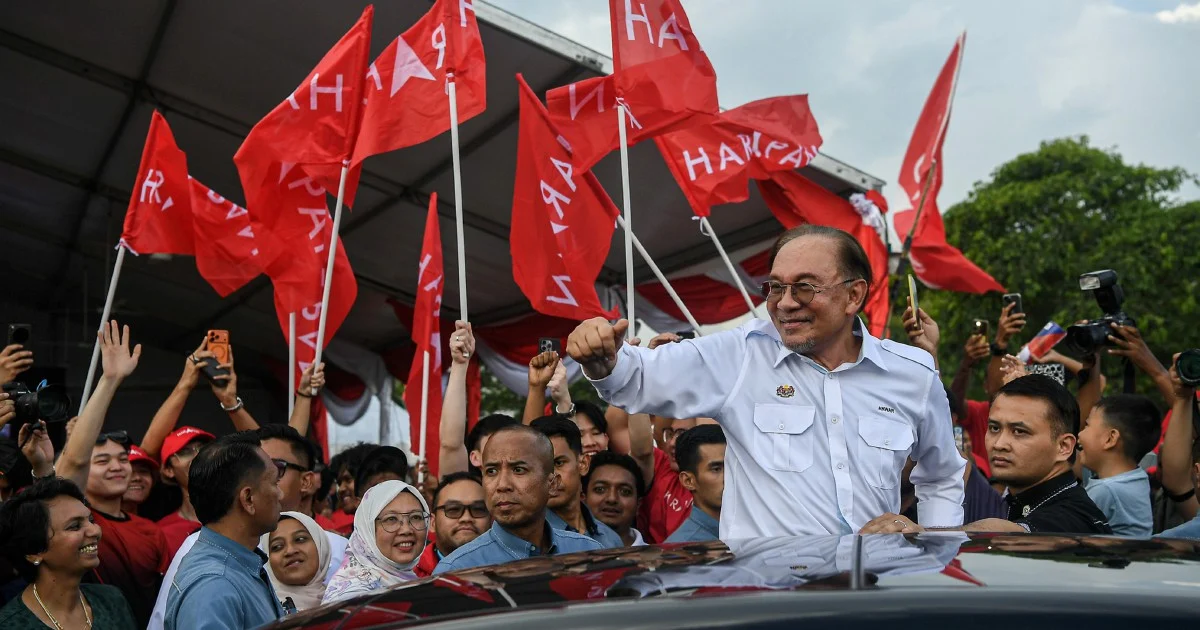
Prime Minister and Pakatan Harapan chairman Datuk Seri Anwar Ibrahim has delivered a pointed rebuke to political opponents who decline to work alongside the Democratic Action Party, framing their refusal as a fundamental disrespect for the electorate. Speaking in Segamat, Anwar characterised such behaviour as wholly inappropriate, signalling growing frustration within the ruling coalition at what he views as obstruction disguised as principle. The remarks underscore deepening tensions within Malaysia's political landscape, where the DAP's role in government continues to provoke resistance from rival camps despite the coalition's electoral victories.
Anwar's intervention arrives at a particularly delicate moment in Malaysian politics. The DAP, as the largest opposition party before the 2022 general election and subsequently the second-largest component in the Pakatan Harapan coalition, has become a lightning rod for criticism from both the Barisan Nasional and Perikatan Nasional blocs. Critics across the political spectrum have questioned the party's influence within government, while DAP leadership has repeatedly emphasised their commitment to inclusive governance. By reframing the debate as one about honouring voters' choices rather than DAP's specific policies, Anwar is attempting to shift the conversation into terrain more favourable to the coalition.
The Malaysian electorate rendered its verdict in two major electoral contests—the 2022 general election and the 2023 state elections—granting Pakatan Harapan and its partners mandates to govern. Anwar's argument rests on the premise that politicians who refuse to engage with DAP are effectively rejecting that mandate, positioning themselves against the democratic will. This framing carries weight among coalition supporters but faces significant headwinds in Malay-Muslim majority constituencies where DAP's secular orientation and status as a largely Chinese-dominated party continue to generate reservations. The Prime Minister appears to be gambling that public appeals to electoral legitimacy can overcome deep-seated communal anxieties.
The broader context involves Malaysia's complex racial and religious political dynamics. Since independence, power-sharing arrangements have hinged partly on ethnic arithmetic and implicit pacts among major communities. The inclusion of DAP in federal government marked a significant departure from this historical pattern, fundamentally altering the conventional alliance structures that had dominated Malaysian politics since 1957. Political actors from Umno, Perikatan Nasional, and various Malay-centric parties have struggled to adjust to this reconfiguration, leading many to campaign against what they characterise as DAP dominance, regardless of actual evidence of party control over policy-making.
Anwar's comments also reflect his personal political investment in maintaining Pakatan Harapan's cohesion. The coalition has proven fragile, with various departures and tensions between component parties. Relations between PKR and DAP have occasionally shown strain, particularly over resource distribution and policy priorities. By publicly championing DAP's inclusion, Anwar is signalling to his grassroots supporters that opposition to his coalition partner is unacceptable. Simultaneously, he is attempting to silence internal coalition critics who might wish to distance themselves from the party to improve their standing in particular constituencies.
For DAP specifically, the Prime Minister's remarks provide diplomatic cover. The party has frequently complained of being scapegoated for government policies when popular measures are credited to Malay-Muslim parties and unpopular ones are blamed on DAP influence. Anwar's public defence, framed in democratic rather than communal terms, offers a counternarrative that the party can deploy in its own communication efforts. However, the necessity of such defence also highlights DAP's continued vulnerability within Malaysian politics, where a single coalition partner must require the public backing of the Prime Minister to maintain its position.
The long-term implications of Anwar's stance remain uncertain. If political rivals continue to refuse collaboration with DAP while still engaging with other coalition members, the Prime Minister's criticism may prove ineffective. Malaysian politics has historically shown that such principled stands frequently yield to pragmatic calculations when elections approach. Politicians who currently distance themselves from DAP may find it expedient to negotiate directly with Pakatan Harapan during coalition-building exercises after future elections. Conversely, if Anwar's words signal a hardening of coalition boundaries—a willingness to exclude parties that reject DAP—this could reshape the political landscape more fundamentally.
Within the Southeast Asian context, Malaysia's experience offers instructive lessons about managing diversity in multi-ethnic democracies. Unlike some neighbouring countries that have experimented with authoritarian alternatives, Malaysia continues to operate through coalition politics that, however imperfectly, require negotiation among different communities and ideologies. Anwar's insistence that voters' choices demand respect for DAP participation represents one approach to sustaining this system. Whether this appeals to sufficient numbers of Malaysians, particularly in rural and semi-urban areas where communal concerns often predominate, will likely determine the trajectory of Malaysian politics in coming years and the durability of current governing arrangements.

