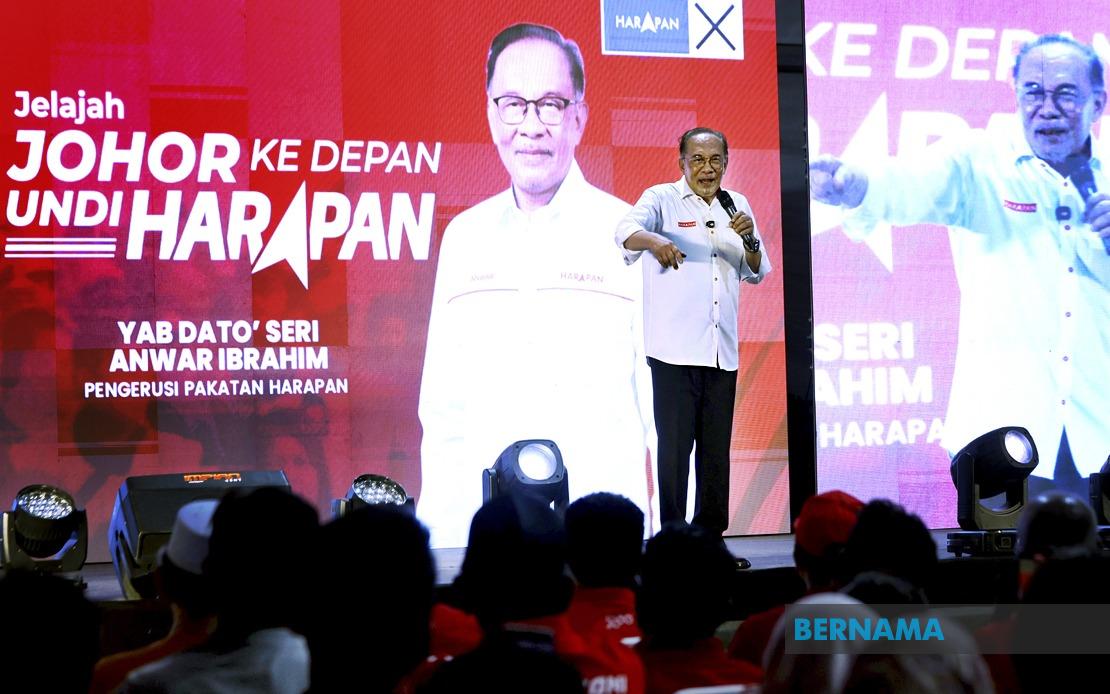
Prime Minister Datuk Seri Anwar Ibrahim has drawn a sharp line under Malaysia's past, declaring that the systematic plunder of state resources through nepotism and contract manipulation will no longer be tolerated under his MADANI Government. Speaking at a campaign rally in Sungai Mati, Muar, on the eve of the Johor State Election, Anwar cast the choice before voters as fundamental: between leaders of integrity or those shrouded in rhetoric designed to obscure previous abuses. His forceful language signals a recalibration of the government's anti-corruption stance as a cornerstone political message, particularly as Pakatan Harapan seeks to consolidate support in the crucial state poll scheduled for July 11.
At the heart of Anwar's statement lies a direct confrontation with what he terms the "culture of plunder"—a reference to patterns of governance where political office became a vehicle for personal enrichment through family contracts, cronies gaining preferential access to tenders, and the systematic diversion of public funds for private benefit. This framing casts corruption not merely as individual criminal acts but as an entrenched institutional practice. By framing it this way, Anwar positions anti-corruption reform as central to Malaysia's economic competitiveness and international standing, linking clean governance to the nation's ability to attract investment and respect on the global stage.
Crucially, Anwar emphasised that integrity and honesty ought to transcend communal boundaries. His statement—"I want Malays who are good, honest and not corrupt to become leaders. I want Chinese who are good and not corrupt to become leaders"—deliberately sidesteps ethnic framing in favour of merit-based assessment. In a political landscape where opposition parties have frequently mobilised narrow racial narratives to consolidate support, this approach represents an attempt to reclaim the moral high ground by arguing that character should supersede identity. For Malaysian readers, this distinction carries significance: it reflects an internal PH strategy to counter opposition rhetoric whilst building a multi-ethnic coalition around governance competence rather than demographic advantage.
The timing of these remarks, delivered during intensive Johor campaigning, underscores the strategic importance of the state election. Johor has traditionally been a stronghold of the Barisan Nasional coalition, and Anwar's presence across 15 engagements over two days reflects the government's determination to make meaningful inroads. By anchoring his campaign message to anti-corruption, Anwar attempts to reframe the contest around institutional reform rather than personality-driven politics, offering voters a forward-looking vision tied to cleaner administration and better resource management.
Anwar's categorical assurance that "no one would be protected by the government if found to be involved in corruption during his tenure" represents a deliberate signal to both allies and potential defectors. Within the Malaysian political context, where party-switching and factional realignments remain common, such statements carry weight as implicit warnings. The commitment suggests that his administration will pursue corruption cases impartially, irrespective of whether the accused are current coalition members or opposition figures. This approach contrasts sharply with earlier periods when prosecutorial decisions were often perceived through a partisan lens.
The government's primary strategic objective, as Anwar articulated, centres on fundamentally restructuring Malaysia's administrative apparatus to eliminate entrenched corrupt practices. This extends beyond high-profile prosecutions to encompassing procurement reform, financial transparency, and institutional safeguards against the conversion of public office into personal opportunity. For Southeast Asian observers, Malaysia's anti-corruption trajectory carries regional significance, as neighbouring nations grapple with similar challenges and often look to comparable institutional democracies for models and lessons.
Anwar also addressed opposition efforts to capitalise on discontent, characterising such moves as driven by a "personal agenda to regain control of the federal government" rather than genuine governance concerns. This framing attempts to delegitimise criticism as factional rather than substantive. However, it also implicitly acknowledges that anti-corruption messaging remains potent in Malaysian electoral competition, with opposition parties clearly seeking to exploit perceptions of ongoing misconduct or selective enforcement.
The Johor State Election itself represents a significant test of PH's ability to translate anti-corruption messaging into electoral gains. With 172 candidates contesting 56 state seats, the contest involves numerous local races where administration competence, service delivery, and perceived integrity of individual representatives will influence voter behaviour. Anwar's campaign presence underscores the government's recognition that state-level contests shape national political momentum, and losses in Johor would reverberate through the broader coalition.
For Malaysian readers and regional observers, Anwar's emphasis on clean governance reflects both genuine reform commitments and acute political necessity. The MADANI Government inherited a country fatigued by corruption scandals, and electoral sustainability depends partly on demonstrable progress in prosecution and institutional reform. Simultaneously, the focus on integrity serves PH's coalition-building interests by emphasising shared values across ethnic and religious lines, a counterweight to opposition appeals based on narrower communal concerns.
The presence of Penang Chief Minister Chow Kon Yeow and Ledang MP Syed Ibrahim Syed Noh at the rally highlights coordination within PH's leadership structure, though it also reflects the reality that campaign messaging requires multiple voices reinforcing central themes. Chow, as a state chief minister overseeing a government component, carries particular weight in discussions of administrative competence and anti-corruption implementation.
Moving forward, Anwar's anti-corruption positioning will face rigorous testing through implementation. Voter scepticism in Malaysia frequently stems from the gap between pre-election promises and post-election reality. Early voting on July 7 and main polling on July 11 will indicate whether his messaging resonates with Johor voters or whether other factors—local grievances, perception of incumbency, opposition counter-narratives—prove decisive. The outcome will offer crucial data about whether anti-corruption campaigns can effectively mobilise voters in Malaysia's current political environment, or whether traditional factors continue to exert primary influence. Either way, Anwar has committed substantial political capital to establishing integrity as a defining feature of his administration's identity.

