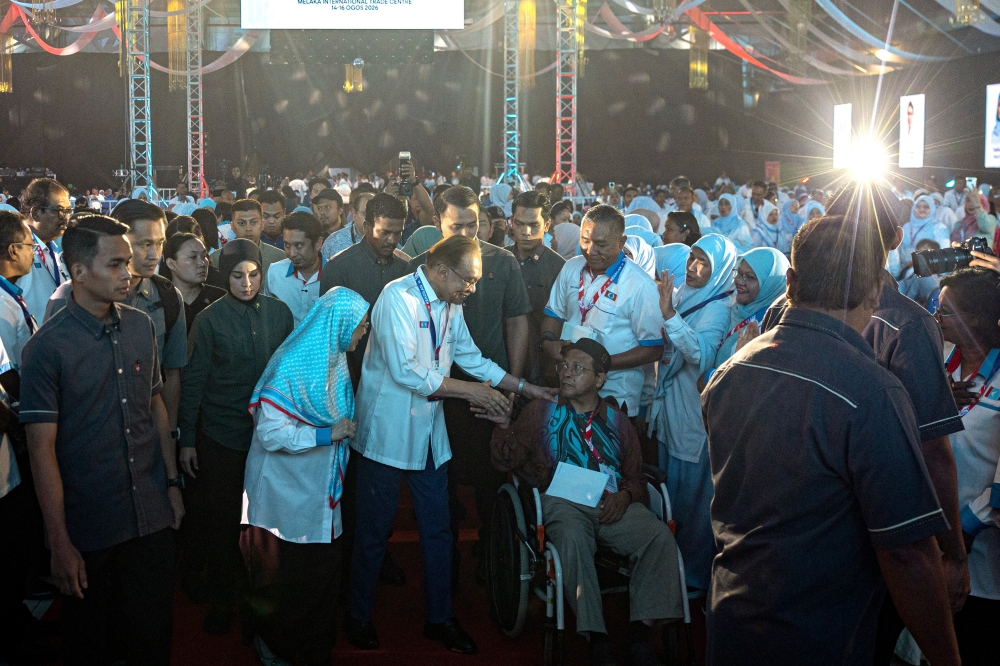
Prime Minister Datuk Seri Anwar Ibrahim has injected a note of caution into the ongoing internal coalition debate over Umno's role in Malaysian politics, declaring that any major decisions affecting the party must be anchored to the welfare of ordinary Malaysians rather than driven by historical grievances or emotional reactions. Speaking to PKR delegates in Melaka, Anwar articulated a position that reflects the delicate balancing act required to maintain the Pakatan Harapan-led government while navigating the deeper complexities of Malaysia's fractious political ecology.
The statement carries particular weight given Anwar's position as both Prime Minister and president of PKR, the dominant party within the ruling coalition. His emphasis on welfare-focused decision-making rather than sentiment-based responses suggests an implicit warning to elements within the coalition who may be pushing for a harder line against Umno, the party that previously dominated Malaysian politics for nearly seven decades before its dramatic electoral defeat in 2018. The rhetoric implicitly acknowledges that managing the post-Umno political order remains unfinished business in Malaysian politics, and that hasty or emotionally-charged responses could undermine economic stability or social cohesion.
Anwar's comments arrive at a moment of considerable flux within Malaysia's political establishment. Umno's internal dynamics have shifted markedly since its ejection from power, with the party fracturing into competing factions representing different generational perspectives and policy orientations. The United Malays National Organisation has attempted to position itself as a constructive opposition force while simultaneously managing former prime ministers and senior figures entangled in legal proceedings related to corruption allegations. This complexity makes any unified "decision" on Umno exceedingly difficult to implement in practice.
The Prime Minister's framing of the issue around public welfare rather than political vendetta reflects a pragmatic understanding that Malaysian governance cannot function effectively if major political actors remain locked in zero-sum antagonism. Economic challenges, including inflationary pressures affecting household budgets and the need for competitive positioning within Southeast Asia's regional economy, demand a political environment where cooperation on substantive matters becomes possible. Allowing historical resentments to dictate coalition strategy risks subordinating these practical concerns to political symbolism.
Within the PKR base itself, Anwar's message serves multiple purposes. For party delegates who harbour deep skepticism toward Umno rooted in the latter's authoritarian governance patterns and alleged abuse of institutional power, his words function as a reality check: politics must ultimately serve bread-and-butter interests rather than abstract principles or historical settlement. For those within PKR inclined toward pragmatic cooperation with former adversaries, the statement provides cover and justification for pursuing compromise arrangements where they advance measurable improvements in public services or economic performance.
The broader coalition dynamics merit attention as well. Pakatan Harapan comprises parties with markedly different ideological orientations and voter bases. PKR occupies the centrist space, DAP represents predominantly urban, non-Malay constituencies with secular liberal leanings, while Amanah appeals to more religiously-conscious Malay-Muslim voters. Any coordinated action against Umno would require consensus across these diverse interests, a consensus that Anwar's welfare-focused framework attempts to construct by appeal to shared material interests rather than ideological purity or historical justice.
Anwar's comments also carry implications for Malaysia's often-volatile ethnic politics. Umno remains deeply embedded in Malay-Muslim consciousness as the custodian of Bumiputera interests, however contested that role has become. Precipitous coalition action against the party risks reactivation of zero-sum framing of Malay political interests, potentially destabilizing the delicate accommodation that has enabled Pakatan Harapan to maintain power without commanding an overwhelming parliamentary majority. By anchoring political decisions to welfare outcomes measurable across ethnic lines, Anwar attempts to transcend this binary.
The international dimension cannot be overlooked either. Malaysia's standing in global financial markets and its attractiveness to foreign direct investment depend partly on political predictability and the absence of governance paralysis. Emotional or revenge-driven politics risks spooking investors concerned about institutional volatility. Conversely, demonstrating that Malaysia's political elite can subordinate grievances to economic logic sends positive signals about institutional maturity and economic governance capacity, potentially benefiting ordinary Malaysians through improved investment flows and employment opportunities.
Looking forward, Anwar's emphasis on welfare considerations establishes an interpretive framework for how the coalition may approach potential cooperation or competition with Umno across various domains—parliamentary votes on critical legislation, positions on economic policy, or even possible limited coordination on issues like anti-corruption measures where interests might superficially align. The Prime Minister has essentially declared that pragmatic flexibility remains available, provided such flexibility demonstrably improves outcomes for ordinary voters rather than merely consolidating power or pursuing narrow partisan advantage.
The statement also signals to international observers that Malaysia's government possesses sufficient political maturity to distinguish between managing former adversaries and capitulating to them. This distinction matters considerably in regional geopolitics, where perceptions of Malaysian institutional stability influence broader Southeast Asian strategic calculations. By framing coalition decision-making through the lens of public welfare rather than political vendetta, Anwar positions Malaysia as a rational political actor even amid the complications of its plural society and competitive political landscape.

