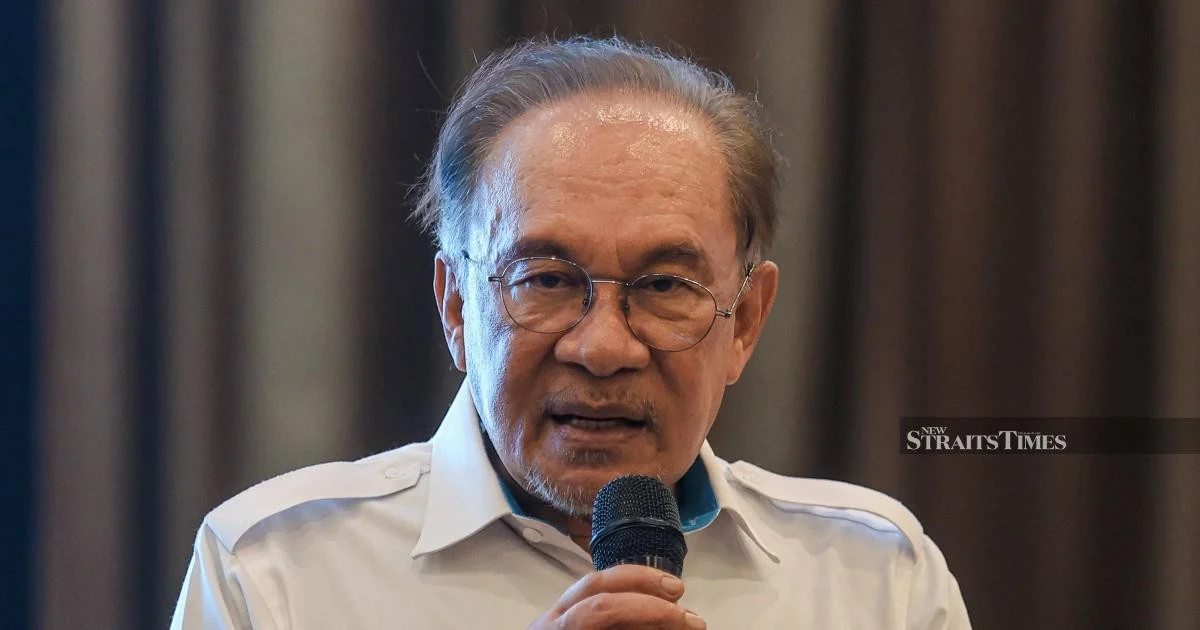
Prime Minister Datuk Seri Anwar Ibrahim has launched a sharp rebuke at political figures across the Malaysian landscape who weaponise sentiments of racial supremacy to advance their personal political ambitions and consolidate power for themselves, their families, and their networks of political allies. Speaking in Johor Baru, Malaysia's second-largest state and a crucial political battleground, the prime minister articulated growing concern about the instrumentalisation of identity politics in the country's political discourse.
The criticism reflects an escalating tension within Malaysia's political establishment around how identity and ethnicity are invoked in public debate and electoral competition. Rather than serving as a legitimate framework for understanding group interests within Malaysia's multi-ethnic democracy, Anwar suggested, racial supremacy rhetoric has been reduced to a cynical tactic deployed by politicians seeking electoral advantage without regard for the broader social consequences. This framing positions such political behaviour as fundamentally corrupt—not merely controversial or strategically motivated, but corrupting of the political process itself.
Anwar's intervention also signals his administration's approach to managing one of Malaysia's most sensitive and fraught political dimensions. Since gaining office in November 2022, his coalition government has attempted to chart a middle course between acknowledging the constitutional recognition of Malay-Muslim special rights and pushing back against what it characterises as opportunistic politicisation of these frameworks. This latest statement suggests the prime minister believes that distinction has become increasingly necessary to articulate clearly to Malaysian voters.
The Johor context carries particular significance. The state has long been a stronghold of the opposition Barisan Nasional coalition, particularly the United Malays National Organisation (UMNO), though the 2022 general election demonstrated shifting electoral dynamics. As an environment where multiple political movements actively contest for support among Malay-Muslim voters—traditionally the largest voting bloc—Johor represents exactly the kind of arena where racial supremacy rhetoric tends to be deployed most aggressively. Anwar's choice of location thus underscores his message: the prime minister is directly challenging narratives being constructed in spaces where such politics prove most electorally potent.
The mechanism Anwar identifies—politicians leveraging racial sentiment to enrich themselves, their families, and their patronage networks—points to a form of political corruption that extends beyond conventional bribery or embezzlement. It suggests that racial polarisation itself becomes weaponised not from ideological conviction but from instrumental calculation. This framing aligns with broader international observations about how identity politics can be instrumentalised by elites seeking to consolidate power while extracting personal benefit, a phenomenon scholars have documented across numerous democracies.
For Malaysian society, the implications are substantial. If significant portions of the political elite are indeed mobilising racial sentiment primarily for personal gain rather than principled advocacy for group interests, the resulting discourse may become increasingly divorced from substantive policy discussion about education, economic opportunity, representation, or cultural recognition. The consequence would be a political environment where racial messaging escalates without corresponding clarity about what material changes or policy outcomes such rhetoric is meant to advance. This can deepen polarisation without producing meaningful resolution to underlying grievances.
Anwar's critique also implicitly positions his own political project as an alternative model—one ostensibly grounded in broader coalition-building across ethnic and religious lines, with policy substance taking precedence over identity mobilisation. His Pakatan Harapan coalition has long marketed itself as a multiethnic alliance capable of addressing Malaysian challenges through inclusive governance rather than zero-sum ethnic competition. The prime minister's latest remarks can be read as reinforcing that brand distinction against political competitors he characterises as more transactional and self-serving.
The challenge for Malaysian public discourse lies in distinguishing between legitimate advocacy for particular group interests within a diverse democracy and the opportunistic deployment of racial supremacy rhetoric. Malaysia's constitutional framework explicitly recognises Malay-Muslim special rights, creating a complex political landscape where such advocacy can sometimes be framed as constitutional rather than supremacist. Anwar's intervention attempts to police that boundary by suggesting that when racial arguments become vehicles purely for personal enrichment and family advancement, they abandon any claim to principled advocacy. Whether this distinction proves persuasive to Malaysian voters, particularly in states like Johor where such debates carry highest electoral stakes, remains an open question that will shape Malaysian politics leading into future electoral contests.
The prime minister's remarks also underscore the ongoing struggle within Malaysia's political system to establish what constitutes acceptable and unacceptable forms of identity-based political mobilisation. As the country navigates its continued evolution as a multiethnic democracy, this tension between honouring constitutional recognition of particular group interests and preventing those frameworks from being weaponised for corruption appears likely to remain a central feature of political contestation.

