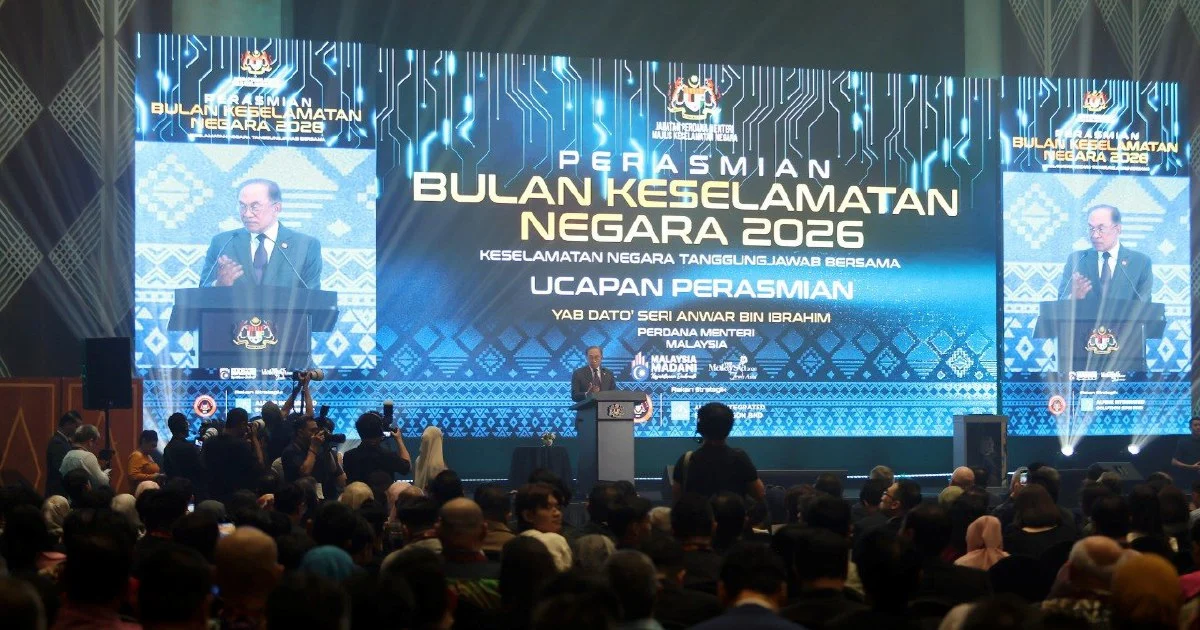
Prime Minister Datuk Seri Anwar Ibrahim has expressed alarm at the persistence of racial and regional fault lines in Malaysian political discourse, particularly as Johor approaches a critical state election that could reshape the country's political landscape. Speaking from his office in Putrajaya, Anwar underscored the risks of allowing the nation to remain tethered to outdated identity-based narratives that have historically fragmented communities and complicated coalition-building at both state and federal levels.
The caution from Malaysia's top leader reflects growing concern within Putrajaya that electoral contests, especially in traditionally politically significant states like Johor, can inadvertently reignite communal tensions if campaigns lean heavily on ethno-nationalist messaging. Johor, with its substantial Malay-Muslim majority and significant Chinese and Indian minorities, has long been a bellwether for national political trends, making the character and tone of its electoral process a matter of wider consequence. The state has historically delivered bloc votes that influence the composition of parliament and the stability of federal coalitions.
Anwar's intervention suggests the Prime Minister views the upcoming election as a test case for whether Malaysian politics can evolve toward issue-based competition focused on governance, economic performance, and service delivery rather than ancestral grievances and communal rivalries. His emphasis on moving beyond "old" narratives implies a recognition that parties competing in Johor have sometimes relied on stoking racial anxieties to mobilise voter turnout, a tactic that delivers short-term electoral gains but corrodes social cohesion and complicates the task of nation-building across religious and ethnic lines.
The timing of Anwar's statement is significant in Malaysia's current political context. The nation has experienced multiple transitions since 2018, with coalitions fragmenting and reforming in unpredictable ways. Johor's electoral outcome could affect the balance between the federal government and state administrations, particularly if results sharpen ideological or communal cleavages. Anwar's leadership has explicitly promoted an inclusive vision of Malaysian identity and development, contrasting with more identity-centric approaches that previous administrations have sometimes employed.
For regional observers, Anwar's caution reflects a wider challenge across Southeast Asia: how multiethnic, multireligious democracies can manage electoral competition without allowing identity politics to override institutional stability and economic progress. Thailand, Indonesia, and the Philippines have all grappled with similar tensions between electoral pluralism and the risk that majoritarian mobilisation can marginalise minorities or destabilise governance structures. Malaysia's status as a functioning democracy with significant economic integration makes its handling of this dilemma consequential not just domestically but for regional perceptions of how diverse societies should conduct politics.
Johor's specific dynamics compound these stakes. The state remains an economic powerhouse, hosting major port facilities, manufacturing centres, and agricultural sectors that employ workers from multiple communities. Electoral polarisation along racial lines could disrupt these economic networks and deter investment if investors perceive increased governance instability or intercommunal friction. Anwar's emphasis on moving beyond divisive narratives can thus be read as both a moral appeal and an economic argument—that inclusive politics serves growth and prosperity more effectively than zero-sum ethnic competition.
The Prime Minister's concerns also reflect internal dynamics within Malaysia's ruling coalition. Pakatan Harapan, Anwar's umbrella coalition, comprises parties representing different communities and ideological traditions. Maintaining coherence across these factions requires a framework that accommodates diversity without allowing any single group's grievances to dominate the agenda. In Johor, where Pakatan's local strength varies, the temptation for individual parties or candidates to appeal narrowly to their communal bases could intensify unless senior leadership consistently signals that such tactics contradict the coalition's broader vision.
Opposition parties, notably the Barisan Nasional, which has traditionally dominated Johor, face their own incentives around messaging strategy. Barisan's long tenure in the state has rested partly on narratives of stability and Malay-Muslim representation, framing its dominance as essential to honouring constitutional protections for Bumiputera interests and Islam's position. Anwar's warning implicitly challenges such frameworks, arguing that they trap Malaysia in cycles of defensive identity politics rather than forward-looking governance focused on solving concrete problems—inflation, employment, education, healthcare—that affect all communities.
The Johor election thus becomes a microcosm for broader questions about Malaysia's political maturity and its capacity to evolve beyond the communal bargains that sustained the state during the postcolonial decades. Anwar's statement represents an attempt by the national leadership to establish a new political grammar in which appeals to shared national interest and plural belonging supersede traditional ethnic mobilisation. Whether voters, candidates, and local political machines in Johor embrace this reframing will offer crucial data on whether Malaysian politics can genuinely transcend the identity-centric paradigm.
The success or failure of this transition carries implications for Malaysian society's cohesion during a period of economic uncertainty and generational change. Younger voters, particularly in urban Johor, may respond positively to campaigns centred on economic inclusion and institutional transparency rather than ancestral narratives. However, entrenched political interests and communal institutions may resist such reorientation, fearing that decentring identity politics could erode their constituencies' sense of security and representation. Anwar's leadership will ultimately be judged partly on whether the national political culture he models and encourages can genuinely reshape how local contests like Johor's are conducted.

