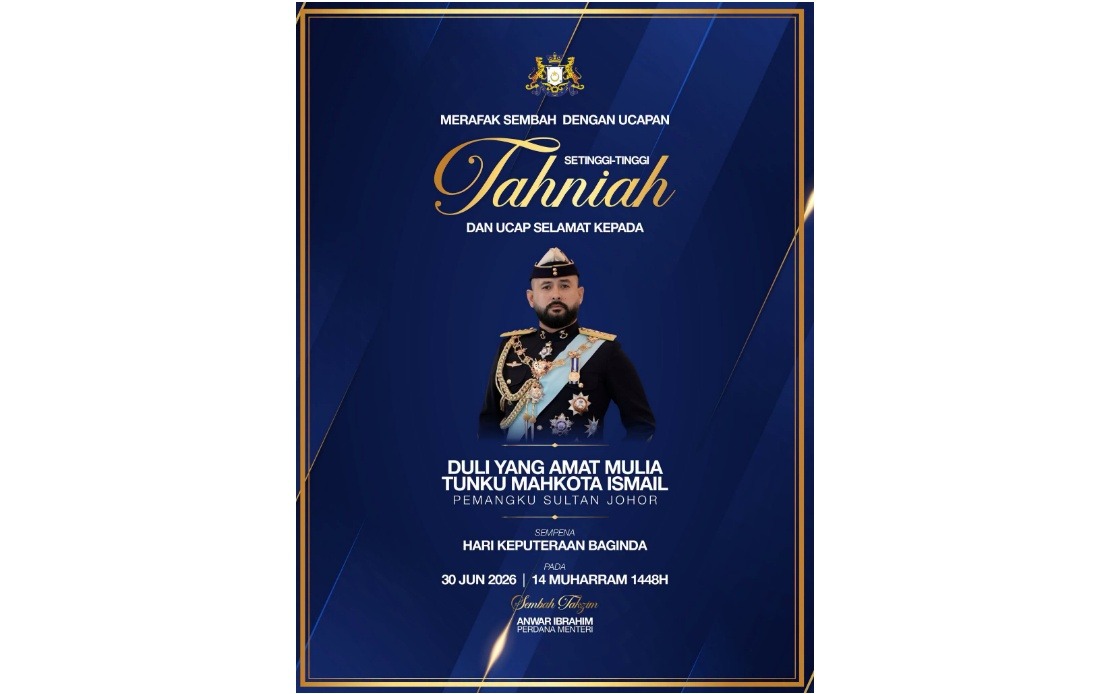
Prime Minister Datuk Seri Anwar Ibrahim marked the birthday of Tunku Mahkota Ismail, the Regent of Johor, with a public message of congratulations delivered through social media on Sunday. The gesture reflects the customary protocol observed among Malaysia's top political leadership towards the country's royal institutions, particularly the sultans and regents who hold constitutional significance in the federal structure.
Through a Facebook post, Anwar conveyed warm wishes to His Royal Highness while invoking blessings for the prince's continued good health and personal wellbeing. The message also extended prayers for Tunku Mahkota Ismail to be showered with grace and prosperity. Such public acknowledgments of royal birthdays serve as important symbolic gestures within Malaysia's constitutional monarchy framework, where the reigning monarchs and their heirs occupy positions of ceremonial and legal prominence across the nation's thirteen states.
Deputy Prime Minister Datuk Seri Dr Ahmad Zahid Hamidi similarly marked the occasion with his own birthday message posted on social media. Zahid's statement focused on invoking divine blessings upon the Johor Regent, specifically requesting continued health and protection for the prince. The Deputy Prime Minister's remarks extended beyond mere pleasantries to include a reflection on the Regent's role as the future leader of Johor Darul Ta'zim and his responsibility towards the Bangsa Johor—the broader Johor community and population.
In his message, Zahid articulated a prayer that Allah grant Tunku Mahkota Ismail the wisdom necessary to govern Johor effectively. This phrasing underscores the Malaysian political culture's integration of religious sentiment with constitutional governance, where leaders frequently frame their hopes for royal and institutional leadership through Islamic invocations. Such language is particularly common among Malaysia's Muslim-majority leadership and reflects the intertwining of Islamic values with the state's administrative framework.
Tunku Mahkota Ismail holds a position of considerable importance within Johor's governance structure and broader Malaysian politics. As the heir to the Johor sultanate, he represents the continuity of one of Malaysia's most historically significant and politically influential royal houses. Johor has long played a central role in Malaysia's constitutional architecture, and the state's sultan has traditionally wielded considerable authority both within his domain and within the larger framework of Malaysia's Conference of Rulers.
The Regent's significance extends beyond ceremonial duties. In recent years, members of Johor's royal family have become increasingly visible in public discourse and development initiatives across the state. Tunku Mahkota Ismail has been associated with various modernisation and economic development projects, positioning himself as a forward-thinking leader prepared to navigate Johor's future within Malaysia's evolving political and economic landscape.
The public birthday wishes from Malaysia's top two elected officials underscore the careful balance that the federal government maintains in its relations with the nation's monarchical institutions. Such gestures, while appearing routine, carry subtle political significance in Malaysia's constitutional system. They demonstrate respect for the institutional framework within which both elected officials and the monarchy operate, reinforcing the separation of powers and the primacy of constitutional arrangements that have governed Malaysia since independence.
For readers across Southeast Asia observing Malaysian politics, these interactions illuminate how Malaysia's dual system of elected government and constitutional monarchy functions in practice. While democratic elements guide the nation's administration through elected representatives and cabinet ministers, the royal institutions retain ceremonial authority and, in certain constitutional matters, substantive decision-making power. The respectful acknowledgment of royal occasions by senior elected leaders reflects this constitutional reality.
The timing and public nature of these birthday greetings also reflect broader patterns in Malaysian political communication. Senior government figures routinely utilise social media to address both domestic constituencies and the international community, with messages designed to convey key values such as respect for institutions, Islamic piety, and commitment to Malaysia's constitutional framework. These digital announcements serve multiple audiences and purposes simultaneously, reinforcing both the legitimacy of the government and the importance of Malaysia's constitutional pillars.
For Johor specifically, such gestures carry particular weight given the state's historical role as a power centre within Malaysia and its considerable economic importance. The state remains a crucial political battleground, with multiple competing political factions vying for influence. Messages of respect and support from federal leadership toward Johor's royal institutions signal an intent to maintain constructive relationships with state-level power structures, regardless of which political parties currently govern the state.
The broader context of these birthday greetings also reflects Malaysia's ongoing commitment to its constitutional monarchy within a Westminster-style parliamentary system. Unlike fully republican systems or absolute monarchies, Malaysia has crafted a unique institutional arrangement where elected officials and hereditary monarchs share governance responsibilities according to constitutionally defined boundaries. Public displays of deference and respect toward royal institutions by elected leaders help reinforce the legitimacy and stability of this arrangement.

