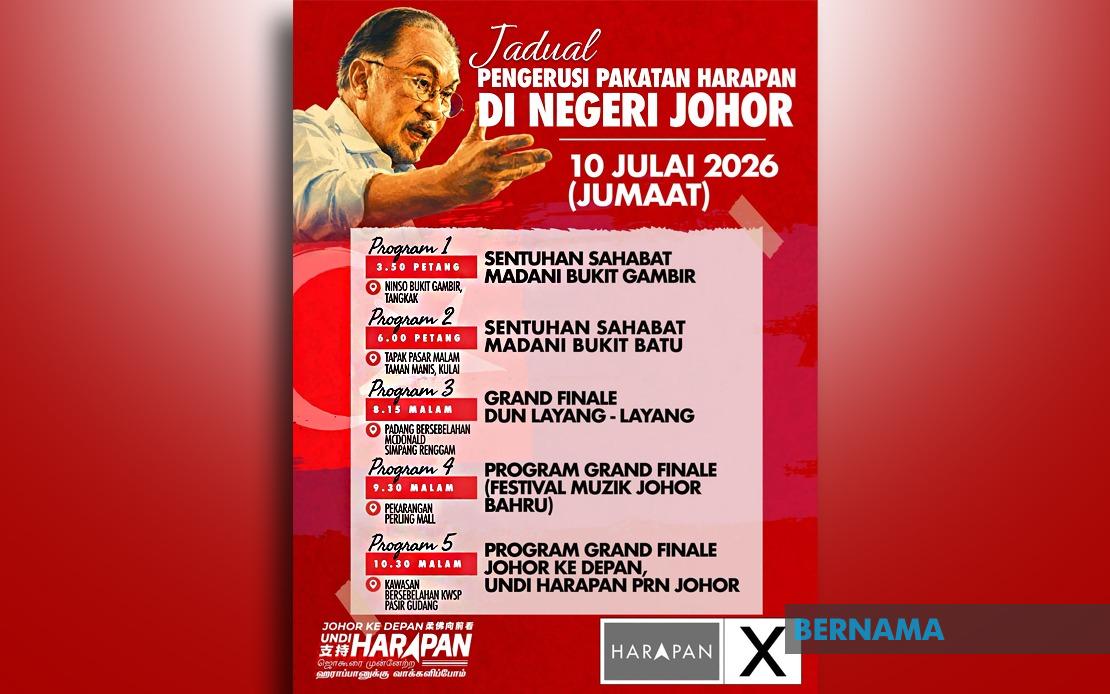
Prime Minister Datuk Seri Anwar Ibrahim will undertake a demanding, multi-venue campaign sweep through Johor tomorrow as Pakatan Harapan makes its final push to secure victory in the 16th Johor State Election, scheduled for Saturday. The intensive itinerary will take the PH Chairman across five strategically selected constituencies throughout the day and evening, reflecting the coalition's determination to maximise voter turnout in what observers view as a critical test of the government's popularity in the crucial southern state.
The campaign trail begins with the 'Sentuhan Sahabat MADANI' programme in Bukit Gambir, Tangkak at 3:50 pm, marking the opening salvo of what promises to be an exhausting schedule designed to energise party supporters and undecided voters in the final hours before polls open. This first stop in the Tangkak area allows Anwar to address constituents in a region where Pakatan Harapan will be defending its interests against opposition advances. The Prime Minister's decision to personally lead the campaign blitz underscores the coalition's perception that upper-level mobilisation may be necessary to overcome any momentum building among rival camps.
By early evening, Anwar will travel to Bukit Batu in Kulai at approximately 6:00 pm, maintaining the frenetic pace established in the opening hours. This Kulai stop is strategically important given its proximity to Johor Bahru, the state capital, where middle-class and urban voters may hold decisive sway. The programme targets constituencies where demographic shifts and economic concerns have created pockets of electoral volatility, making personal appearances by senior party figures potentially decisive in securing narrow margins.
As darkness falls, the campaign reaches its ceremonial centrepiece with the DUN Layang-Layang 'Grand Finale' programme scheduled for Simpang Renggam at 8:15 pm. This evening event typically draws larger crowds than daytime engagements, allowing Anwar to address supporters in a more festive atmosphere that encourages community participation and media coverage. The timing is deliberate, positioning the Prime Minister's message during prime television and social media viewing hours when Malaysian audiences are most engaged with political content.
The schedule then pivots toward entertainment and broader appeal with the Johor Bahru Music Festival on the grounds of Perling Mall at 9:30 pm. This unconventional campaign element reflects a broader shift in Malaysian political strategy, where parties increasingly blend entertainment with political messaging to reach younger voters and families less motivated by traditional rally formats. The festival setting lowers barriers to attendance and creates a more relaxed environment where political engagement occurs alongside cultural programming, a tactic that has gained traction across Southeast Asian democracies.
The marathon campaign day culminates in the 'Johor Ke Depan, Undi Harapan PRN Johor' Grand Finale Programme in Pasir Gudang at 10:30 pm, a notably late finish that pushes campaign activities to the absolute limit of voter energy and engagement. Pasir Gudang, an industrial and working-class constituency, represents a demographic group that Pakatan Harapan has worked to consolidate across multiple election cycles. The late timing ensures maximum symbolic impact while testing supporters' commitment through their willingness to attend evening events.
Anwar's personal appearance across all five venues represents a significant time commitment for a sitting Prime Minister, signalling the paramount importance Putrajaya and the coalition assign to the Johor result. For Malaysian political observers, such intensive engagement suggests either confidence in the campaign's trajectory or concern about potential shortfalls that require executive-level intervention. The geographical spread from Tangkak in the north to Pasir Gudang in the south demonstrates an attempt to maintain support across diverse constituencies spanning rural and urban zones.
The formal campaigning period, which commenced on nomination day on June 27, concludes at 11:59 PM tomorrow, making this final day the last opportunity for parties to mobilise supporters through organised events. Political analysts note that this compressed timeframe concentrates voter attention and media focus during the final forty-eight hours, potentially magnifying the impact of any last-minute developments or messaging strategies. The concentration of campaign intensity in closing days reflects Malaysian electoral dynamics, where undecided voters often make final choices after accumulated exposure to competing narratives.
Saturday's election will determine representation for 56 State Legislative Assembly seats among an anticipated 2.7 million registered voters across Johor. This electorate size positions the state as a significant bellwether for national political sentiment, particularly regarding the stability and performance of the federal government. Regional observers view Johor results as an important indicator of rural and urban support distribution for Pakatan Harapan, potentially influencing calculations about the coalition's viability heading into future federal elections. The state's status as Malaysia's second-largest economy by population and contribution to national GDP amplifies the stakes beyond regional politics into national economic governance assessment.
Through his Facebook messaging, Anwar has framed the election as part of a broader "wave of change" and invitation to realise a "new hope for the people and the future of the state," language that attempts to broaden the campaign beyond traditional partisan appeals. This messaging strategy emphasises forward-looking governance narratives rather than dwelling on past political grievances, reflecting calculations that voters increasingly evaluate parties on future-oriented competence metrics. For Malaysian readers across diverse backgrounds, such campaigns offer glimpses into how national leaders perceive voter priorities and what policy domains they emphasise during high-stakes electoral moments.
The simultaneous scheduling of entertainment programming alongside political rallies demonstrates evolving approaches to political engagement in contemporary Malaysia, where traditional models compete with multimedia and experiential strategies. Younger voters and families increasingly encounter political messaging through cultural events rather than exclusively through formal campaign rallies, reshaping how parties calculate their outreach effectiveness. Understanding these tactical shifts provides insight into broader regional trends in Southeast Asian political communication, where electoral competition increasingly incorporates entertainment and lifestyle elements alongside substantive policy discussion.

