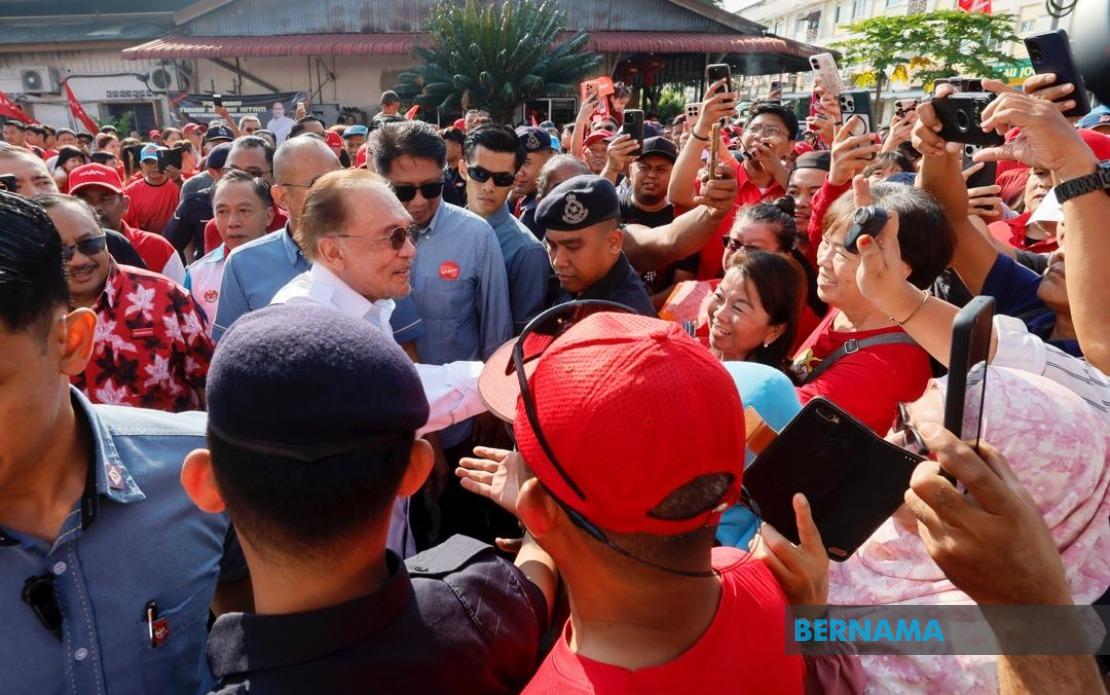
Prime Minister Datuk Seri Anwar Ibrahim's presence at a campaign engagement in Simpang Renggam on the ninth day of Johor's election campaign has delivered a crucial morale injection to the Pakatan Harapan machinery contesting the Machap and Layang-Layang state seats. The visit underscored the coalition's commitment to the electorate just days before voting takes place on July 11, signalling the high stakes both parties attach to retaining and winning ground in Johor.
The campaign appearance, framed as a casual community breakfast titled 'PMX Santai Sarapan Bersama Masyarakat', drew over 1,000 residents and served as a platform for the Prime Minister to reinforce core messaging about service-oriented governance. Rather than presenting himself as a remote political figurehead, Anwar's relaxed approach—meeting constituents informally and engaging directly with concerns—appears designed to counter criticism that Pakatan Harapan has become disconnected from grassroots sentiment. This tactical shift in campaign presentation reflects growing recognition among the ruling coalition that electoral fortunes depend on demonstrating authentic engagement with communities beyond formal party structures.
Nur Hafiz Roslan, the PH candidate for Machap, described Anwar's intervention as pivotal in reinforcing the coalition's philosophical framing of political service. According to Roslan, the Prime Minister emphasised that campaign activities must centre on serving the public rather than pursuing narrow partisan advantage, drawing on the Islamic concept of 'amal soleh' or righteous conduct. This appeals to the moral and ethical dimensions of voter choice, attempting to position Pakatan Harapan as guided by principle rather than mere electoral calculation. The resonance of such messaging depends heavily on whether voters perceive genuine commitment behind the rhetoric or view it as standard campaign theatre.
The strategic importance of the visit lies partly in galvanising campaign workers and volunteers who face fatigue and uncertain prospects in competitive contests. Layang-Layang and Machap both represent constituencies where results remain uncertain, making sustained ground-level mobilisation essential. Roslan's comments about intensified outreach efforts suggest that the Prime Minister's presence functioned to reset expectations and inject fresh energy into what may have been flagging door-knocking operations. For political machines dependent on volunteer enthusiasm, such high-profile validations from national leadership can translate into tangible increases in campaign intensity.
Guna Balakrishnan, the PH candidate for Layang-Layang, echoed sentiments about renewed determination following Anwar's appearance, though he acknowledged that strong community sentiment alone cannot guarantee victory. His comment that Anwar instructed him to develop the constituency and support the local community if elected frames political obligation in terms of concrete service delivery. This conditional approach—positioning the vote as a contract requiring incumbent performance—reflects awareness that Johor voters have witnessed multiple election cycles and increasingly evaluate candidates on demonstrable results rather than promises alone.
The attendance of over 1,000 residents at the Simpang Renggam programme represents substantive popular engagement, though context matters considerably. The venue sits within the Simpang Renggam parliamentary constituency, an area where Pakatan Harapan presumably enjoys existing support networks capable of mobilising attendance. Whether this crowd reflects organic enthusiasm for the coalition or represents organised party machinery generating visible numbers remains important for interpreting actual electoral sentiment. Malaysian political observers typically scrutinise turnout at such events as barometers of party strength, yet distinguishing spontaneous support from coordinated mobilisation remains notoriously difficult.
Resident testimonies recorded by journalists provide limited but suggestive evidence about swaying voter preferences. Chuan Chee Mei, 48, attributed strengthened support to witnessing Anwar's visible commitment to candidates and willingness to engage in community settings. The appeal here centres on what political scientists term 'presence signalling'—the interpretation that a leader's physical appearance in a constituency suggests seriousness about winning it and delivering subsequent development benefits. Voters in less developed areas particularly value such signals, viewing them as potential predictors of resource allocation if the visiting leader's party gains power.
Similarly, Noor Takiyudin Salleh highlighted the informality and accessibility of Anwar's demeanour as persuasive factors. The explicit mention of the programme's 'casual' nature and the crowd size suggests that creating an impression of grassroots connection holds electoral significance beyond policy discussions. This reflects broader trends in Malaysian electoral competition where voter decision-making increasingly incorporates judgements about leader personality and perceived approachability. Anwar's positioning as a politician willing to engage without formal ceremony potentially resonates with segments tired of distant, hierarchical political styles.
The Johor state election contest involves 172 candidates competing for 56 seats, making this a significant test of political fortunes for the ruling coalition. Pakatan Harapan's performance in Johor carries implications extending beyond state-level governance, potentially signalling momentum or decline heading into subsequent electoral contests. The coalition's decision to deploy the Prime Minister's campaign time and energy in Machap and Layang-Layang specifically suggests these constituencies were identified as winnable but competitive, requiring top-level intervention to secure. Such tactical allocation of leadership attention reflects calculations about which seats represent the coalition's best opportunities for consolidation or breakthrough.
Polling takes place on July 11, with early voting scheduled for July 7, leaving minimal time for campaign momentum to shift substantially. The Prime Minister's visit effectively represents a closing argument to voters in these constituencies, delivered through the authority and symbolism of national leadership. Whether such interventions ultimately influence outcomes remains contested in electoral research, though candidates and party strategists consistently view them as valuable. For Pakatan Harapan in Johor, every available advantage matters in a competitive environment where territorial losses would damage the coalition's broader political position.
The broader significance of this campaign engagement extends to questions about how Malaysian political competition has evolved in the post-2018 landscape. Pakatan Harapan's rise disrupted long-entrenched patterns of electoral competition, yet maintaining momentum requires continual demonstration of vitality and popular connection. Events like the Simpang Renggam community breakfast represent efforts to sustain the narrative of a party close to ordinary Malaysians, capable of delivering responsive governance. Whether voters perceive authenticity in these gestures or view them cynically as perfunctory campaign mechanics will ultimately determine their electoral efficacy across constituencies throughout Johor.

