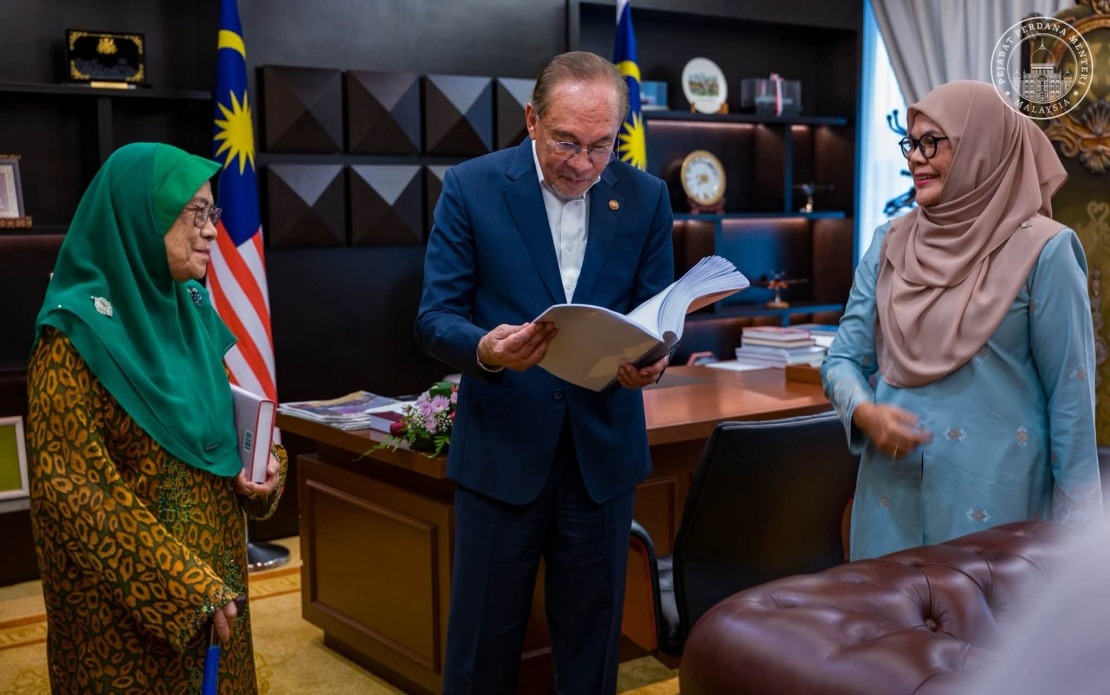
Prime Minister Datuk Seri Anwar Ibrahim has expressed optimism that a forthcoming book chronicling his intellectual contributions and governance philosophy will become a valuable resource for scholars and policymakers in generations to come. Speaking through a Facebook post on July 1, Anwar indicated that the publication represents an important effort to systematically capture his approach to leadership and nation-building, drawing from decades of political engagement and extensive personal reflection.
The book project emerged from a collaboration between the Prime Minister and two leading academics from Universiti Malaya's Academy of Malay Studies. Professor Dr Salinah Ja'afar, a linguist and lecturer at the institution, authored the manuscript after conducting exclusive interviews with Anwar to capture his perspectives comprehensively. This direct engagement ensured that the work faithfully represents his worldview and the intellectual foundations underlying his policy positions.
The project also benefited from the scholarly oversight of Professor Emeritus Datuk Dr Nik Safiah Abdul Karim, an eminent language expert who served as academic adviser throughout the writing process. Her involvement underscores the publication's commitment to rigorous academic standards and clarity of expression. Anwar took a hands-on approach, personally reviewing the manuscript and providing detailed feedback to shape the final content, demonstrating his investment in the project's quality and accuracy.
For Malaysian readers and observers of Southeast Asian politics, this archival effort carries particular significance. It reflects a broader trend among senior political figures to systematize their intellectual legacies while in office, creating institutional records that can inform public discourse beyond their tenure. In the Malaysian context, where political transitions often result in discontinuity in policy frameworks and institutional memory, such documented works serve as stabilizing references.
Anwar's emphasis on the book's potential utility for future generations speaks to his concern with institutional sustainability and intellectual inheritance in governance. By explicitly articulating the philosophical underpinnings of his approach to nation-building and personal values formation, he seeks to establish continuity between his administration's initiatives and successor governments' priorities. This represents a form of soft institutional entrenchment through ideas rather than formal mechanisms.
The focus on "personal values" and "life experiences" as foundational to the work suggests the publication will move beyond simple policy documentation to explore the ethical and philosophical frameworks guiding Anwar's decision-making. This biographical-intellectual approach offers readers insight into how personal formative experiences shape political leadership, a dimension often absent from conventional policy papers or speeches. For Malaysian civil servants and emerging political leaders, such contextual understanding can illuminate the reasoning behind specific governance choices.
The collaboration with University of Malaya scholars also positions this work within Malaysia's academic ecosystem, potentially influencing university curricula and research agendas. Political science and public administration programs may incorporate the book as primary source material for case studies on leadership and governance. The involvement of established academics lends credibility and scholarly rigor to what might otherwise be perceived as a political figure's self-presentation.
From a regional perspective, this documentation effort aligns with broader Southeast Asian patterns of political leaders creating intellectual legacies. The work joins similar endeavors by regional statesmen seeking to articulate their vision for their nations' development and values. These publications often become influential reference points in regional discourse on governance, democracy, and nation-building, particularly when authored or endorsed by sitting heads of government.
The Prime Minister's articulation that the book will serve "for the benefit of all" suggests an intention for the work to transcend partisan political boundaries and appeal to a broader Malaysian audience concerned with governance principles and public service ethics. This framing positions the publication as a contribution to national discourse rather than a narrow political instrument, though its reception will inevitably be shaped by contemporary political dynamics and ideological perspectives.
For international observers and scholars of Malaysian politics, the work will provide valuable primary source material for understanding the intellectual drivers of current government policies. As Malaysia navigates complex challenges including economic transformation, demographic shifts, and regional geopolitical changes, having explicit documentation of the Prime Minister's governing philosophy offers external analysts and local stakeholders a clearer window into policy rationale and long-term strategic thinking.
The book project also reflects evolving approaches to political communication in the digital age. Rather than relying solely on speeches, policy announcements, or media interviews—formats inherently fragmented and reactive—this comprehensive written work allows for sustained, deep exploration of complex ideas. For Malaysian readers seeking to understand their leadership's intellectual foundation beyond headline-driven news cycles, such publications provide substantive alternatives.
Looking forward, the success and reception of this book may establish a precedent for other Malaysian political figures and public sector leaders to undertake similar documentation efforts. If the work achieves its stated ambition of becoming a reference standard, it could catalyze broader institutional practices of systematic intellectual archiving within Malaysian government and academia, ultimately strengthening the country's capacity for policy continuity and informed governance transitions.

