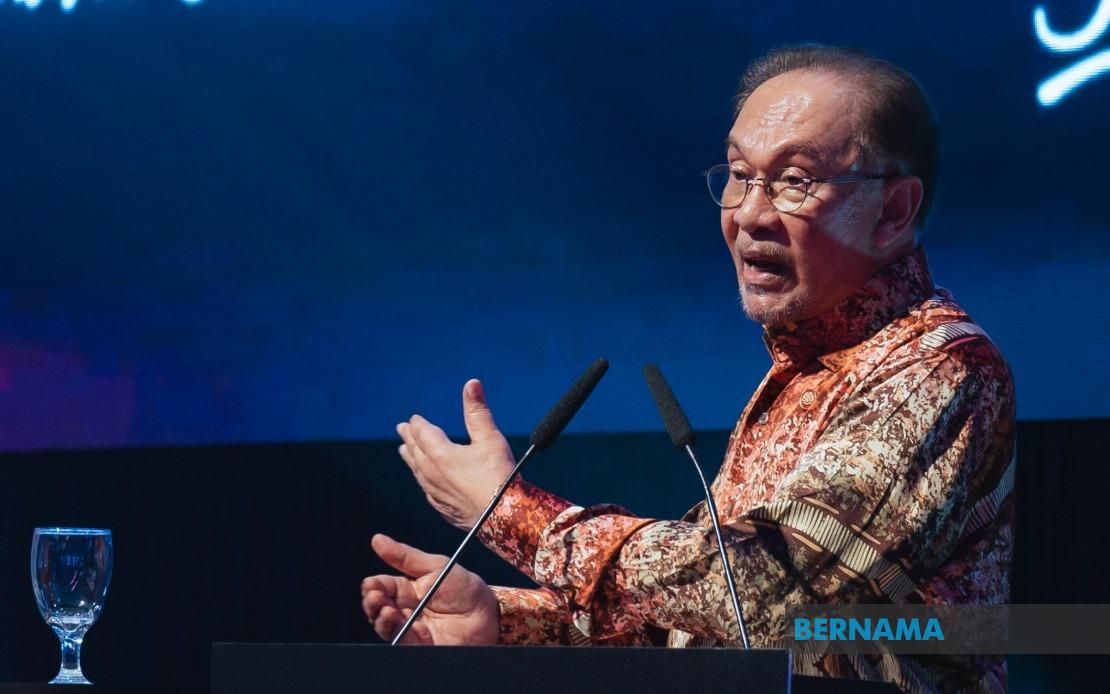
Prime Minister Datuk Seri Anwar Ibrahim's recent observations about Taiwan have drawn scrutiny, particularly his acknowledgement that China reserves the option of force should peaceful reunification efforts ultimately fail. Critics interpreted these remarks as problematic, yet a closer examination reveals they represent a measured articulation of state deterrence doctrine rather than an advocacy for military action. The distinction proves crucial for understanding Malaysia's nuanced position in one of Asia's most volatile geopolitical flashpoints, where strategic ambiguity often serves national interests better than categorical declarations.
Anwar's framing rested fundamentally on the principle of national sovereignty and the immutable right of states to preserve their territorial integrity. To illustrate his point, he drew a parallel with Malaysia's own federation, positing that no rational government would passively accept the fragmentation of its territory without mounting a credible defence. This analogy cuts to the heart of realist international relations theory: states do not voluntarily dismantle themselves, nor do they adopt positions of unconditional non-resistance when faced with secessionist movements or external pressure to relinquish control over claimed territories. Such reasoning applies universally and symmetrically—it describes how nations actually behave, rather than prescribing how they should behave in a cosmopolitan ideal.
Critically, Anwar's position establishes a hierarchy of preference that prioritises negotiation, legal frameworks, and political accommodation well ahead of military solutions. The explicit logic holds that deterrence operates most effectively when rivals understand that consequences exist for pursuing certain actions, yet those consequences need never materialise if the deterrent succeeds in its purpose. This classical security dilemma framework suggests that renouncing force entirely—committing unconditionally to pacifism—paradoxically undermines stability by removing the very credibility that discourages aggressive challenges to existing arrangements. Deterrence depends upon adversaries accepting that an actor possesses both the capability and the will to respond, even if that response remains perpetually unused.
Within the context of Malaysia's long-standing One China policy, Anwar's remarks align logically with diplomatic consistency. Malaysia officially recognises the People's Republic of China as the legitimate government of China, does not extend formal sovereign recognition to Taiwan, and maintains this posture while simultaneously cultivating robust economic relationships and people-to-people connections with Taipei. Operating within this framework obliges Malaysia to acknowledge the legitimacy of Beijing's concerns regarding national reunification and territorial integrity. To do otherwise would represent either insincerity regarding the One China commitment or intellectual inconsistency in claiming that territorial integrity matters for some states but not others.
The Taiwanese perspective presents an entirely different moral and political universe. Taipei views the island as an established liberal democracy with a distinct political system, independent institutions, and popular will expressed through genuine elections—characteristics that Taiwan's government argues distinguish it fundamentally from the status of a rebel province awaiting reincorporation. From this vantage point, any international acknowledgement that force remains a legitimate option invokes the spectre of coercion against democratic will. Taiwan's supporters fear that language permitting military options, however theoretically framed, provides diplomatic cover for aggression against a polity that has committed itself to peaceful governance and international cooperation.
Yet Anwar's intervention operates at a different analytical level than either of these positions. His remarks do not constitute an endorsement of warfare but rather a description of how state behaviour functions in anarchic international systems where no supreme authority exists to compel compliance. The observation that China maintains the option of force reflects empirical reality rather than moral judgement. Whether one approves of this posture, whether one believes Taiwan's democratic credentials supersede reunification claims, or whether one advocates for complete demilitarisation of the strait—these remain separate normative questions from the factual observation that deterrence requires credible capabilities and apparent willingness to employ them.
For Malaysia and the broader Southeast Asian region, the implications of any Taiwan Strait conflict extend far beyond the bilateral relationship between Beijing and Taipei. A military confrontation would inflict catastrophic consequences on regional commerce, disrupting supply chains integral to manufacturing and trade networks throughout ASEAN. Southeast Asian economies depend heavily on the unimpeded flow of goods through the Taiwan Strait, which ranks among the world's busiest shipping lanes. Beyond economics, regional security architecture itself—built on ASEAN's non-aligned principles, the ASEAN Regional Forum, and frameworks designed to manage great power competition without choosing sides—would face severe strain if a major power conflict shattered the region.
This strategic vulnerability explains why Malaysian policy consistently emphasises restraint, dialogue, and commitment to peaceful dispute resolution mechanisms. These are not abstract platitudes but reflections of concrete national interests. Malaysia cannot afford to see the Taiwan Strait erupt into open warfare, regardless of sympathies regarding democratic governance or concerns about coercion. Therefore, the nation's diplomatic messaging appropriately promotes negotiation while refraining from taking sides on the substance of reunification claims or Taiwan's political status.
Anwar's careful formulation serves a specific purpose within this diplomatic framework. By acknowledging that deterrence operates through the credible possibility of action rather than the certainty of inaction, he demonstrates understanding of how great powers think and behave. This intellectual honesty actually supports the cause of peace more effectively than naive declarations that armed force plays no role in international relations. When lesser powers pretend they do not understand the role of military capability in deterrence, they position themselves poorly to negotiate, mediate, or construct agreements that actually prevent conflict.
Moreover, Anwar's position simultaneously rejects the notion that acknowledging deterrence logic necessitates supporting coercion. He explicitly emphasises Malaysia's commitment to One China while maintaining that this commitment does not entail endorsing the use of force to achieve reunification. The combination represents sophisticated diplomacy: Malaysia respects Beijing's sovereignty concerns while advocating for peaceful resolution of the reunification question. This balance avoids suggesting that Malaysia would either enable military action or, conversely, that Malaysia naively ignores how deterrence actually functions.
The broader regional context reinforces why Malaysia must maintain this equilibrium. ASEAN's centrality in regional architecture depends on member states preserving the capacity to engage all major powers without being forced into bloc alignments. Vietnam, the Philippines, Indonesia, and other Southeast Asian nations face pressures to choose sides in great power competition, yet ASEAN's institutional survival depends on resisting such binary choices. Malaysia's ability to maintain this position while acknowledging the realities of deterrence doctrine exemplifies the delicate diplomacy required to navigate contemporary Asian geopolitics.
Ultimately, Anwar's remarks reflect a mature recognition that states do not voluntarily accept dismemberment and that deterrence requires the credible possibility of defence, even when peaceful resolution remains the first and preferred option. This understanding does not constitute warmongering but rather a clear-eyed assessment of how the international system functions. Malaysia's challenge lies in continuing to advocate for dialogue and peaceful settlement while acknowledging that all parties maintain legitimate interests in their territorial integrity and that stability requires respecting this universal principle. The path forward depends on all stakeholders—Beijing, Taipei, Washington, and regional powers like Malaysia—choosing dialogue over the catastrophic alternative.

