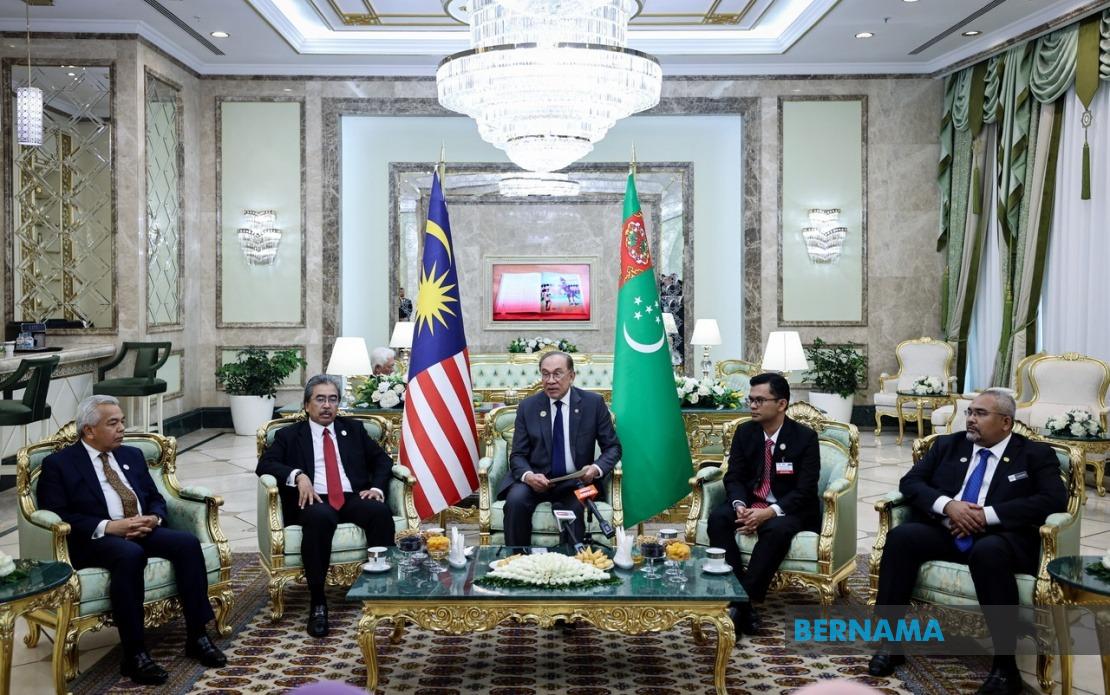
Prime Minister Datuk Seri Anwar Ibrahim has characterised his official working visit to Turkmenistan as a success, underscoring the achievement of key diplomatic and economic objectives while reinforcing the strategic partnership between Malaysia and the Central Asian nation. The Prime Minister's assessment, delivered through a public statement, points to the visit's role in establishing fresh momentum for bilateral engagement at a time when Malaysia is actively diversifying its international partnerships beyond traditional regional frameworks.
The visit, which commenced on June 18 and spanned two days, represented Anwar's maiden official trip to Turkmenistan in his capacity as Malaysia's 10th prime minister, a position he has held since November 2022. Taking place at the formal invitation of Turkmenistan President Serdar Berdimuhamedov, the engagement was structured to facilitate high-level dialogue and establish concrete pathways for institutional cooperation between the two governments. This timing reflects Malaysia's broader strategy to strengthen ties with energy-rich nations and emerging markets across Asia and beyond.
The energy sector emerged as a principal focus of the bilateral discussions, with Malaysian officials identifying substantial untapped potential for collaborative ventures. Malaysia's keen interest in Turkmenistan's hydrocarbon reserves and natural gas resources underscores the domestic energy security considerations driving the engagement. As an energy-importing nation increasingly seeking to diversify its supply sources and reduce dependency on traditional suppliers, Malaysia views partnerships with Turkmenistan as strategically valuable. The presence of PETRONAS, Malaysia's national petroleum corporation, within the delegation signalled the commercial dimension of the visit and the company's direct involvement in evaluating partnership opportunities.
Anwar acknowledged the comprehensive preparations undertaken to ensure the visit's success, extending gratitude to President Berdimuhamedov and the Turkmen government for their hospitality. The Prime Minister's remarks specifically recognised the contributions of the ministerial delegation, the Malaysian Embassy in Ashgabat, PETRONAS representatives, security personnel, and accompanying media, each playing defined roles in orchestrating the diplomatic engagement. This acknowledgment reflects the multifaceted nature of modern state visits, where success depends on coordination across government agencies, commercial entities, and institutional frameworks.
The delegation composition itself carries significance for understanding Malaysia's priorities during the engagement. Minister of Investment, Trade and Industry Datuk Seri Johari Abdul Ghani's participation underscored the commercial and investment dimensions of the visit, positioning the discussions within a framework that encompasses not merely diplomatic courtesy but substantive economic negotiation. Minister of Economy Akmal Nasrullah Mohd Nasir's attendance further emphasised the macroeconomic implications of potential bilateral cooperation, suggesting discussions extended beyond energy to encompass broader frameworks for economic partnership. The inclusion of officials from the Prime Minister's Office and the Foreign Ministry ensured alignment between commercial objectives and foreign policy considerations.
The characterisation of the visit as having "opened a new chapter" in bilateral relations carries particular resonance for Malaysia's positioning in Central Asian geopolitics. Central Asia remains a region where Malaysian diplomatic presence has been relatively modest compared to larger powers, creating opportunities for Malaysia to establish itself as a reliable partner in an area of strategic importance to China, Russia, and Middle Eastern states. By elevating engagement with Turkmenistan to the level of prime ministerial visits, Malaysia signals serious commitment to developing substantive partnerships rather than maintaining purely ceremonial diplomatic relations.
Turkmenistan's significance extends beyond its energy reserves to its positioning as a gateway to broader Central Asian markets and as a participant in regional connectivity initiatives. The nation's strategic location along historical trade corridors and its role in pipeline infrastructure connecting Central Asian resources to global markets make it valuable for Malaysian interests in regional economic networks. Anwar's visit potentially positions Malaysia to participate in or benefit from Turkmenistan's integration into broader Eurasian economic frameworks, areas where Malaysian expertise in logistics, finance, and trade could prove complementary.
The emphasis on cooperation in "various areas of mutual interest" suggests the discussions ranged beyond energy, potentially encompassing trade, investment, technology transfer, and institutional exchanges. This broader framing indicates Malaysia is not approaching Turkmenistan solely as an energy source but as a comprehensive partnership opportunity spanning multiple sectors. Such multifaceted engagement creates resilience in bilateral relations, as cooperation across diverse domains generates multiple stakeholders with vested interests in maintaining positive relations.
For Malaysian readers and policymakers, the Turkmenistan visit reflects the Anwar administration's foreign policy philosophy emphasising strategic autonomy and diversified partnerships. Rather than concentrating regional engagement within ASEAN or traditional partners, the government is systematically cultivating relationships with emerging economies and resource-rich nations. This approach, if sustained, could reshape Malaysia's economic partnerships and energy security profile, with implications for how the nation positions itself in increasingly multipolar Asian geopolitics. The success metrics of such visits—measured in subsequent investment flows, energy supply agreements, and institutional linkages—will determine whether the diplomatic groundwork translates into tangible national benefits.
%22%2F%3E%3C%2Fpattern%3E%3C%2Fdefs%3E%3Crect%20width%3D%22100%25%22%20height%3D%22100%25%22%20fill%3D%22url(%23ph22sd5g)%22%2F%3E%3Crect%20width%3D%22100%25%22%20height%3D%22100%25%22%20fill%3D%22url(%23ph22sd5p)%22%2F%3E%3Ctext%20x%3D%2250%25%22%20y%3D%2250%25%22%20text-anchor%3D%22middle%22%20dominant-baseline%3D%22central%22%20fill%3D%22rgba(255%2C255%2C255%2C0.95)%22%20font-family%3D%22Georgia%2C%20'Times%20New%20Roman'%2C%20serif%22%20font-weight%3D%22700%22%20font-size%3D%22151%22%20letter-spacing%3D%22-0.02em%22%3EPerikatan%3C%2Ftext%3E%3C%2Fsvg%3E)