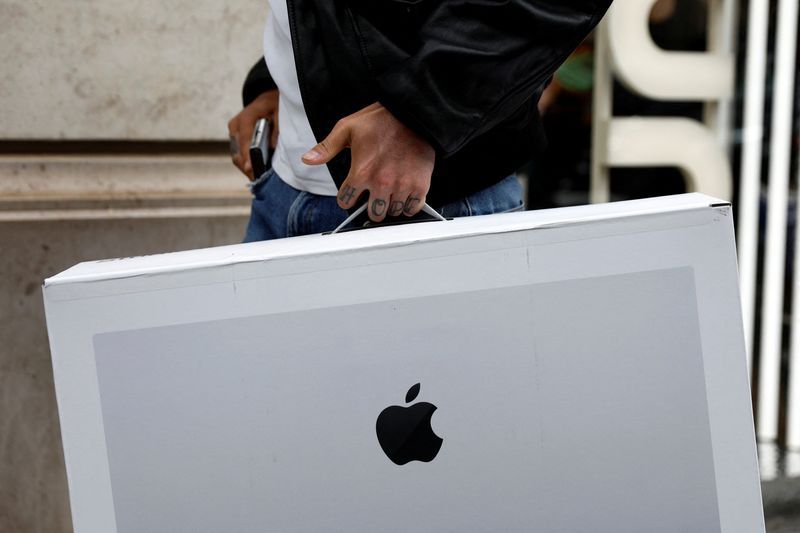
The technology landscape experienced a notable realignment on Friday when Apple displaced Nvidia from the top position to become the world's most valuable company, with a market capitalisation of $4.88 trillion compared to Nvidia's $4.86 trillion following a 3.5 per cent decline in the chipmaker's shares. This development represents far more than a routine shuffling of corporate rankings. It signals a fundamental recalibration by investors in how they view the artificial intelligence opportunity and which companies are best positioned to capitalise on it.
Apple's ascent to the summit marks its return to the world's top position for the first time since April of the previous year, ending Nvidia's roughly twelve-month reign as the most valuable enterprise. The chipmaker had achieved historic significance in October when it became the first company globally to breach a $5 trillion valuation, a milestone that underscore its dominance in powering the generative AI revolution. Yet that commanding position has given way to reassessment and reallocation of capital by sophisticated investors who are now questioning whether the most obvious beneficiaries of the AI boom will continue to justify premium valuations.
Investment strategists point to a crucial distinction between the two companies' respective relationships with artificial intelligence. Toni Meadows, head of investment at BRI Wealth Management, observed that Apple was previously dismissed as lagging in the AI race because it was not undertaking substantial expenditure to develop large language models. However, sentiment has undergone a marked transformation as market participants recognise that Apple's business model offers superior economics. Rather than being exposed to the punishing capital expenditure requirements that burden chipmakers, Apple can monetise artificial intelligence through its ecosystem of interconnected services, the powerful lock-in effects of its hardware platforms, and the capacity to drive upgrading cycles among its existing customer base.
This revaluation carries particular significance given Apple's positioning at a crucial juncture in its corporate leadership. Chief Executive Officer Tim Cook is preparing to step aside in September in favour of hardware industry veteran John Ternus, and the timing of Apple's return to pre-eminence could substantially influence how Cook's tenure is retrospectively assessed. During his final months in charge, the company has rolled out an extensively reworked version of Siri, its virtual assistant, which had languished for years without meaningful enhancement. The overhaul represents Apple's deliberate attempt to narrow the considerable gap that had opened between its capabilities and those of competitors ranging from entrenched technology giants to emerging artificial intelligence specialists.
Apple possesses what some market observers characterise as an invaluable asset in its artificial intelligence strategy: the profound repository of personal data residing on billions of iPhones globally. This information, generated through years of user interactions and device behaviour, could render Siri substantially more useful by enabling personalised responses and expanding the assistant's functional capabilities. The critical challenge lies in the company's foundational commitment to privacy protection. Apple has architected its operating systems to restrict access to such data, and unlocking its commercial potential without compromising the privacy guarantees that form a cornerstone of its brand positioning presents a delicate technical and philosophical problem that remains largely unresolved.
However, market observers caution against interpreting Apple's current advantage as indicating a permanent or irreversible shift in the competitive hierarchy. Nvidia continues to benefit substantially from the extraordinary capital deployment occurring across the technology and telecommunications industries as organisations build out artificial intelligence infrastructure and expand computational capacity. The company's graphics processing units remain indispensable to the generative AI momentum that continues to captivate corporate decision-makers and venture capital investors. Benjamin Hall, vice president of alpha research at Segal Marco Advisors, emphasised that Nvidia is likely to remain a significant participant in whatever technological and commercial developments unfold across the industry in coming years. Nvidia could readily reclaim the top position if market sentiment undergoes another realignment.
Apple's own position contains inherent vulnerabilities that merit investor consideration. The company has pursued a pricing strategy predicated on offsetting rising manufacturing and operational costs through higher consumer prices. While this approach preserves margins in the near term, it carries the latent risk of constraining demand among price-sensitive customer segments, particularly in markets experiencing economic headwinds. Such dynamics could exert downward pressure on revenue growth rates and potentially undermine the earnings expansion that has contributed to the recent rerating of Apple's valuation multiple.
The broader transformation unfolding across the semiconductor sector suggests that the concentration of investor focus and capital allocation may be dispersing beyond the narrow group of mega-cap technology companies that dominated market attention during the initial explosive phase of the artificial intelligence boom. Memory chipmakers including Micron crossed the $1 trillion valuation threshold in May as sophisticated investors came to appreciate the significance of memory and storage infrastructure in enabling artificial intelligence systems. South Korea's SK Hynix made its debut on the Nasdaq exchange earlier in July, introducing another substantial competitor into the ecosystem vying for institutional capital and market recognition.
This widening of investor attention across the semiconductor value chain reflects a maturing understanding that artificial intelligence deployment encompasses far more than the headline-grabbing large language model development conducted by the most visible technology companies. The Philadelphia SE Semiconductor index, which encompasses the diverse range of chipmakers benefiting from infrastructure buildout, experienced a turbulent July as market participants reassessed the sustainability of the artificial intelligence investment thesis. The index declined nearly 19 per cent from its all-time highs, suggesting that even specialist investors have begun questioning whether valuations had become untethered from fundamental economic realities. Despite this substantial retreat, the index has nonetheless outperformed Nvidia on a year-to-date basis, indicating that the broadening of the semiconductor opportunity across multiple categories of chip specialists may be creating more durable returns than concentration in any single company.

