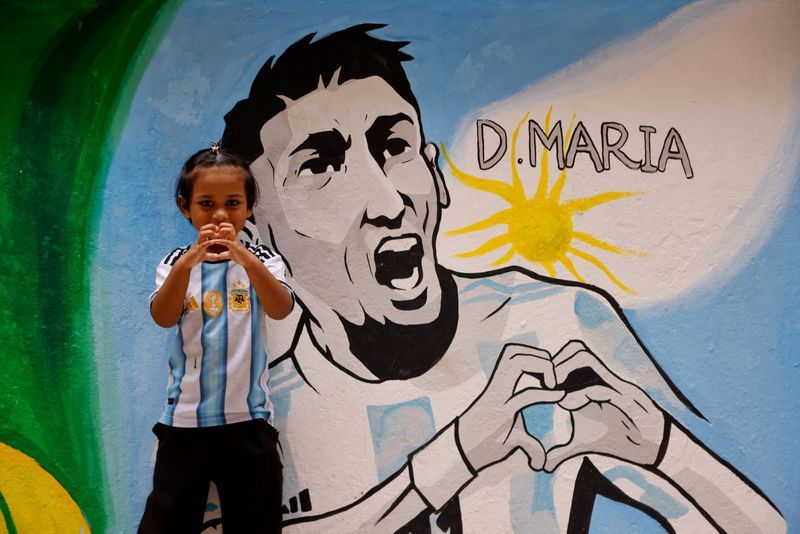
When Argentina and Switzerland step onto the pitch in Kansas City on Saturday, they will be revisiting one of the most pivotal moments in recent World Cup history—though the two nations' trajectories since their last encounter could hardly be more contrasting. Twelve years have elapsed since that tense round-of-16 clash in Sao Paulo, where Lionel Messi's side engineered a breakthrough when Angel Di Maria finally pierced Swiss defences in extra time, securing passage to the next round. The memory of that match continues to loom large over both camps as they prepare for another knockout-stage collision, yet the context surrounding this fixture bears almost no resemblance to the one that unfolded in Brazil in 2014.
The 2014 version of Argentina arrived in that round-of-16 encounter burdened by the weight of an entire nation's hopes. Messi, then operating at the absolute zenith of his powers, carried the expectation of delivering Argentina's first World Cup title since 1986—a gap spanning nearly three decades of heartbreak and near-misses. Switzerland, by contrast, occupied a different position in the tournament hierarchy. They had become reliable World Cup participants, yet the quarter-final remained an elusive frontier, with their last appearance in that stage reaching back to 1954. Both teams were, in their own ways, pursuing unfulfilled ambitions, making that encounter a clash of competing narratives.
The present tableau could scarcely be more different for either side. Argentina arrives as the reigning world champions following their triumphant campaign in Qatar last year, capping a journey that included a runner-up finish at Russia 2018. The burden of searching for a maiden triumph has been replaced by the weight of defending a crown, a transition that fundamentally alters expectations and pressure dynamics. Messi, now 39 years old, no longer possesses the explosive athleticism that defined his career at Barcelona and in his earlier Argentina years. Yet despite the passage of time and the physical demands of professional football, the tournament continues to orbit around his presence. The captain demonstrated precisely this dynamic during the knockout round when he inspired Argentina's extraordinary comeback against Egypt, orchestrating a 3-2 turnaround from a position of two-goal deficit with merely eleven minutes remaining on the clock. As Messi himself reflected following that rollercoaster encounter, Argentina's collective resolve remains unshakeable, with the squad refusing to surrender even when facing seemingly insurmountable odds.
Switzerland, meanwhile, have authored their own remarkable story at this tournament. Under the stewardship of coach Murat Yakin, the Swiss finally achieved what had eluded them for seven decades—a return to the quarter-finals. That achievement came through grit rather than spectacle, as they outmaneuvered Colombia in a penalty shootout following a goalless encounter that tested defensive organisation and mental fortitude. The breakthrough represents more than a statistical milestone for the Swiss; it signals a watershed moment for their tournament aspirations and provides legitimate grounds for believing they can compete against the world's elite.
Contrastingly shaping the pre-match narrative is the reality that only three players span both encounters. Messi remains the obvious linchpin, but Swiss captain Granit Xhaka and defender Ricardo Rodriguez offer living institutional memory from the 2014 meeting. Xhaka, now 33, has articulated a mixture of respect and determination in his assessment of the challenge ahead, acknowledging both Messi's individual brilliance and the collective quality that Argentina possesses. Rodriguez, equally seasoned and measured in his appraisal, framed the encounter with characteristic Swiss pragmatism—recognising Argentine pedigree while refusing to concede psychological advantage before a ball has been kicked.
The tactical dimension of this fixture carries particular intrigue. Switzerland have evolved considerably from the stereotype of defensive rigidity that historically characterised their approach. The potential availability of midfielder Johan Manzambi, who has been nursing a knee injury sustained during the group phase, could meaningfully enhance their creative capacity in midfield. Manzambi's absence was acutely felt during the Colombia encounter, where his ability to orchestrate play and generate attacking opportunities from deeper positions was sorely missed. Yakin's comments suggesting that Argentina's recent struggles—particularly against Cape Verde and Egypt—have exposed genuine vulnerabilities represent neither hyperbole nor false bravado, but rather a tactical assessment grounded in observable tournament evidence. Argentina's propensity for defensive lapses has been evident, and Switzerland possess the technical resources to ruthlessly punish such moments.
Argentina's coaching staff, led by Lionel Scaloni, has approached the matchup with appropriate respect rather than complacency. Scaloni indicated he would retain the bulk of his squad from the Egyptian victory, suggesting satisfaction with the current tactical configuration and personnel deployment. His acknowledgment of Switzerland's "incredible World Cup tradition" and their cache of "outstanding players" reflects neither fear nor genuine surprise at their progression, but rather a coach's prudent acknowledgement that knockout football admits no margin for underestimation. The defending champions recognise that maintaining their title will demand consistency, particularly in defensive compactness and transition efficiency.
The historical arc separating these two encounters encapsulates the broader currents of World Cup football. Argentina transitioned from desperate seekers to satisfied possessors of the trophy; Messi evolved from a player seemingly destined to carry an eternal burden to one who has finally unburdened himself of that weight. Yet paradoxically, his presence remains the tournament's gravitational centre. Switzerland moved from capable bystanders to genuine contenders, from perpetual round-of-sixteen participants to quarter-final combatants. The symmetry of their re-encounter carries almost scripted inevitability, yet the vastly altered circumstances guarantee that Saturday's encounter will forge its own distinct narrative rather than simply replicating the melodrama of 2014.

