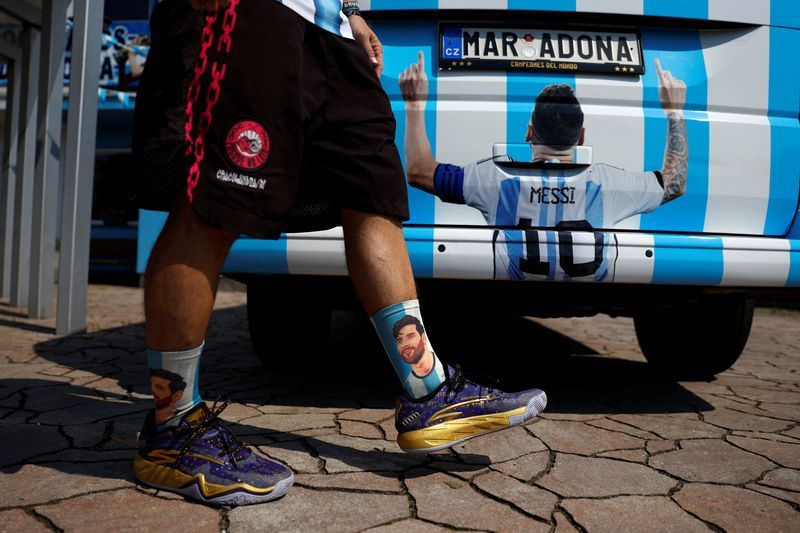
In a small village 90 kilometres east of Prague, one Czech man has created what may be Europe's most unconventional tribute to Argentine football. Miloslav "Curby" Urbanec, a 51-year-old music promoter, has devoted his entire household to celebrating La Selección, turning his three-storey home in Bukovka into a living monument to his beloved team. Every surface tells a story of his passion: the exterior walls painted in sky-blue and white, the towering sun emblem of the Argentine flag commanding the roofline, and throughout the property, larger-than-life representations of the nation's greatest footballers.
Urbanec's dedication transcends typical fandom. A life-size statue of Diego Maradona stands sentinel in his courtyard, while a sprawling mural of Lionel Messi dominates the rear of the house. Behind the residence, a full-sized all-weather football pitch sits surrounded by photographs and placards showcasing players from Boca Juniors, the storied Buenos Aires club where Maradona himself once played. Even his personal vehicles bear testimony to his allegiance: his van is emblazoned in the same patriotic colours, displaying images of both Maradona hoisting the World Cup and Messi in action, accompanied by the declaration "In Messi we trust" and a vanity plate reading simply "MARADONA".
The origins of this extraordinary passion trace back to Urbanec's childhood. At just four years old, he watched Argentina's 1978 World Cup victory alongside his father, an experience that proved transformative. He recalls being captivated by the flowing locks and graceful style of players like Mario Kempes, who led Argentina to that first World Cup triumph. That moment crystallised into a lifelong commitment that has only deepened across the decades. For Urbanec, this was not merely an innocent childhood memory but rather the ignition point for what would become an all-consuming devotion to Argentine football culture.
The depth of Urbanec's commitment extends into his family planning. Seven years ago, convinced of the exceptional talent of a young player ascending through the ranks, he named his second son Lionel, after Lionel Messi. "It was clear this guy is absolutely special," Urbanec explained, demonstrating an prescient understanding of the footballer who would go on to become widely recognised as one of the greatest ever to play the game. This decision reflects how thoroughly Argentine football has been woven into the fabric of his family identity.
Urbanec's perspective on the sport itself reveals an almost romantic view of football as an art form. He is not primarily focused on tactical minutiae or statistical analysis, but rather on what he perceives as the aesthetic beauty of how Argentina plays. To him, La Selección represents something transcendent about the beautiful game itself. This philosophical stance distinguishes his fandom from the purely results-oriented perspective many supporters adopt, suggesting instead a deeper appreciation for the stylistic and cultural elements of Argentine football.
For Southeast Asian readers, Urbanec's phenomenon offers an interesting lens through which to view global sports culture. Just as football loyalties in Malaysia, Singapore, and other regional nations often centre on European clubs, Urbanec demonstrates how passionate followings for teams thousands of kilometres away flourish in unexpected corners of the world. His story illustrates how football has become a truly universal language, capable of transcending geography, nationality, and cultural boundaries to create genuine emotional connections between distant communities.
Urbanec's confidence in Argentina's prospects at the time reflected broader belief in the team's capabilities. He expresses absolute certainty that La Selección would secure victory in the upcoming matches. "La Selección this time is absolutely amazing," he declared, his conviction seemingly unshakeable. His prediction carried the weight of decades spent analysing the team, though ultimately dependent on the performances of players he so clearly reveres. The prospect of another Argentine triumph would not merely be a sporting victory but a validation of his lifetime commitment.
The implications of Urbanec's fandom extend beyond the merely personal or recreational. His home has likely become a tourist attraction and point of local interest in Bukovka, drawing visiting football enthusiasts and curious observers. In an era where cultural globalisation is often lamented, his example suggests that cross-cultural appreciation and international community-building through sport remain powerful forces. His willingness to display his passion so publicly and permanently through architectural modification demonstrates a confidence in the universality of football as a cultural connector.
Urbanec's story also highlights the phenomenon of football supporter identity formation across generations. His father introduced him to Argentine football at a formative age, and in turn, Urbanec has embedded this allegiance so deeply into his own life that it influences fundamental decisions like his children's names. This transmission of fan loyalty across family lines suggests how football communities extend beyond temporary enthusiasms to become genuine cultural inheritances comparable to other forms of national or ethnic identity.
At the time of the original reporting, Argentina were preparing to face Cape Verde in a round-of-32 match on July 3, a fixture that represented another opportunity for Urbanec's beloved team to advance. Yet regardless of individual match outcomes, Urbanec's devotion appears immune to the volatility of sport. His commitment was forged in 1978 and has only solidified with each passing year, suggesting that for true believers like Urbanec, Argentine football represents something far more permanent and meaningful than any single competition or result could ever diminish or enhance.

