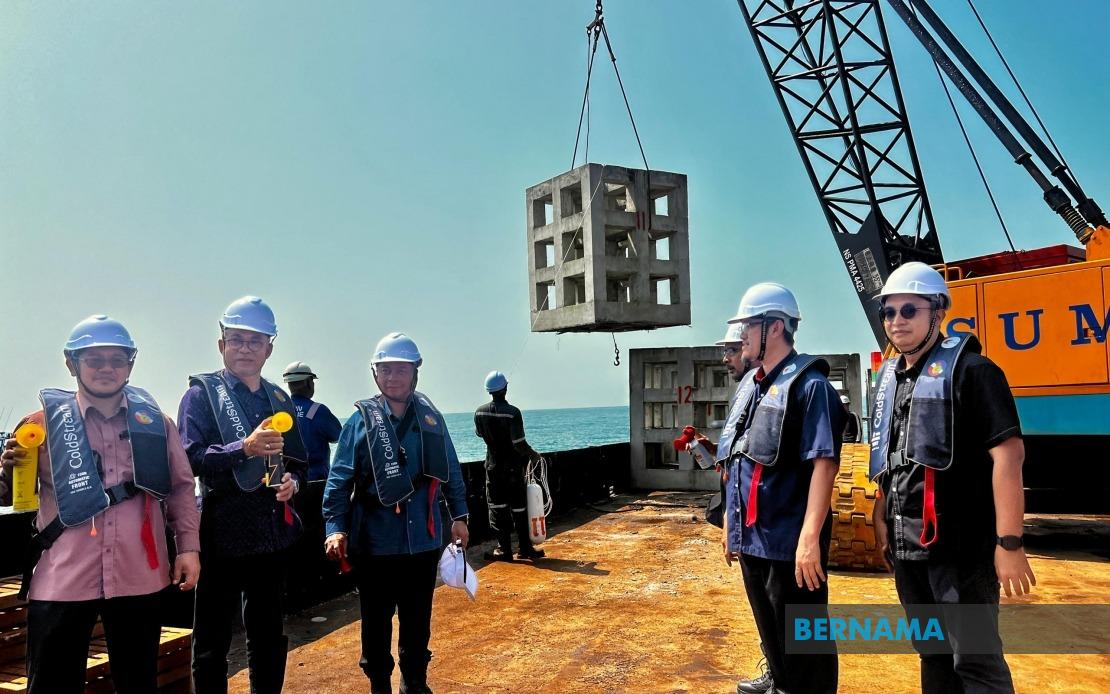
The Kelantan Fisheries Department has launched a strategic initiative to strengthen the state's coastal fishing sector through the deployment of 30 artificial reefs in waters off Tok Bali, positioned approximately 4.6 nautical miles from the jetty. This conservation project, funded through contributions from Sultan Muhammad V, represents the first major undertaking in the state specifically dedicated to fisheries habitat preservation and marks a departure from conventional resource management approaches in the region. The structures serve a dual purpose that extends beyond traditional marine conservation, addressing both ecological restoration and the economic vulnerabilities facing small-scale fishing communities in Kelantan.
According to Kelantan Fisheries Department director Ismail Ibrahim, the artificial reefs function as both breeding sanctuaries and physical deterrents against commercial overfishing. The structures, anchored on the seabed, create underwater obstacles that entangle fishing equipment from larger industrial vessels, effectively establishing a buffer zone where traditional small-scale fishers can operate with reduced competition from mechanised fleets. This design philosophy reflects growing recognition in Southeast Asia that managing fishing pressure requires not just regulatory frameworks but also structural interventions that make resource-rich coastal zones less accessible to capital-intensive operations that would otherwise exhaust local stocks.
The ecological dimension of the project centres on creating controlled environments where various fish species can reproduce and develop before reaching commercial size. By concentrating juvenile fish populations in designated zones with enhanced habitat complexity, the artificial reefs accelerate growth cycles and increase survival rates during vulnerable early stages. Ismail emphasised that measurable impacts on fish breeding activity typically emerge within six months of deployment, though the timeline depends considerably on environmental conditions and how quickly local marine ecosystems colonise and stabilise around the new structures. For Malaysian readers, this represents a practical application of habitat restoration technology that has gained traction across Southeast Asian fisheries management, with similar initiatives being piloted in Sabah, Sarawak, and Terengganu.
The scale of Kelantan's commitment to artificial reef deployment demonstrates sustained investment in this conservation strategy. Since 2007, the department has installed approximately 400 artificial reefs across four distinct locations within state waters. This year alone, the department is progressively deploying an additional 72 units, indicating accelerated expansion of the programme. All structures remain positioned within five nautical miles of the coast, ensuring they primarily benefit artisanal and small-scale fishers operating in traditional fishing grounds rather than supporting distant-water operations. The concentration of reefs near shore reflects a deliberate policy choice to reinforce the ecological and economic foundations of localized fishing communities.
Beyond creating nurseries for fish stocks, the artificial reefs function as a form of spatial zoning that indirectly protects the livelihoods of coastal fishing households. Large industrial vessels, equipped with sophisticated trawling and purse-seine gear, cannot operate efficiently or safely around submerged structures without risking equipment damage. This physical reality creates what amounts to a low-cost enforcement mechanism that supplements regulatory measures. Rather than relying exclusively on maritime patrols and compliance monitoring, which require continuous government resources, the artificial reef system achieves protective effects through passive infrastructure. For policymakers across the region wrestling with enforcement challenges, this approach offers a scalable alternative to resource-intensive surveillance.
The initiative also speaks to food security concerns that resonate throughout Malaysia and Southeast Asia. Kelantan's coastal zones support thousands of fishing households whose income and protein production depend on marine resources. By bolstering fish populations through habitat enhancement, the programme aims to increase landings available to local fishers and, by extension, domestic supplies to consumers across the peninsula. In an era of globalised seafood markets and concerns about supply chain disruption, initiatives that strengthen regional food production capacity hold particular significance for national resilience planning. The artificial reefs essentially represent an investment in domestic food self-sufficiency through biological enhancement rather than industrial intensification.
Maintenance and adaptive management form critical components of the programme's long-term viability. The Kelantan Fisheries Department conducts regular monitoring and cleaning operations to remove detritus, entangled ropes, and fishing gear that accumulate on reef structures. This custodial approach acknowledges that artificial habitats require active stewardship to function optimally. Without periodic intervention, debris and accumulated organic matter can degrade water quality and reduce the structural benefits the reefs provide. The commitment to ongoing maintenance reflects a maturing understanding within regional fisheries agencies that marine infrastructure, like terrestrial systems, demands continuing investment in operational care rather than one-time capital deployment.
The Sultan of Kelantan's financial contribution underscores growing princely engagement with fisheries conservation in Malaysia. Royal patronage for sectoral development projects, while historically focused on agriculture and urban development, has increasingly extended to maritime resources. This pattern reflects both ecological awareness among state leadership and recognition that fisheries crises threaten social stability in coastal constituencies. The Sultan's investment sends a signal that fisheries management ranks among state-level development priorities, potentially influencing how competing budgetary claims are adjudicated across government departments. For coastal communities reliant on fishing, such high-level endorsement can strengthen political commitment to long-term conservation objectives that might otherwise face pressure from short-term economic interests.
The implications of Kelantan's approach extend beyond the state's borders, offering lessons for other coastal jurisdictions throughout Malaysia and Southeast Asia contending with similar fisheries pressures. The artificial reef model combines conservation biology, livelihood protection, and spatial management in an integrated package that addresses multiple policy objectives simultaneously. As regional governments confront declining fish stocks, resource conflicts between industrial and artisanal sectors, and pressures to maintain coastal employment, scalable interventions like this assume greater importance. The Kelantan experience provides empirical foundation for assessing whether artificial habitat enhancement can sustainably increase yields while reducing the economic incentives for unsustainable fishing practices.
Looking forward, the success of this programme will likely depend on coordination between fisheries management agencies and local fishing communities. Artificial reefs function optimally only when compliance with zone restrictions remains high and when adjacent fishing pressure remains calibrated to support natural regeneration. Building fisherman buy-in and ensuring equitable access to reef-enhanced fishing grounds requires sustained engagement with coastal communities. The Kelantan department's framing of the initiative as benefiting fishermen and supporting food security creates a narrative alignment that may facilitate community cooperation, though translating stated objectives into durable behavioural change across dispersed fishing populations remains a persistent implementation challenge in maritime governance.
The artificial reef deployment also reflects broader regional trends toward ecosystem-based fisheries management that integrate ecological sustainability with social equity concerns. Unlike purely extractive approaches to fisheries, this model invests in biological regeneration as a precondition for sustained productivity. For Malaysian policymakers and fisheries administrators throughout Southeast Asia, the Kelantan experience demonstrates that technology and infrastructure can be harnessed to align conservation with livelihood protection, potentially creating durable solutions to conflicts that have historically pitted environmental protection against rural development. As competition for marine resources intensifies across the region, such integrated approaches may prove essential to maintaining both food security and coastal community prosperity.

